⚙ Motor Efficiency Calculator
Calculate motor efficiency, power losses, IE class rating & annual energy consumption
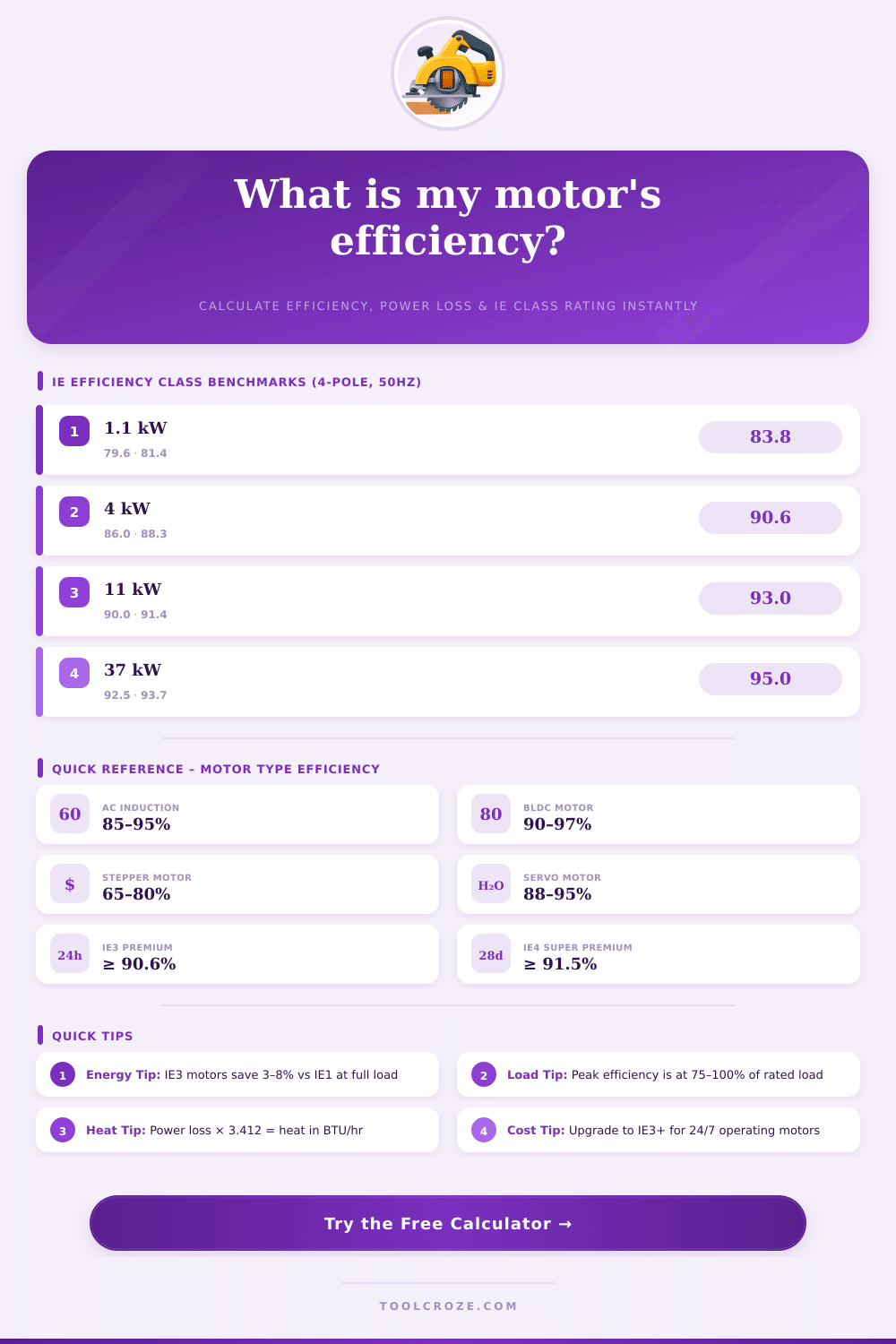
| Rated Power | IE1 Min % | IE2 Min % | IE3 Min % | IE4 Min % |
|---|---|---|---|---|
| 0.75 kW | 75.0 | 78.9 | 80.7 | 82.5 |
| 1.1 kW | 79.6 | 81.4 | 83.8 | 85.0 |
| 2.2 kW | 83.5 | 85.6 | 87.4 | 88.7 |
| 4 kW | 86.0 | 88.3 | 90.6 | 91.2 |
| 7.5 kW | 88.5 | 90.7 | 92.1 | 93.0 |
| 11 kW | 90.0 | 91.4 | 93.0 | 93.6 |
| 18.5 kW | 91.0 | 92.6 | 94.1 | 94.6 |
| 37 kW | 92.5 | 93.7 | 95.0 | 95.4 |
| 75 kW | 93.5 | 94.7 | 95.8 | 96.2 |
| 160 kW | 94.6 | 95.6 | 96.5 | 96.8 |
| Load (%) | Typical Efficiency % | Notes |
|---|---|---|
| 25% | ~82 | Significant efficiency drop |
| 50% | ~88 | Moderate efficiency |
| 75% | ~92 | Near-peak efficiency |
| 100% | ~91–93 | Full-load rated efficiency |
| 110% | ~90 | Slight decrease, risk of overheating |
| 125% | ~87 | Overload – not recommended |
| Efficiency % | Annual kWh Input | Annual kWh Loss | Cost at $0.12/kWh |
|---|---|---|---|
| 75% (Old) | 117,080 | 29,270 | $14,050 |
| 85% (IE1) | 103,059 | 15,588 | $12,367 |
| 90% (IE2) | 97,333 | 9,733 | $11,680 |
| 93% (IE3) | 94,194 | 6,608 | $11,303 |
| 95% (IE4) | 92,211 | 4,632 | $11,065 |
| 97% (BLDC) | 90,309 | 2,741 | $10,837 |
A motor’s efficiency in short words shows how well a motor converts electrical energy to mechanical. Consider it as proportion between the output power and the input power. The bigger that proportion, the more well the motor does its task without useless energy waste.
High efficiency results in fewer energy that gets lost so reduce the energy use and the current running expenses.
What is motor efficiency?
Counting it is fairly easy. Standard method uses the called horsepower, the burden as a percentage of the called power and the input power in kilowatts. The output power relates to the torque and to the involved pace for move that, to what the motor is tied.
The input power depends on the amount of electricity, that the motor coils receive. When the output power stays same, then increase the efficiency simply wants to say, that the motor requires fewer input power for same work.
Even so not all motors are done equally. Some types only convert around 75 to 80 percent of the electrical power to mechanical, what makes them less good choice. For instance, single phase motors at 3450 RPM reach not almost 90 percent efficiency.
Actually, around 75 percent already lays one from them in the top class of efficiency. Rather, good electrical motor can pass 75 percent, and if it is made for efficiency, it reaches more then 90 percent. Shaded-pole motors have truly bottom efficiency, but they are cheap and good for tasks, that run only occasionally.
Every motor has ideal pace and burden, where it reaches its peak efficiency. If one goes from that best spot up or below, the efficiency drops. The speed of that decrease depends on the type of the motor.
Modern permanent magnet motors use internal permanent magnets, that forms holes in the magnetic field. Motor can use those holes for making unwanted torque, what helps the efficiency in high RPM and partially loaded. The mainstream gains during the last decades came from motor controllers, that adjust the work point to the real needs of the usage.
Losses of efficiency come from various source spots. Copper losses happen because of the resistance in the wires, what produces heat. Fixed losses, as iron losses and bearing friction, stay permanent, during copper losses grow with the square of the flow in the motors during bigger burdens.
Putting too much power in little body wants to say, that even a bit of weakness can raise the temperatures like this, that damage happens. Even good motors drop in efficiency during they age. Keep the bearings in good state and ensure, thatthe alignment is correct, helps to escape extra stress on the motor.
Too big motor not always is good notion. Big electrical motor is most efficient only when it works closely to its mighty limit at the wanted level.