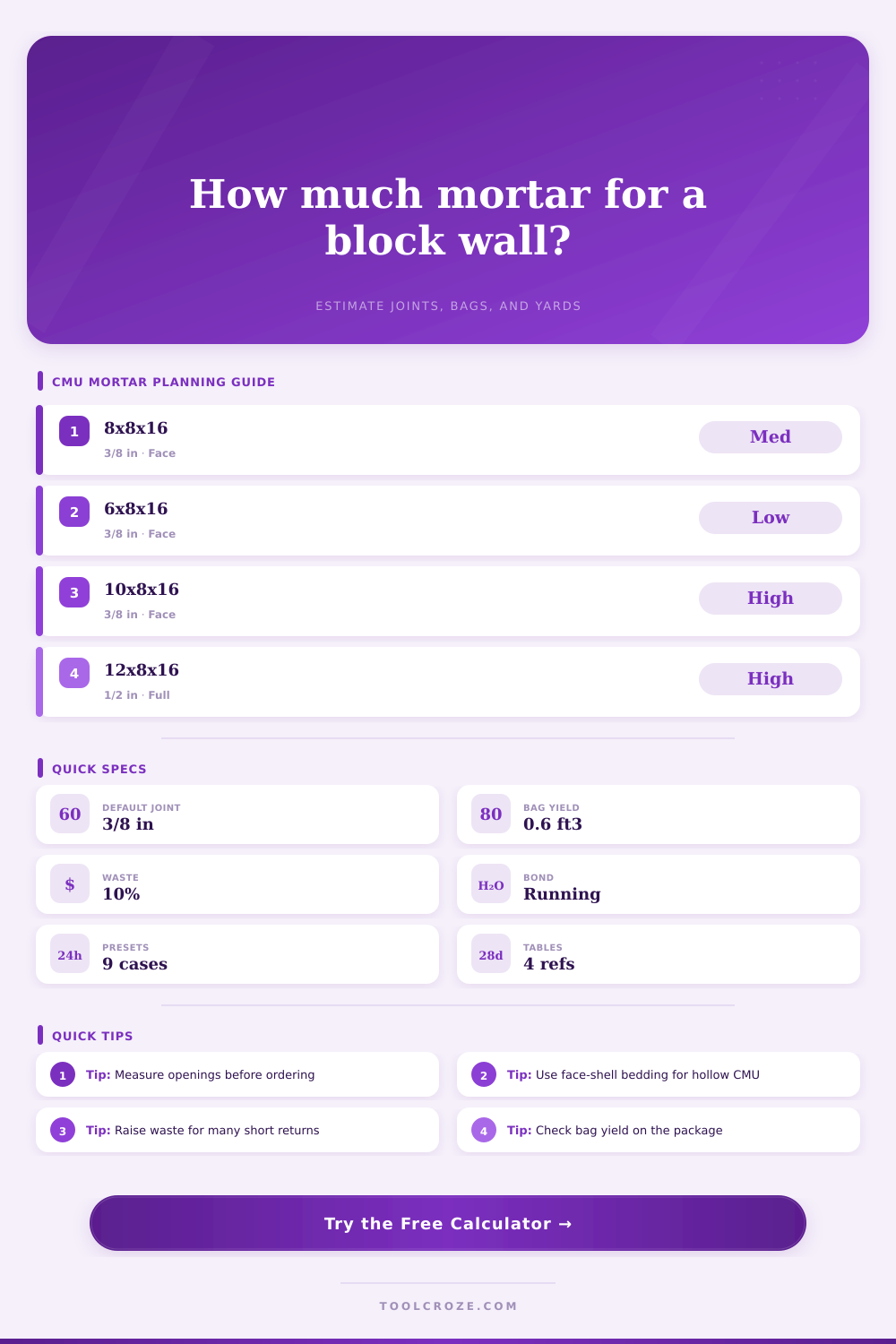
Mortar Calculator for Block Wall
Estimate CMU wall mortar from block size, wall dimensions, bed joints, head joints, openings, bond pattern, bedding style, waste, bags, and cubic yards.
The estimate separates horizontal bed joints from vertical head joints. It is intended for CMU masonry takeoff planning, not structural design or grout-core estimating.
| Nominal Block | Actual Size Used | Module With 3/8 Joint | Typical Bedding |
|---|---|---|---|
| 8 x 8 x 16 CMU | 7.625 x 7.625 x 15.625 in | 8 x 16 in | Face-shell bed for hollow units |
| 6 x 8 x 16 CMU | 5.625 x 7.625 x 15.625 in | 8 x 16 in | Partition walls and screens |
| 10 x 8 x 16 CMU | 9.625 x 7.625 x 15.625 in | 8 x 16 in | Foundation and retaining stems |
| 12 x 8 x 16 CMU | 11.625 x 7.625 x 15.625 in | 8 x 16 in | Higher mortar volume per joint |
| 190 x 190 x 390 mm | 190 x 190 x 390 mm | 200 x 400 mm | Metric modular wall layout |
| Mortar Source | Common Yield | Input Value | Best Use |
|---|---|---|---|
| 80 lb premix mortar | About 0.60 cu ft | 0.60 | Small repairs and short walls |
| 60 lb premix mortar | About 0.45 cu ft | 0.45 | Patch work or light handling |
| Type S field mix | Batch dependent | Use measured yield | Foundations and exterior CMU |
| Type N field mix | Batch dependent | Use measured yield | Above-grade nonstructural walls |
| Bulk mortar delivery | Ordered by yd³ | Use yards card | Large wall runs or crews |
| Condition | Calculator Effect | Typical Range | Field Note |
|---|---|---|---|
| 3/8 in joint | Standard modular spacing | 0.375 in | Most CMU layout tables assume this joint. |
| 1/2 in joint | Higher bed and head volume | 0.50 in | Useful for irregular units or rough layout. |
| Running bond | Normal head joint count | 1.00 factor | Common half-block lap pattern. |
| Stack bond | Slight head joint increase | 1.05 factor | Often needs reinforcement by design. |
| Third bond | More cut and head-joint allowance | 1.08 factor | Use higher waste on complex returns. |
| Opening Type | Area Deducted | Perimeter Added | Why It Matters |
|---|---|---|---|
| Single service door | About 21 sq ft | About 22 ft | Removes blocks but adds jamb and head mortar. |
| Small window | 6 to 12 sq ft | 10 to 16 ft | Short returns increase joint handling waste. |
| Garage opening | 60 to 90 sq ft | 30 to 40 ft | Large deduction changes courses and bond cuts. |
| No openings | 0 sq ft | 0 ft | Straight-run wall gives the cleanest takeoff. |
First, there’s a roll of tape measure. And then there’s nothing but hole in ground. There’s no wall here. You are just standing in the gap, imagining where each block will fit into place and what each line will be. It all becomes crystal clear except for one thing: the math. That changes once you break it down.
Masonry rely on an invisible glue known as mortar. Getting this part wrong is the number one error when planning a block wall. Underestimate it, and your project come to a screeching halt halfway up the wall. Overestimate it, and you’re stuck with hardened bags of mortar (otherwise known as expensive trash).
How to Calculate Your Mortar Needs
Enter the block wall calculator, designed to tackle complicated shapes between block modules and joints while letting you concentrate on building it. It divide head joints and bed joints (which do matter; the amount of mortar needed is dramatically different for both).
A block, to most folks, is a rectangular solid. But standard CMUs are actualy hollow. Because they’re hollow, you don’t have to fill all the way through the block with mortar when laying a course. Industry standard is face shell bedding. Why? Because it’s faster. It uses less material.
Face shell bedding saves material and time without sacrificing structural integrity for typical wall. Face shell bedding is the industry standard for a reason. It place mortar only on the outer webs, usually about 1.25 inches on each side, leaving the center empty. Full bedding mean you are filling every single inch. You’d only do that for a fully grouted wall, or maybe solid blocks. But for a standard partition, that triples amount of mortar required.
The tool takes this option into account and will adjust its output accordingly; depending on whether you want to fill the cavity or just skim the surface. Seems like a small toggle but it changes the price more dramatic.
And then there are openings: doors and windows that interrupt flow of the wall. Even if they seem to be a big reduction in blocks, think about it; you still have a perimeter that requires mortar. You’ve got to carefully fill the jambs, header and sill. If you just deduct the square footage of the opening, you’ll fall short on material. Those vertical and horizontal joints is still present, so you must add back in the linear footage of their edges. There’s a field for opening perimeter in the calculator to account for this detail. This way, when you tie in the lintel over the door, you won’t run out of mix. This is what most contractor miss when making a rough estimate.
You should of also consider waste. Even in a perfect world with absolutely straight walls, there’s only so long before a bucket of mortar goes off. When I do a simple run without many corners/returns, I use 10% allowance; on more complex walls, I’ll go higher. There will be waste from cutting block. There will be spills. The mixture will stiffen.
It all gets spelled out in the reference table below which shows the total yield based off various combinations of block size and bond pattern. In general, running bond is most efficient. Stack bond need more reinforcement and may need more attention paid to joint handling. Third bond incurs even more cut waste. These aren’t academic terms. This represent actual work involving real material.
Bottom line: We want to show up with all the cubic yards (or bags) we need to complete the job uninterrupted. Enter the volumes of each side together into the calculator as “joint volume.” The calculator will find total and convert it to bags. It assumes a typical yield of 0.6 cubic feet per bag, or 80 lbs., which is a good starting point for any type of premixed mortar. If you’re mixing your own Type S or if you’re using 60 lb. Bags instead, tweak that figure. This way you have a number to scribble on the purchase order.
From vague emptiness, it’s transformed into a firm plan. No more wondering how many bags will fit in the back of the pickup. Instead, you are thinking about what the first block will look like. Math is over. Time to build the wall.