Mortar and Grout Calculator
Estimate masonry units, bed-joint mortar, vertical grout cells, bond beam grout, rebar cells, bag counts, cubic yards, and waste for CMU or brick walls.
Masonry Material Estimate
| Unit | Nominal face | Typical depth | Units per ft² | Grout cells |
|---|---|---|---|---|
| 8 in CMU | 16 in x 8 in | 7.625 in | 1.125 | 2 |
| 6 in CMU | 16 in x 8 in | 5.625 in | 1.125 | 2 |
| 10 in CMU | 16 in x 8 in | 9.625 in | 1.125 | 2 |
| 12 in CMU | 16 in x 8 in | 11.625 in | 1.125 | 2 |
| Modular brick | 8 in x 2.625 in | 3.625 in | 6.86 | 0 |
| Material | Common field unit | Typical yield | Use in calculator | Adjustment note |
|---|---|---|---|---|
| Type S mortar | 80 lb bag | 0.55 to 0.65 ft³ | 0.60 ft³ | Use for many reinforced CMU walls |
| Type N mortar | 70 to 80 lb bag | 0.50 to 0.65 ft³ | 0.60 ft³ | Common for veneer and above-grade brick |
| Fine grout | 80 lb bag | 0.45 to 0.55 ft³ | 0.50 ft³ | Use for tighter cells and smaller lifts |
| Coarse grout | 80 lb bag | 0.50 to 0.60 ft³ | 0.55 ft³ | Use only where cell size allows aggregate |
| Unit depth | Approx cell grout per CMU | 50% grouted | 100% grouted | Bond beam allowance |
|---|---|---|---|---|
| 6 in CMU | 0.14 ft³ | 0.07 ft³/unit | 0.14 ft³/unit | 0.10 ft³/unit |
| 8 in CMU | 0.20 ft³ | 0.10 ft³/unit | 0.20 ft³/unit | 0.14 ft³/unit |
| 10 in CMU | 0.26 ft³ | 0.13 ft³/unit | 0.26 ft³/unit | 0.18 ft³/unit |
| 12 in CMU | 0.32 ft³ | 0.16 ft³/unit | 0.32 ft³/unit | 0.23 ft³/unit |
| Wall preset | Typical size | Mortar range | Grout range | Waste factor |
|---|---|---|---|---|
| Small garden wall | 24 ft x 3 ft | 4 to 6 bags | 0 to 8 bags | 10% |
| Garage wall panel | 40 ft x 8 ft | 18 to 25 bags | 25 to 70 bags | 10% |
| Brick veneer run | 30 ft x 9 ft | 24 to 36 bags | 0 bags | 10% |
| Basement wall | 50 ft x 8 ft | 25 to 34 bags | 90+ bags | 15% |
The space between the blocks is how you make a wall. You see the bricks or concrete block, but it’s the mortar that ties everything together. Underestimate the volume of the joint and you’ll find yourself mixing buckets mid-pour. Your crew will slow down and the resulting weak spots (called cold joints), will compromise the strength of your wall.
Plug your wall dimension into the calculator and let it do the math for you. No need to convert or mess around with coefficients. It translates abstract wall area into concrete bags. It’s the bridge from napkin sketch to placing an order at the supply yard.
How to Order the Right Amount of Building Materials
Joint thickness is the first one that catches folks off guard. A standard three-eighths of an inch might sound like a negligible difference than a half-inch joint, but it isn’t. Wrong. It all adds up over hundreds of linear feet. And by choosing a tight tooling profile in the tool, you’re telling it your units are clean and your masons is skilled at placing them. By selecting a heavy buttering profile, the tool’s algorithm figures you’ve got some rougher conditions and need additional paste coverage.
This is important because the amount of mortar yield depends wildly on how much paste remains on the trowel vs. It depends on how much paste sticks to the unit and goes into the joint. Whether you like to admit it or not, you’re paying for the waste.
The physics get real on the grout calculations. Blocks of concrete contain voids. Some are for reinforcement; others is to reduce weight. If they’re there for reinforcement… As called out on your structural drawings (then you have to fill them with grout). The calculator also requires an input for the number of cells per wall that will be filled. That lets it handle partially-filled cells, something permitted by certain designs.
Fully filling walls make them stronger but adds a lot to materials cost. A ten inch block contains almost double the volume of voids compared to a six inch partition block. The tool automatically figures in the difference in height between these blocks but still requires you to know what size block you’ve purchased. Choosing the wrong kind here skews the grout estimate by a factor of two or more.
The other gotcha variable is openings. For example, maybe you’re building a 40-foot wall but a third of it’s a garage door. No mortar needed in that void space! The tool lets you remove rough opening areas. Avoid ordering air. It sounds trivial, but this is one of those reasons a contractor will end up with half-full bags of Type S mortar on the pallet weeks after the fact.
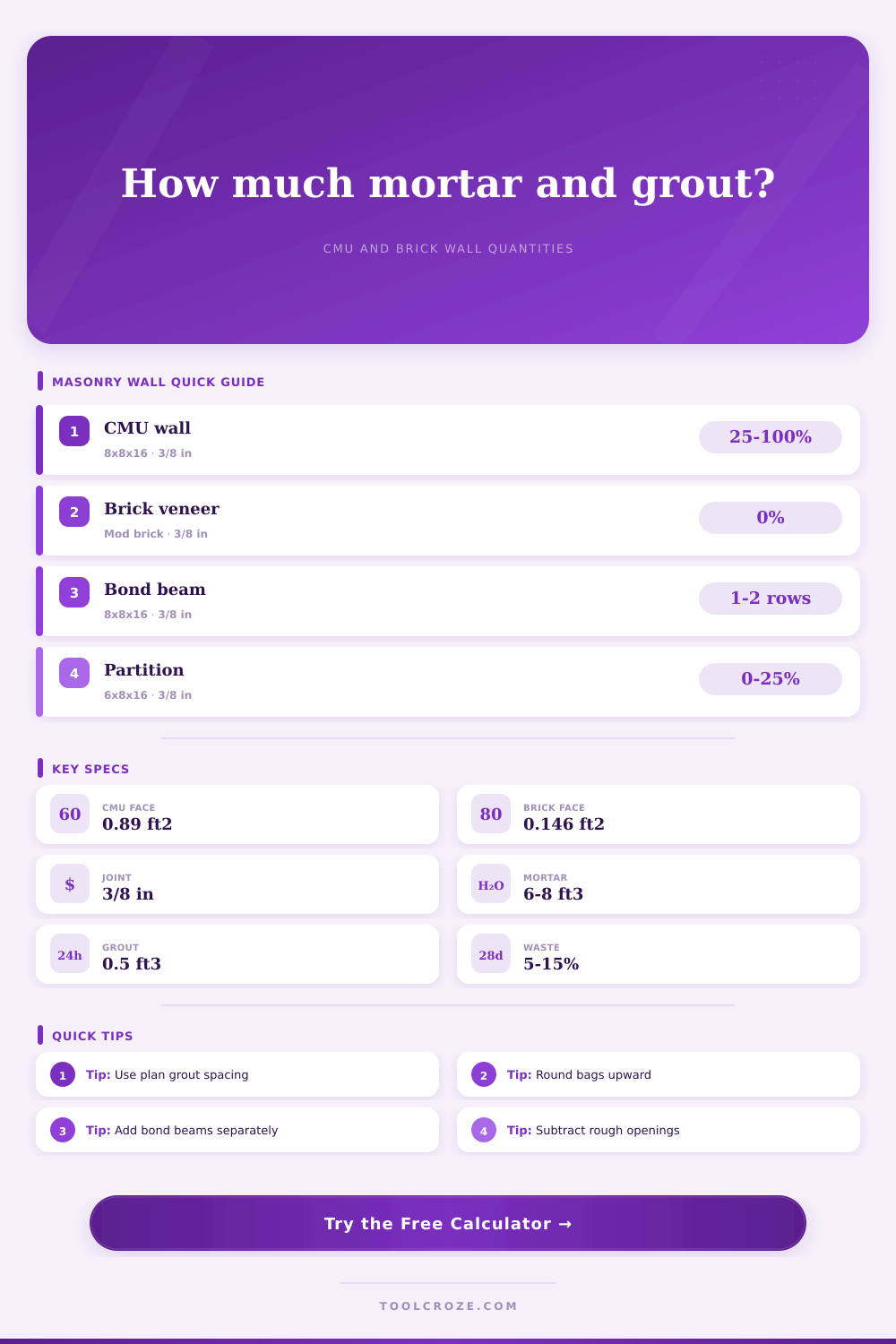
The brick/block reference table on the page lists the face areas of various units. Use this to double-check that you’ve ordered enough material for the size of your wall. It’s not that the waste factor is simply an emergency measure, it’s how the job works. You have scraps from cuts, you have mortar drying on your hawk, and you have grout spattering on your shoes.
If you’re working on a clean wall with few cuts, maybe give yourself a five percent waste factor, but if you’re on a wall with lots of little windows and all sorts of corner complications, go for more. Fifteen or twenty percent waste factor is inexpensive insurance against being low by the end of the last course. Nothing is worse then finding yourself out of mortar halfway up a bond beam.
It’s much simpler to buy bags than to calculate cubic yards. Based off yield per bag, the calculator will convert the cubic yardage you need into the number of bags. For example, most mortar comes in an 80-pound bag and each bag should yield approximately 0.60 cubic feet. Depending on the mix, your grout may yield a little less.
This knowledge allows you to accurately budget, but it can help with planning the mix as well. After all, why would you want to mix just one bag in a five gallon bucket when you could order a larger quantity of pre-mixed grout? The tool also provides total amount in cubic yards. It is handy if you’re ordering from a readymix plant for a larger job.
So basically this: When you’re ready to order materials, you should of have enough on hand. Not too many. That causes waste and cleanup. But not too few. That halts your progress.
It also assumes you’ve had some sort of drawing done by a structural engineer; this isn’t meant as a replacement for that. It simply turns that drawing into a shopping list. This takes the anxiety out of the process so you can do the real masonry work instead, like getting those cells filled in correctly and those joints right. That’s what makes a wall last. The numbers are just the way to get there.