
When you’re welding, if all goes well the sound of that arc will be a steady aggressive buzz. It’s right on target. If you hear your welding gun go from a steady buzz to a hissing sputter or a cracking pop, you’ve got an issue. Many new welders has been trained to think this is just a matter of bad luck. It almost never is. In most cases the initial setup was fine and then some variable came in and threw the process off balance.
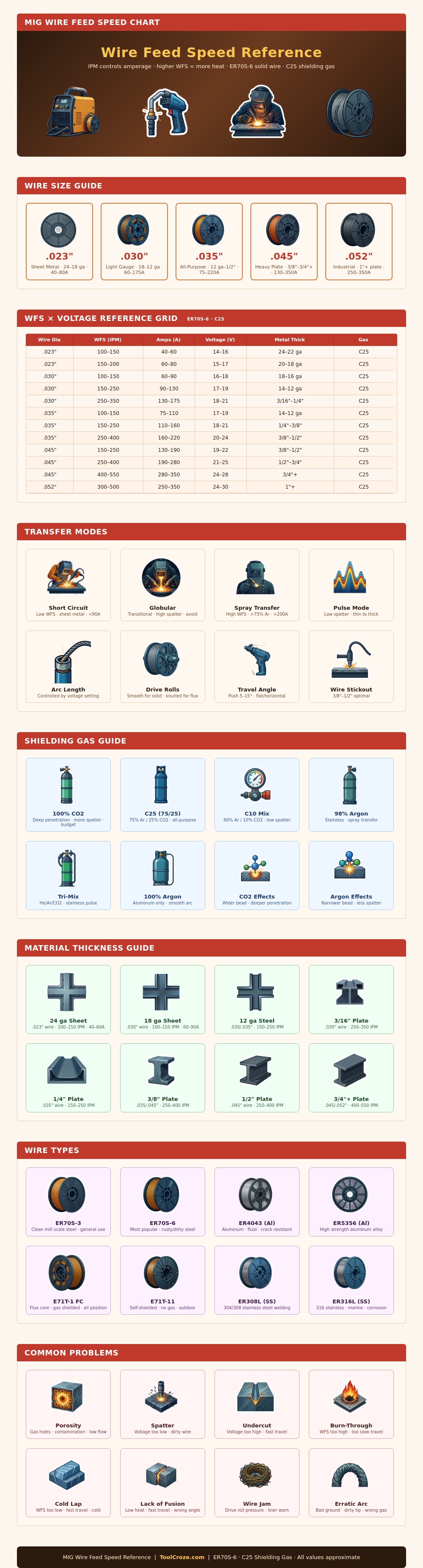
Typicaly that variable are the wire feed speed. The voltage regulate the length of the arc. Feed speed is the throttle. How fast does it feed metal into the pool? Too slow and the wire will stick in the gun. Too fast and you might blow through sheet metal before you know it. So what’s the relationship between material thickness, amperage and the feed speed? It’s all represented in this chart above.
How to Fix Welding Problems
The most common diameter of mild steel begins at.035 inches in diameter. This means that the wire will fit the end of your welding rod gun without changing over and weld sheet metal down to 12 gauge or plates up to a quarter inch thick. For heavy structural steels such as half-inch plate, step up to thicker wire size of.045 inches. Besides being too big a diameter for the gun end, there’s also another reason why we make this upgrade: thermal input. The larger diameter wire has more carrying capacity so you can apply sufficient heat to the heavier metal without melting edges of it. Remember, the larger sizes corresponds to heavier base metals and higher amps on the grid reference.
The type of gas used matter greatly in determining weld quality. Deep penetration come from pure carbon dioxide, ideal for welding rusted or otherwise dirty metals. But this produces much more spatter, meaning tiny blobs of molten metal will fly out of the arc. Using an eighty-fifteen blend, or 75% argon and 25% carbon dioxide (C25), results in a smoother arc. Weld beads is cleaner and require less post-weld cleaning time. You can see these gases and their effects on spatter and penetration level outlined in the infographic.
This also illustrates why welds might still turn out sloppy despite seeming dialed-in. The outcome is also affected by mechanical problems. The drive roll can be worn. This causes it to slip under load, which crushes the softer solid wire and results in erratic feed. A bad bead will not be corrected with setting changes if the wire doesn’t slide smoothly into the tip. Maintain proper tension on the wire so that it grips but is not deformed by liner. Also mind the angle at which you travel. Pushing just slightly forward opens up the shielding gas and allows you to see the puddle better. Pulling back on the gun exposes more metal to contamination, this slight tweak has a large effect on the weld quality.
Mismatching your settings is a common cause for trouble spots such as poor fusion or porosity. Too much spatter occurs when the welder runs too fast and low voltage, because short arc can’t effectively transfer enough metal. Meanwhile, using low feed speed and high voltage will most likely produce undercut, melting away base metal without filling it back in. To help identify the problem based off the appearance of the bead, the visual guide plots possible defects to probable causes in its troubleshooting section. No more guesswork!
More important than learning the numbers is relationship. How do variables of gas, voltage and wire speed work together? What does it sound like when the arc goes from a steady buzz to a crackling pop or a sputtering hiss? Understanding this stops reactive troubleshooting and allows you to adjust before there’s an issue. Soon you’ll start hearing whether you’re in spray transfer or short-circuit transfer on different metals. That’s when you know you have it. Your eyes and ears will be your best guides, that chart is where you start. Once you know those connections, that buzz becomes music instead of static. You should of checked the settings first.
