
MIG Welding is like being in a restaurant where everything is on a complicated menu. Because of what you’ve seen in one YouTube video, you read off some plausible-looking numbers into the dials on your machine, hoping the arc cooperates. And most times, you end up with a burned through hole in something and a day ruined, or else a stringy, spattery mess.
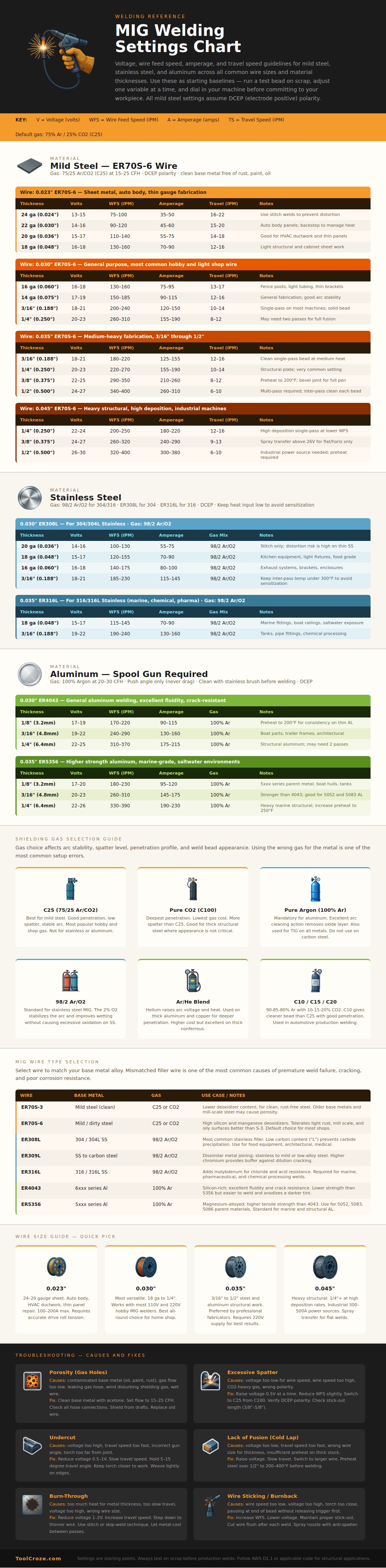
Until one day it clicks: It’s just physics. There are three pairs of variables: Voltage vs. Wire Feed Speed, Travel Speed vs. Fusion, and Heat Input vs. Metal Thickness. Wire Feed Speed, Travel Speed vs. Fusion, Heat Input vs. Metal Thickness. Get them a hair wrong, and your weld is toast. The chart above breaks it down to manageable levels for aluminum, stainless and mild steel.
Getting Better at MIG Welding
But you shouldn’t treat the chart like a rule book. Think of these settings as starting points, they are not guarantees.
Cleaning the metal: This is probably the number one mistake shops make; they fail to consider condition of their base material. Regardless of how well you set up for voltage and wire feed speed, if there is rust, mill scale, or oil on your metal, your weld will be weak and porous. The chart really stresses cleaning before you even pick up the torch.
Mild steel is relatively forgiving when compared to other metals, especially with ER70S-6 wire which can handles slight contamination better than purer wires. Aluminum has no forgiveness whatsoever. The oxide layer will melt at much higher temperatures then the actual base metal. Unless you get out the good ole’ stainless steel brush and scrub it down right before welding, you are effectively sealing contaminants into your bead. A lot of it has to do with hygiene and not just thermals.
For example: Switching metals involves more than swapping out the spool of wire. You need to switch the entire shielding gas as well. Aluminum should never be welded with a carbon dioxide mix. That’s a recipe for disaster, the arc will be unstable and erratic. Pure argon is called out for welding aluminum due to its ability to provide a cleaning action which strips away the oxide layer while welding.
Mild steel doesn’t need pure argon if you want a deep-penetrating weld. If you run pure argon on mild steel, you’ll have a shallower penetration, and your bead will look like beads of wax laying on the surface of the plate, not fusing with it. The takeaway: Half the battle is getting the gas mix correct. Dual-regulator set-ups are expensive, and cylinder swaps can cost money too. However, you won’t save money if you try to weld aluminum with C25 and waste more time on cleanup than on set-up.
Stainless steel introduces its own set of headaches. These are mainly sensitization and distortion. Poor thermal conductivity means the heat doesn’t spread out; instead, it concentrates. This can cause warping on thinner gauges unless you’re careful. Stitch welding addresses that heat concentration, as the chart recommends for smaller gauge material. It’s a pain-in-the-butt slow way to get there, but it’ll save your butt from having a piece warped like a crumpled up soda can.
On thicker stainless, you have to be mindful of temperature between passes being kept relatively low, preventing any chromium carbides from forming along the grain boundaries. That chemical process kills the corrosion resistance in the weld area, rendering the whole point of using stainless to begin with moot.
The other factor is what wire diameter you choose. The smaller the diameter wire, the more control you have on welding thinner metal without burning holes in your parts. However, it has to be fed very evenly or it will burn out in places or get bunched up in the liner and cause problems. On the opposite end of the spectrum, thinner wire allows you to weld thinner metal without burning through, but it requires precise drive roll tension to feed consistently. For the most part, most hobbyists seem to do well with middle ground wire sizes, which give you enough flexibility for most applications without having to constantly tweak everything to get it working right for any given job.
All that being said though, practicing still trumps memorizing a chart. Practice running test beads on scrap. Do this until you can see what you need to in the weld pool more accuratly than what you see on the dial of your machine. Steady penetration, ripples, those are the things you want to look for.
Once you quit guessing and really begin to see how your hand movements affect the puddle, the numbers stop mattering. You will KNOW when you’ve got it right or wrong without waiting for the arc to tell you. THAT’S what makes the difference between a novice and a person who actualy creates things that withstand time.
The chart gets you close…your hands finish the work.
