🔧 Metric Tap Drill Size Calculator
Calculate the exact drill bit size needed before tapping any metric thread — with tolerance, engagement %, and material guidance
| Thread | Pitch (mm) | Drill (mm) 75% | Drill (inches) | Minor Dia (mm) | Pitch Dia (mm) |
|---|---|---|---|---|---|
| M1.6 | 0.35 | 1.25 | 0.0492" | 1.221 | 1.373 |
| M2 | 0.40 | 1.60 | 0.0630" | 1.567 | 1.740 |
| M2.5 | 0.45 | 2.05 | 0.0807" | 2.013 | 2.208 |
| M3 | 0.50 | 2.50 | 0.0984" | 2.459 | 2.675 |
| M3.5 | 0.60 | 2.90 | 0.1142" | 2.850 | 3.110 |
| M4 | 0.70 | 3.30 | 0.1299" | 3.242 | 3.545 |
| M5 | 0.80 | 4.20 | 0.1654" | 4.134 | 4.480 |
| M6 | 1.00 | 5.00 | 0.1969" | 4.917 | 5.350 |
| M7 | 1.00 | 6.00 | 0.2362" | 5.917 | 6.350 |
| M8 | 1.25 | 6.80 | 0.2677" | 6.647 | 7.188 |
| M10 | 1.50 | 8.50 | 0.3346" | 8.376 | 9.026 |
| M12 | 1.75 | 10.20 | 0.4016" | 10.106 | 10.863 |
| M14 | 2.00 | 12.00 | 0.4724" | 11.835 | 12.701 |
| M16 | 2.00 | 14.00 | 0.5512" | 13.835 | 14.701 |
| M18 | 2.50 | 15.50 | 0.6102" | 15.294 | 16.376 |
| M20 | 2.50 | 17.50 | 0.6890" | 17.294 | 18.376 |
| M24 | 3.00 | 21.00 | 0.8268" | 20.752 | 22.051 |
| M30 | 3.50 | 26.50 | 1.0433" | 26.211 | 27.727 |
| Material | M3–M6 RPM | M8–M12 RPM | M14–M20 RPM | Cutting Fluid | Hardness (HB) |
|---|---|---|---|---|---|
| Aluminum/Brass | 300–600 | 200–400 | 100–200 | WD-40 / Kerosene | 60–120 |
| Mild Steel | 150–300 | 80–150 | 40–80 | Cutting oil | 120–180 |
| Stainless Steel | 60–100 | 40–80 | 20–40 | Sulfur-based oil | 170–250 |
| Cast Iron | 100–200 | 60–120 | 30–60 | Dry or light oil | 160–220 |
| Titanium | 40–80 | 20–50 | 10–30 | Cutting oil (heavy) | 200–350 |
| Plastic/Nylon | 400–800 | 250–500 | 150–300 | Dry | N/A |
| Wood/MDF | 500–1000 | 300–600 | 200–400 | Dry | N/A |
| Copper/Bronze | 200–400 | 120–250 | 60–120 | Cutting oil | 50–150 |
| Thread | Fine Pitch (mm) | Drill (mm) 75% | Drill (inches) | vs. Coarse Drill | Typical Use |
|---|---|---|---|---|---|
| M8×1.0 | 1.00 | 7.00 | 0.2756" | +0.20mm larger | Automotive, precision |
| M10×1.0 | 1.00 | 9.00 | 0.3543" | +0.50mm larger | Instrumentation |
| M10×1.25 | 1.25 | 8.75 | 0.3445" | +0.25mm larger | Fine adjustment |
| M12×1.0 | 1.00 | 11.00 | 0.4331" | +0.80mm larger | Hydraulic fittings |
| M12×1.25 | 1.25 | 10.75 | 0.4232" | +0.55mm larger | Precision machine |
| M14×1.5 | 1.50 | 12.50 | 0.4921" | +0.50mm larger | Automotive bolts |
| M16×1.5 | 1.50 | 14.50 | 0.5709" | +0.50mm larger | Wheel studs |
| M20×1.5 | 1.50 | 18.50 | 0.7283" | +1.00mm larger | High strength |
| Exact Tap Drill (mm) | Nearest Metric (mm) | Nearest Fractional | Nearest Letter/Wire | Error (mm) |
|---|---|---|---|---|
| 2.50 | 2.5 | — | #40 (2.489mm) | −0.011 |
| 3.30 | 3.3 | — | #30 (3.264mm) | −0.036 |
| 4.20 | 4.2 | — | #19 (4.216mm) | +0.016 |
| 5.00 | 5.0 | 13/64" (5.159mm) | #9 (4.978mm) | −0.022 |
| 6.80 | 6.8 | 17/64" (6.747mm) | H (6.858mm) | +0.058 |
| 8.50 | 8.5 | R (8.611mm) | R (8.611mm) | +0.111 |
| 10.20 | 10.2 | Z (10.490mm) | Z (10.490mm) | +0.290 |
| 14.00 | 14.0 | 35/64" (13.891mm) | — | −0.109 |
The formula is: Drill Diameter = Nominal Diameter – (0.7465 × Pitch × Thread%/100 × (100/75)). For 75% engagement (standard): Drill = D – (Pitch × 0.9949). Always verify with a thread gauge after tapping the first hole.
Drill the blind hole at least 1.5× the required thread depth + 3× pitch extra to allow tap runout. Example: M8×1.25 needing 15mm thread → drill to at least 22.75mm deep (15 + 3×1.25 + some clearance).
Election of the right Tap Drill for metric thread seems simple but it is really quite easy, when one gets the basic ideas. The basic rule is made of this: one takes the main width of the thread and takes away the step of the thread. Like this one gets the wanted size for the Tap Drill.
For instance, for thread M6 x 1, one does 6 minus 1, so the drill must be 5 mm. For M10 x 1.5 result 10 minus 1.5, what gives 8.5 mm. This method works always for metric threads, and honestly, it counts also for imperial threads.
How to choose the right tap drill for metric threads
Knowing this trick allows one to count sizes by heart, without always searching a table. Even so, it helps to have a table beside you. Charts for Tap Drills usually show the main width in millimeters, the step of the thread and the advised drill size for every type.
They normally cover sizes from M1.6 until M27 or even M30. Those charts most commonly offer drills for around 75 percent engagement of the thread, what wroks for the most many tasks.
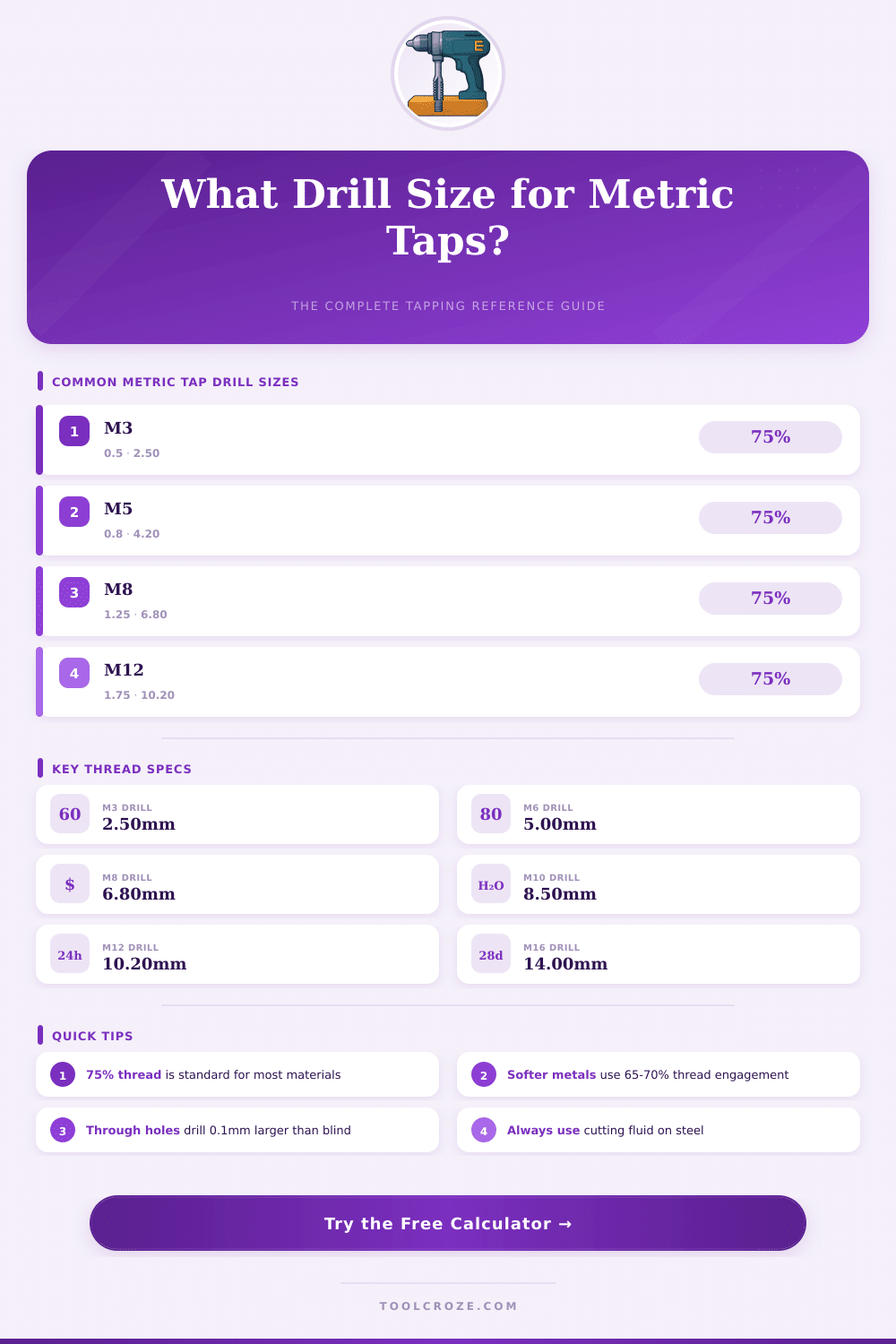
Here some of the most common sizes for Tap Drills of coarse threads in metric system. For M4 one uses 3.3 mm drill. M5 requires 4.2 mm.
For M6 it is 5 mm. M8 requires 6.8 mm. And for M10 answers 8.5 mm.
The most used Tap Drills for coarse threads usually come in standard metric set, that goes in 0.5 mm steps. Exceptions are M4, where one can use 1/8-inch drill as replacement, and M5, that can take 11/64-inch drill, if metric tools lack.
It does not matter too much, if one goes off by 0.05 mm during drilling. Drills do not always cut very exactly according to there called size. A set of metric drills with steps in 0.1 mm quite well serves for the most many tapping needs.
The strength of thread does not grow straight with the percentage of engagement. 100 percent thread is only around 5 percent stronger than one with lower engagement. Use between 60 and 70 percent for the most many tasks is good practice, that can help the threads last much more long.
For difficult materials, like certain grades of stainless steel, going down to 50 or 60 percent can make the job easier.
Fine metric threads also exist, but one meets them less commonly than coarse threads. For instance, standard fine thread M8 x 1 requires a Tap Drill of 7 mm, instead of the 6.75 mm for the common type. That 6.8 mm drill, that one commonly uses for common M8, is only 0.05 mm bigger than the meant 6.75 mm, what fully well works.
The drill must be sharp and well ground, to cut exactly the right hole. Building your ownset of metric drills in the common sizes is a handy way to prepare for tapping tasks.