
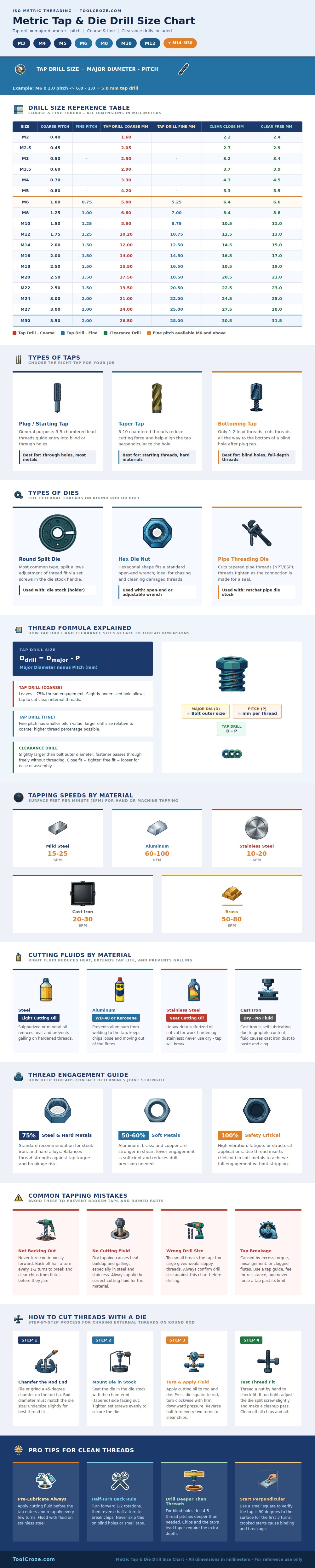
Here’s the scenario: You’re at your bench with a tap and a hole drilled. Will the tap break? Will the whole thing come together? That depends on how far apart the drill bit is from eventual thread diameter. In metalwork, a busted tap is not cheap.
The equation is pretty simple (the chart above). You subtract the pitch from the major diameter of the bolt. If you have an M6 (major diameter) bolt with a 1.0 millimeter pitch then you drill for 5.0 millimeters. Simple enough, right? But it is so very easy to do wrong. So many people guess at this instead of figuring it out.
How to Use a Tap Without Breaking It
Taps snaps off under pressure. Threads are too slack to support anything.
These are the calculations listed out on infographic from tiny M2 screw all the way up to huge M30 bolts. They range from coarse to fine. Most general hardware is going to be a coarse thread, It is a nice blend of easy to assemble and strong.
Fine threads offer a much bigger drill diameter compared to bolt size. This means you can get more thread engagement. This is great when working with softer materials such as aluminum. Because if you don’t have enough surface area the threads will strip.
The infographic points out that you do get options at certain sizes when it comes to pitch (M6 and above). So check your bolt spec before grabbing a drill bit. It is a little thing, but it really alters the whole geometry of the joint.
Another thing about tap selection is that tap sizes is different than drill bit sizes. Your best bet is to choose a drill slightly larger than your tap so there is room for chips (a 3/8″ drill is better then a 1/4″).
You also want to pick the correct type of tap; a tapered tap is long lead. It self-aligns perpendicular to the surface so it can guide itself into the hole. It’s forgiving and great for a beginner as well as tough materials like aluminum where you may want to apply consistent pressure.
A bottoming tap is designed for blind holes where you want the thread to reach all the way down. The taps has very little lead, and if you don’t switch to a plug or taper tap they will immediately bind. This progression is ignored by most folks. So now you wonder what happened to your tap (it broke off midway). It was not bad luck, but a bad sequence.
Threading taps are affected greatly by speed and lube. Mild steel should of been threaded at fifteen to twenty five surface feet per minute according to the reference data. For aluminum, up to a hundred is okay, and of course the proper fluid makes all the difference.
A sulfurized cutting oil works best on steel since it resists galling. Stainless steel also should have heavy duty oil since it quickly work hardens and will grab the tap if allowed to dry out. Cast iron is the exception to this rule. Tap cast iron totally dry. It’s like its own lube due to the graphite content of the iron. If you add lube it turns into more of a gritty paste that plugs the flute.
To tap, you need rhythm, not force. Turn the tap forward. Back off half a turn. This breaks the chip into small pieces. It also reverses the cutting edge just enough to let those pieces out of the flutes. But if you keep turning forward the chips will pack in there and create a vice that snaps your tap. That feels counterintuitive. Why would you reverse? Because it’s the only way to keep the cut clean.
With external threads, it’s similar. You mount a die in a stock. First, you chamfer the end of the rod. Next, you use steady pressure while you turn. If the threads feel too tight, the die has a split design that lets you make small changes to gain some control over the final fit.
Precision counts. Patience matters. Use the chart to verify the drill bit size matches. Select the proper tap type based off hole length. Clear the chips and stay cool. If all goes well, the tap threads easily. The screw fits snugly and secure. Guess wrong or rush and you’ll be fishing for lost metal.
It’s a simple arithmetic equation. Following through requires paying close attention to the substance. Keep your taps lubricated and sharpened. Backing off half a turn can save you starting again at square one.
