
Metric roller chain is one of those components that quietly carries the load in everything from small feeders to heavy conveyors. Get the size wrong and the result can be an early failure, stretching of the links, or even skipped teeth on the drive.
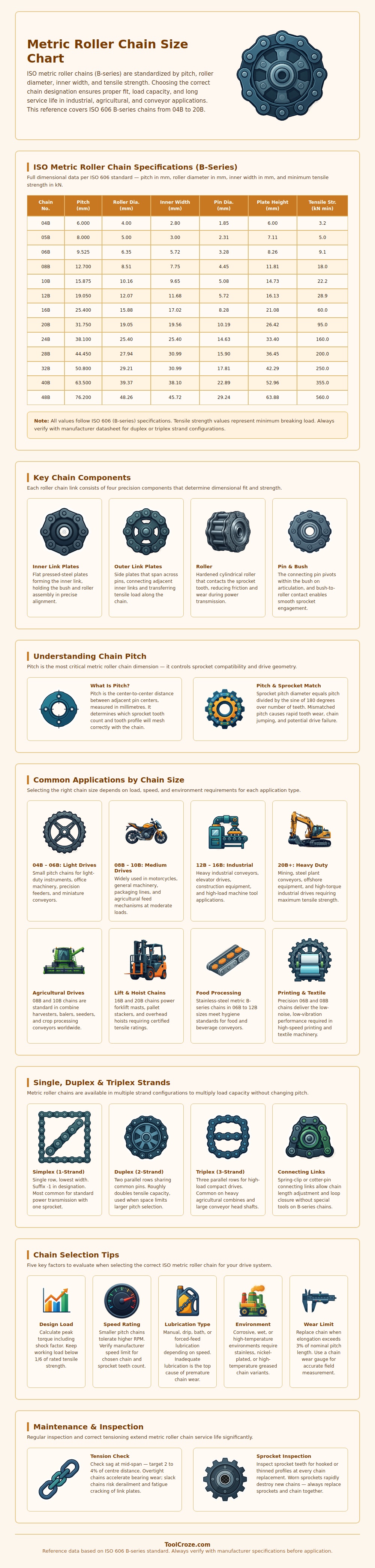
By displaying the dimensions that matter to capacity and fit, size chart eliminates the guessing. Every choice hinges on pitch. That’s the distance from pin center to center. Know that and you won’t have to guess which size matches the correct sprocket.
How to Choose the Right Chain Size
The B-series‘ increasing pitches is reflected in the chart. You’ll notice that as your pitch gets bigger, it sacrifices RPMs for strength. Conversely, a smaller pitch handles higher RPM but carry less force per link. It’s the reason these sizes group as they do on the chart.
Plate height, inner width and roller diameter is also listed in that same chart. All of these variables will affect the side load capacity as well as fit of the chain on the sprocket. A big roller won’t fit inside the tooth profile so it’ll ride up and wear out fast. An inner width that’s too small will cause the bushings to bind when the chain isn’t perfectly straight. Look at the entire row for each size to see everything, not just one part.
Physical layout of the chain is a factor as well. Outer plates carry the pull while inner plates contains the roller and bush. The bush rides on the pin which move each time the chain wraps around a sprocket. These are not drawn in the chart, but knowing what they do help explain why there are both duplex and triplex versions.
Parallel strands multiply capacity without having to jump up to a larger pitch. Going to a larger pitch means going to a larger size sprocket at a lower speed. Where people tend to screw up is in selection of strand counts. For most constant loads, one is fine. If you need extra strength but have a small amount of space, step up to duplex which gets the same envelope with added strength. Step up again to triplex and get even more margin. You add bulk (weight and width) so do that only if the application realy calls for it.
The chart helps you decide by showing how tensile ratings increase when you go from a single to a double and then to a triple.
Any size will last longer if properly maintained. Lubrication is needed to prevent pin-to-bush contact from causing abrasive wear. Chain also needs regular checks of tension so it does not fatigue plates with whipping action. Sprocket tooth profile check is just as critical. Nothing wears out a new chain faster than a worn-out sprocket.
The chart can’t answer when to replace what. It only reminds you that each size has its own window of working loads. That window remains far shorter than rated tensile strength.
Where do you begin? First, start with torque and speed requirements. After multiplying by a service factor you should of select the lowest available pitch to suit your load. Next you check the table for confirmation of numbers. Doing it this way makes for an easy-to-source, reasonably-quiet drive and keeps it small.
Now that you have your size established everything else in the system has to match that selection. This includes things such as the lubrication schedule.
