
How does this relate to a gauge system? Since gauges is designed inconsistently, it is hard for eye to tell 10 ga from 12 ga, or solid steel from a flimsy sheet of metal. When ordering replacement parts, if you don’t have the right size, you’re gonna pay for it!
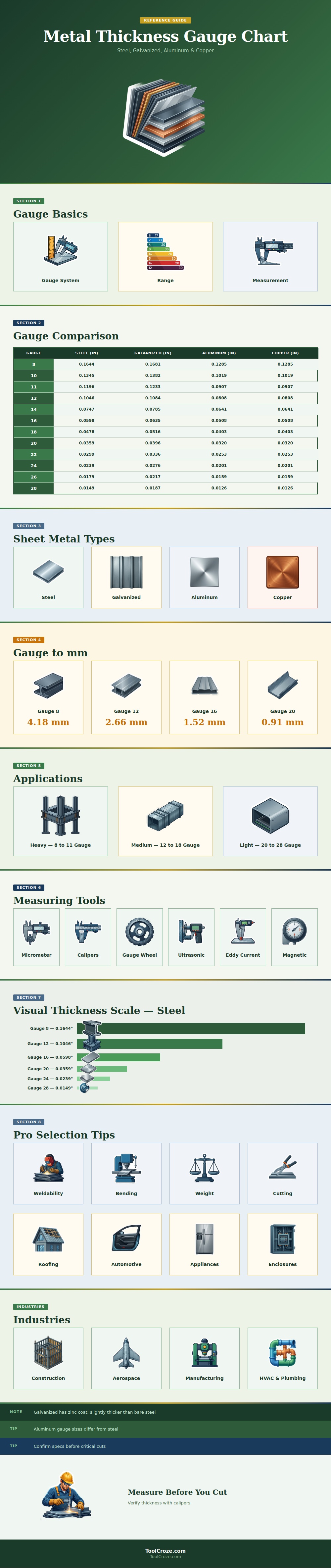
Here’s a chart comparing copper, aluminum, galvanized steel and steel. It ends the guessing game before you take out shears.
What Is Metal Gauge?
The thing that trips people up is that gauge numbers go backwards. The smaller the number the thicker material and the bigger the number the thinner the material. An 8-gauge steel plate would of been almost half of an inch thick! That’s hefty for something you can hold in your hand. Bend it too hard and it’ll just snap at 28-gauge because the material is so thin.
Does that make sense? No, you don’t have to know all the fractions off by heart. However, knowing where on the scale it is let you estimate how much weight it’ll take before buckling or holding its form.
Thicker wire doesn’t necessarily mean a higher gauge number. The scale used differ depending on the material. Steel has one scale while aluminum and copper has another. For example, 14-gauge steel isn’t as thick than 14-gauge aluminum. This is important if your application requires different materials for weight or corrosion resistence.
Bare steel is typicaly a bit thinner than galvanized steel. The zinc coating makes the steel run a little thicker. It is small, but it can impact fit and finish. Ignoring this variance lead to frustration later on when you’re fitting panels in tight spaces.
For heavy duty applications that cannot fail, such as roofing brackets or really heavy duty enclosure… You’ll want something in the 8 to 11 gauge range of metal. For medium jobs like automotive panels or HVAC duct work, go with 12 to 18 gauge metal. And for light applications like electrical boxes, you’re going to use 20 to 28 gauge ranges.
This gives you a bit more of a mental image of how thick all these metals are compared to one another and it gives you a mental ruler for future projects. Now you know what heavy metal feels like versus what flimsy feels like without pulling out a micrometer for every project decision.
Some measurement devices is precise and some are easy to read. Some give the best reading, others are fast, and others are just ok. For exact readings, micrometers are tough to beat. They also take some hand steadiness. For a rough idea or checking multiple items quickly, calipers are pretty handy. Gauge wheels is inexpensive and good for ballpark numbers in the field (but be sure to get the proper gauge wheel for your material). Magnetic and ultrasonic gauges can does non-destructive inspection of completed assemblies.
Select the appropriate measuring device according to how tight you want things to be. Do you need to build a shelf? Maybe a caliper will work. Need to weld some aerospace components? Then it is time for that micrometer.
Thickness matter, Thicker materials will retain and conduct heat differently which changes how easy they are to weld. You have to watch it on the thin stuff too. Too much pressure can melt right through. Same is true for bending, thin metal wants to wrinkle or snap. Thick metal takes a beating to get a nice angle.
When weight becomes an issue like in aircraft or car building, every ounce counts. Different tools is used depending on thickness as well. Snips work for lightweight while plasma cutters handles the beefy stuff.
The standards are the basis for everyday industry, whether it’s specific gauges used in construction frames to meet load requirements, the exact thickness tolerance stamped out at a manufacturing shop, or the size of galvanized or copper plumbing and HVAC pipes chosen to match air flow demands as well as pipe codes. Knowing the norms will let you speak more intelligently with your colleagues and suppliers. They’ll translate fuzzy requests into clear specs.
When in doubt about measurements, double-check with your tools. Manufacturers do not always fall on standard charts for the actual thickness. Measure before you cut. Get that mental ruler out and believe what your tools tell you over what your eyes are telling you.
