
When rushing orders on a foundry floor, you’d better know your metals: their physical characteristics. It’s not just skill but physics, that separates success from failure. At times you require metal that acts like water pouring into a mold. Other times, you want metal that remains firm as it’s being pressed. Otherwise, if you’re wrong, the stuff goes to waste and cracks at joints. That makes engineers grumpy. So, yes, it does matter, knowing, precisely, which metal turn into liquid at any given instant. Not because of heat. Because of physics. You need to know when matter shift state.
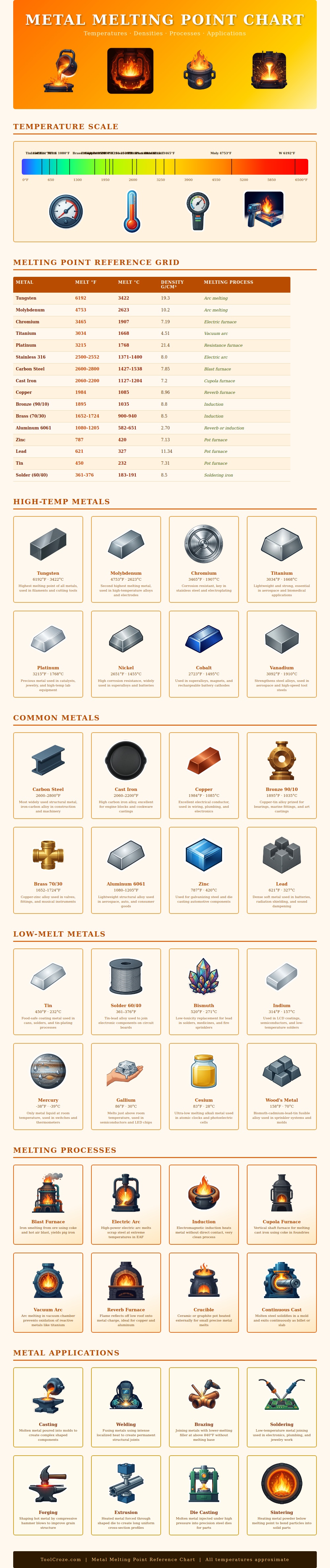
These charts make it very clear where melting points lie. They show refractory metals such as tungsten and solder types. But that doesn’t say anything about working with the material. Working with materials is really more about process and density. Some metals like tungsten and platinum are dense. Their weight are against you when handling. Other lighter metals like aluminum move around easily, but they present challenges because they oxidize rapidy when left in open air.
Why Metal Properties Matter for Your Process
What this graphical display allows us to do is group these metals based off temperature so you can see where they fall next to each other. So if you notice a large difference in the melting point from one metal to another like cast iron versus copper, then you know something important, what decisions you need to make for your process. If I’m making a copper part, I could drop it into a steel mold and have no worry that the mold would suffer damage. That’s a huge thing for how long a tool last.
On the other hand, it is totally different. Metals such as molybdenum and tungsten needs to be melted in vacuums or under arcs. Before these metals even become liquid, oxygen in normal air will react with metal at extreme temperatures. This results in brittle oxides that weaken resulting material. So rather than just temperature, what we’re really talking about here is controlling the atmosphere. That’s why folks fail in their DIY high-heat endeavors: they forget to take this into account. Just cranking up the temp on your regular furnace won’t produce pure metal.
In contrast, solder metals such as tin and lead are easy to understand, but they can be tricky. If the mix is right, they will simply melt in boiling water or on a hotplate. That’s why these low-melt alloys is used for electronics; precise joints is desired without harming sensitive equipment. Timing becomes far more important here then sheer force. You don’t want the metal to boil, only to flow into place. By understanding that tin melts at about 450 degrees Fahrenheit, for instance, you can select an iron with a tip just below this temperature point until contact is establish. It’s all about slow and steady thermal transfer, not maximum voltage.
These physical properties connect directy to the processes in the reference grid. Small batch heats from an induction furnace are both efficient and clean because the metal is heated by electromagnetic fields instead of an open flame which can bring impurities into the process. Blast furnaces use coke to remove oxygen from iron ore at a much greater scale. This makes the process considerably bigger and beyond what we might want as hobbyists. Depending upon your purity and volume requirements, you choose the correct process. An induction unit gives you control if you cast one art piece. Continuous casting systems gives you the throughput if you’re running a line making cars.
The properties of each metal depend on how they give up their form. Some like copper are great conductors of electricity but also stretch and lose tightness over time as they heat up. Aluminum is lightweight but hides cracks easily. But it is also lightweight. If titanium isn’t kept under vacuum then it’ll react to most everything else. By understanding those characteristics you’re able to select the proper material for your application. Whether you need to forge a gear or braze a pipe, pay attention to the limitations of that material’s temperature range. If the material does what the material wants, it works the way you want too.
You should of checked the density first.
