
Maybe you’ve picked up a block and felt it was identical to another in both size and shape, except that one was light whereas the other was dense. One feel like it is made of soft clay while the other feels dense enough to crack concrete if dropped. That’s density, and it’s so much more than a number on a periodic table.
It’s what makes aerospace engineer willing to pay triple for titanium when they’d rather use steel. And it’s what allows you to grab an aluminum beam with one hand, but means you need a crane for an otherwise identical steel I-beam. Knowing about the weight-to-volume relationship will change way you think about fabrication projects.
Why Density Matters for Building Projects
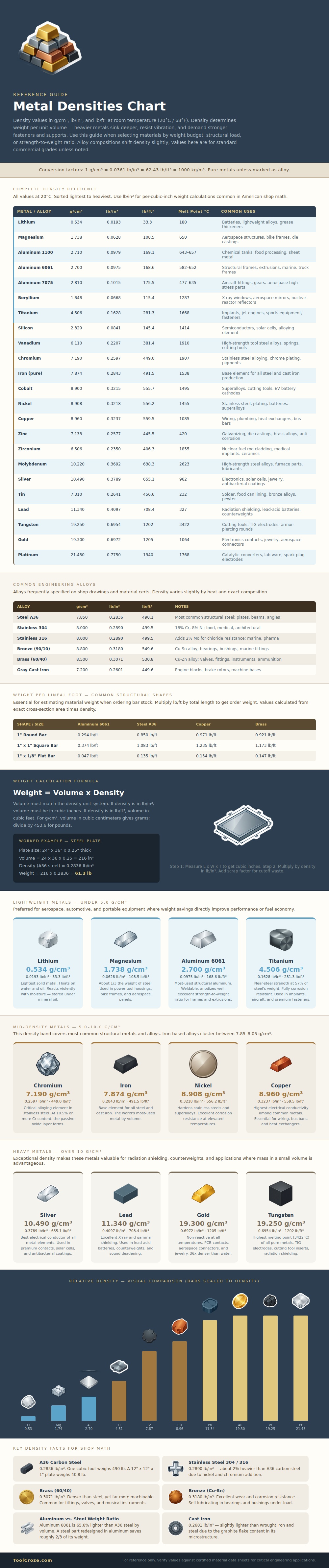
Those values, as split into the three most common units of measure, are displayed in the chart above. Why? Because if you’re working in a shop based off America, they’ll be working in cubic inches. If you’re working with an international team, the rest of world uses grams per cubic centimeter. Your density unit need to match your volume calculation or else you’ll have a structure that will collapse because it’s calculated too light.
The visual comparison in infographic shows just how far apart these materials are. Platinum sinks through mercury like a stone. Lithium floats on water. And that range make all the difference between designing for stability and for portability. That leaves most structural applications livig in a middle ground somewhere between copper and iron. Here, you’ll start to see dominance of steel which provides a good blend of cost and strength.
Looking towards the lighter side of the spectrum, however, we encounter the stuff powering our moddern inventions. By volume, aluminum 6061 are about two thirds as dense than typical carbon steel. This translates into why your car door panels is aluminum today or why your bike frame is made from aluminum. You trade a bit of stiffness for massive weight savings. This directly impact handling speed or fuel economy.
But on the heavy side, density is actualy something good. Tungsten and lead are super-dense. They is ideal for counterweights in things like elevator systems or radiation shields. You don’t want all that weight spread out over a large area because then you has to build really huge enclosures around your equipment.
Gold is right up there with tungsten in terms of weight, as the infographic points out. This is one reason it’s substantial in jewelry. This is also why you’ll find gold plated connectors in high-end electronics. It is corrosion resistant and conductive, but it does not shift or move due to thermal stress.
An easy error that folks starting out make is skipping part of the alloy makeup. Stainless steel 304 contain chromium and nickel, unlike pure iron. These ingredient change its density slightly and drastically change its melting point and corrosion resistance. If your fishing tackle is made of brass or bronze, those too has densities that fluctuate based on the amount of zinc to copper. This is why there’s a section in the reference guide about these more popular alloy. If you’re making exact load calculations with respect to say a marine fitting, don’t assume a generic “brass” value.
Knowing this information ahead of time has some practical applications too when it comes time to order materials. A lot of times shipping isn’t based off how much volume is being shipped but by weight. If you can swap a heavy piece of metal for one that is equal or stronger but lighter, you’ll get a better deal on shipping alone. This is true before you have even cut anything.
The chart includes weight-per-foot data for common bar sizes in the tool section. That way you don’t have to do a bunch of complicated math in your head when you’re up at the warehouse counter trying to figure it out.
In the end, all this comes down to density: weighing cost, weight, strength, and availability. That’s why knowing how heavy a cubic inch of something really is gives you intuition about that thing as soon as you touch it, because it makes abstract data into real understanding. And when you grasp that chunk of metal in your hands, you won’t just be feeling it. You’ll know exactly what the weight feels like, and therefore what those atoms looks like packed inside.
