MDF Weight Capacity Calculator
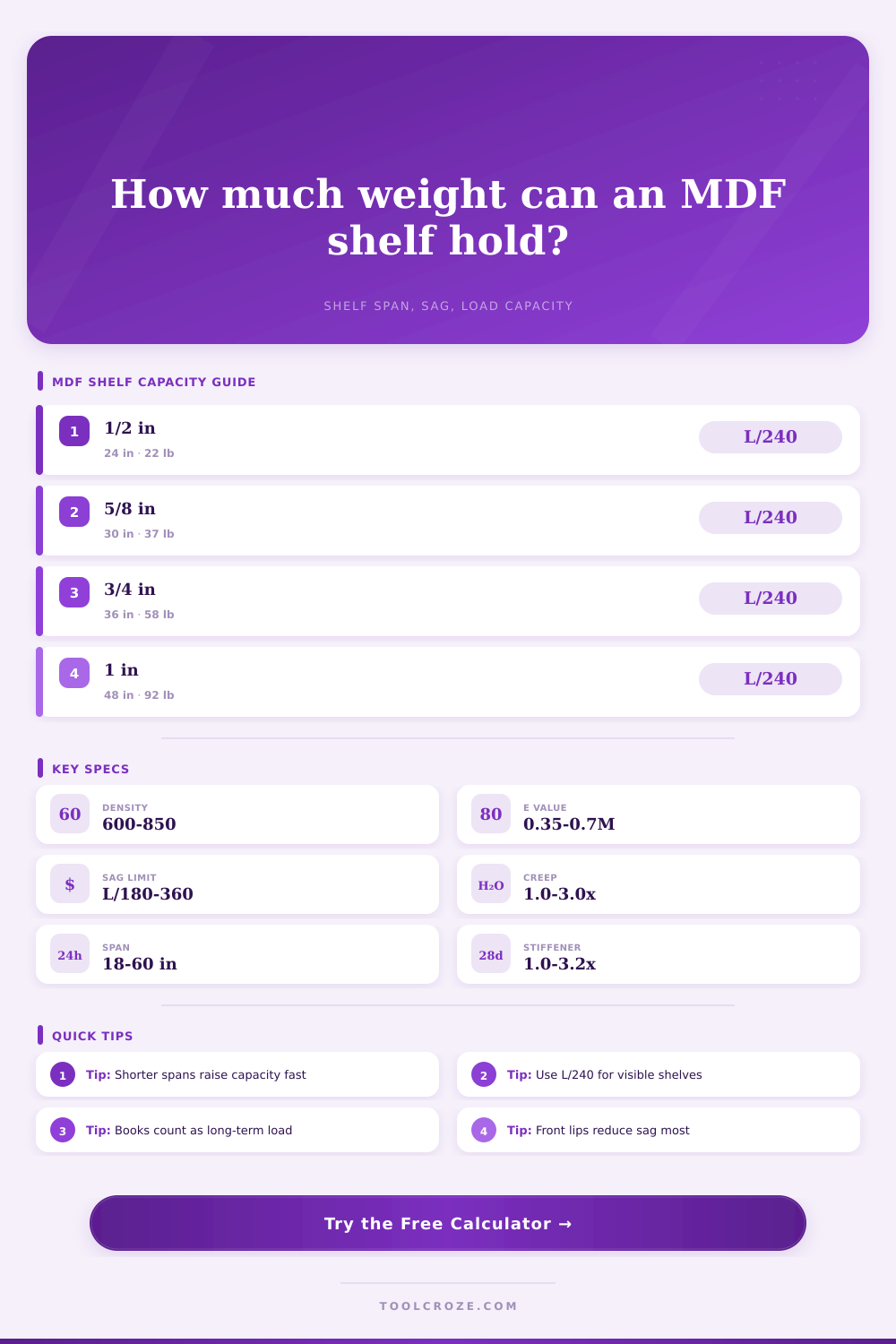
Estimate practical MDF shelf and panel load capacity from thickness, span, depth, support type, load distribution, deflection limit, edge stiffening, and long-term creep.
📌MDF Shelf Presets
⚙Shelf Inputs
MDF Shelf Capacity Results
🧱MDF Spec Grid
📊MDF Grade Reference
| MDF Type | Typical Density | Modulus E | Use In Calculator |
|---|---|---|---|
| Ultra-light MDF | 500-600 kg/m³ | 0.30-0.40M psi | Light display panels, short spans only |
| Standard MDF | 680-760 kg/m³ | 0.45-0.55M psi | Cabinets, bookcases, painted shelves |
| Premium MDF | 740-800 kg/m³ | 0.55-0.65M psi | Better shelves, routed panels, smoother edges |
| Moisture-resistant MDF | 740-820 kg/m³ | 0.50-0.62M psi | Humid rooms when sealed on all faces |
| High-density fiberboard | 800-900 kg/m³ | 0.60-0.75M psi | Higher stiffness with more self-weight |
🛠Support And Stiffener Factors
| Condition | Deflection Effect | Bending Effect | Notes |
|---|---|---|---|
| Shelf pins | Baseline | Baseline | Assumes the ends can rotate freely |
| Dado or rebate | About 20-25% stiffer | Slightly lower moment | Needs tight fit and good side panels |
| Captured fixed ends | Much lower midspan sag | End stresses increase | Only valid when the joint is truly fixed |
| Tall front lip | About 2x shelf stiffness | Better stress margin | Most useful at the front edge |
| Front and back rails | About 3x shelf stiffness | Best for long shelves | Rails must be firmly bonded or fastened |
📏Common MDF Shelf Checks
| Project | Typical Size | Load Pattern | Suggested Limit |
|---|---|---|---|
| Painted bookcase | 3/4 in x 30 in x 12 in | Uniform books | L/240 or stricter |
| Pantry shelf | 3/4 in x 32 in x 15 in | Mixed jars and boxes | L/240 with creep 2x |
| Media console | 1 in x 36 in x 16 in | Center equipment | L/300 if visible |
| Closet shelf | 5/8 in x 36 in x 14 in | Front-biased bins | Add front rail |
| Garage shelf | 1 in x 48 in x 18 in | Heavy uniform load | Use rails and cleats |
📐Deflection Limit Guide
| Limit | 36 in Span Sag | Best For | Calculator Meaning |
|---|---|---|---|
| L/180 | 0.200 in | Utility storage | Accepts visible sag sooner |
| L/240 | 0.150 in | General shelves | Balanced shelf appearance |
| L/300 | 0.120 in | Cabinet runs | Cleaner line under steady load |
| L/360 | 0.100 in | Display shelves | Strict serviceability check |
The reason is that you cut it clean, it takes paint smoothly, and it is cheap and available as medium-density fiberboard (MDF). For half a year it’s just the perfect bookshelf. Then one day the middle of the shelf gently sag. A week later it’s smiling and by Friday you suspect that perhaps gravity has increased its pull. Nope, you built yourself a ramp for your books.
Why? Because you don’t know how this stuff behaves. MDF isn’t wood like oak or pine. It’s engineered. It is made of particles glued together with resin. It hold screws well, but it will sag if you don’t watch its limits.
Why MDF Shelves Sag and How to Fix It
It’s also nice that it does all the math for you (you don’t have to mess around with complicated beam formulas). All you do is enter your numbers into calculator above and it spits out the answer. Clear span is the key metric here. Clear span is how far apart your vertical support post are. You’ll notice in the chart above that as clear span decreases, the stiffness increases very quickly. A little less span mean an enormous amount of stiffness. For example: going from 36″ span to 24″ span gives you ~8 times the stiffness. Everyone misses that. They assume that they can just add some thickness and the problem will be solved. While that certainly helps, significantly reducing your span is exponentially betterer.
What’s on the shelf matters too. It’s not just that books weigh a lot, they’re a long term load. MDF creeps, which means it slowly deforms permanent because it is constantly stressed over time. Your encyclopedia collection weighs down the resin in the board, and it’ll relax a little bit. Leave that load on for five years and the shelf will sag. Load it really hard once a year and maybe it will be ok. To account for this the tool applies a creep factor, sort of derating the board strength to match reality (not some lab test). Most people forget about creep until the day their shelf give way, so save yourself some headaches now by accounting for it.
The kind of support makes all the difference. For instance, if you make a shelf supported by just some pins in holes, that’s basically like a simple beam with the free end able to pivot; it’ll sag. If you put your shelf in a dado cut out in the side panels, now there’s a lot less rotation possible at the ends and it’s much more resistant to that. That’s why calculator takes that into account and lets you see how much stiffer it will be. Putting a stiffener like a lip on the front also helps. Gluing a thin strip of hardwood to the front edge increases its resistance to bending, so the entire assembly behaves as though it were thicker than it actualy is. Cheap trick but it works beautifully.
Don’t trust the raw breaking strength: MDF doesn’t just break like a piece of glass. It warns you. It bends first. And by the time it’s about to break, it’s already looking ridiculous. You’re not trying to prevent it from breaking. You’re trying to prevent it from being a dork. All those deflection numbers are for that. (L/240, anyone?) Those aren’t structural limits; they’re aesthetic limits. A sag past that deflection point isn’t necessarily structurally unsafe but it does make the shelf look weak.
Challenge yourself. Are you storing bins or books? Bins is often biased toward the front edge, while books are uniform. If you’re going to change that bias, flip your settings in the tool, it will figure out the bending moments for you. Higher peak stresses mean greater strain on the shelf, and the more it sags, the closer you get to exceeding aesthetic deflection limits. Consider how long that load will be there. Will the workspace last forever, or just until the project is done? Longer-lasting loads require more rigid creep adjustment and higher safety factors.
The MDF can be cut easily, finished easily, but will never forgive you if you ignore it. There’s no grain to follow in your head. There’s no sheet of wood where you’ll immediately sense it’s soft or stiff. You have to figure it out. That’s why there’s this handy table on the page that lays out how different grades behave. And it reminds you that generally speaking, the higher the density the stiffer the board. However, the higher the density, the heavier the board, which will lower your max load capacity. It’s a give and take. Adding weight to one board make it sag more.
All of this boils down to, as I said: learn your limitations on what’s possible with MDF. Don’t expect it to act like a real piece of wood. Know its weaknesses and support it. You should of not overextend yourself. Give it some time. Most importantly, discover its breaking point. What will it do? How far can I push it? Push past that line, and it’ll bend or break (or worse), it might just collapse under the weight of all those heavy-ass books.