⚓ Marine Wire Gauge Calculator
Calculate the correct AWG wire size for your boat’s 12V, 24V, or 48V DC electrical circuits — ABYC E-11 compliant
| AWG | Conductor Area (mm²) | DC Resistance (Ω/1000ft) | Ampacity @30°C (A) | Ampacity @50°C (A) | Ampacity @60°C (A) | Typical Use |
|---|---|---|---|---|---|---|
| 18 | 0.82 | 6.385 | 16 | 10 | 8 | Instruments, Panels |
| 16 | 1.31 | 4.016 | 22 | 13 | 11 | Cabin Lights, Radio |
| 14 | 2.08 | 2.525 | 32 | 17 | 15 | Nav Lights, Pumps |
| 12 | 3.31 | 1.588 | 41 | 23 | 20 | Bilge Pump, Fans |
| 10 | 5.26 | 0.999 | 55 | 33 | 29 | Windlass, Winch |
| 8 | 8.37 | 0.628 | 73 | 46 | 40 | Main Feed, Thruster |
| 6 | 13.3 | 0.395 | 101 | 60 | 52 | Inverter, Large Motor |
| 4 | 21.2 | 0.249 | 135 | 80 | 70 | Battery Cables |
| 2 | 33.6 | 0.156 | 181 | 100 | 90 | Engine Start |
| 1/0 | 53.5 | 0.098 | 245 | 150 | 130 | High Current Runs |
| 2/0 | 67.4 | 0.078 | 285 | 175 | 155 | Battery Bank Tie |
| 4/0 | 107 | 0.049 | 380 | 260 | 225 | High Power Engine |
| Round-Trip Length | 5A Max AWG | 10A Max AWG | 15A Max AWG | 20A Max AWG | 30A Max AWG | 50A Max AWG |
|---|---|---|---|---|---|---|
| 10 ft (3m) | 18 AWG | 16 AWG | 14 AWG | 14 AWG | 12 AWG | 10 AWG |
| 20 ft (6m) | 16 AWG | 14 AWG | 12 AWG | 12 AWG | 10 AWG | 8 AWG |
| 30 ft (9m) | 14 AWG | 12 AWG | 12 AWG | 10 AWG | 8 AWG | 6 AWG |
| 40 ft (12m) | 14 AWG | 12 AWG | 10 AWG | 10 AWG | 8 AWG | 6 AWG |
| 60 ft (18m) | 12 AWG | 10 AWG | 10 AWG | 8 AWG | 6 AWG | 4 AWG |
| 80 ft (24m) | 12 AWG | 10 AWG | 8 AWG | 8 AWG | 6 AWG | 4 AWG |
| 100 ft (30m) | 10 AWG | 8 AWG | 8 AWG | 6 AWG | 4 AWG | 2 AWG |
| Device | Typical Current | Voltage | Recommended Min AWG | Wire Type | Fuse Rating |
|---|---|---|---|---|---|
| Navigation Lights (LED) | 2–3A | 12V | 18 AWG | BC5W2 | 5A |
| Navigation Lights (Incand.) | 5–8A | 12V | 16 AWG | BC5W2 | 10A |
| VHF Radio (TX) | 6A | 12V | 16 AWG | BC5W2 | 10A |
| Chartplotter / MFD | 3–5A | 12V | 18 AWG | BC5W2 | 5A |
| Bilge Pump (1100 GPH) | 5A | 12V | 16 AWG | BC5W2 | 10A |
| Bilge Pump (2000 GPH) | 10–12A | 12V | 14 AWG | BC5W2 | 15A |
| Windlass (up to 60lb) | 25–35A | 12V | 10 AWG | BC5W2 | 40A |
| Windlass (up to 100lb) | 40–60A | 12V | 8 AWG | BC5W2 | 60A |
| Trolling Motor (55lb) | 50A | 12V | 8 AWG | BC5W2 | 60A |
| Trolling Motor (80lb) | 56A | 24V | 8 AWG | BC5W2 | 60A |
| Marine Refrigerator | 5–8A | 12V | 14 AWG | BC5W2 | 15A |
| Anchor Spotlight (100W) | 8A | 12V | 14 AWG | BC5W2 | 15A |
| Engine Starter | 150–200A | 12V | 2/0 AWG | SGX/Battery | None/Fusible Link |
| Shore Power (30A) | 30A | 120V AC | 10 AWG | UL Listed Marine | 30A ELCI |
The thickness of wires depends on their ratings. The lower the number of the rating, the fatter the cable. For instance, cable of 8 AWG has a diameter a bit more than 3 millimeters, while wire of 18 rating measures only around 1 millimeter.
The AWG system stands for American wire gauge and it is used to estimate the size of wires. Also tinned marine wire measures according to AWG.
Boat Wire Sizes and How to Choose
The American Boat and Yacht Council, or ABYC, sets rules for marine wiring. Because of those rules, every wire on a ship must reach at least 16 AWG. This is the smallest allowed size.
Calculators for wire gauge size, that are based on AWG, help to determine exactly what rating one needs for safe setup.
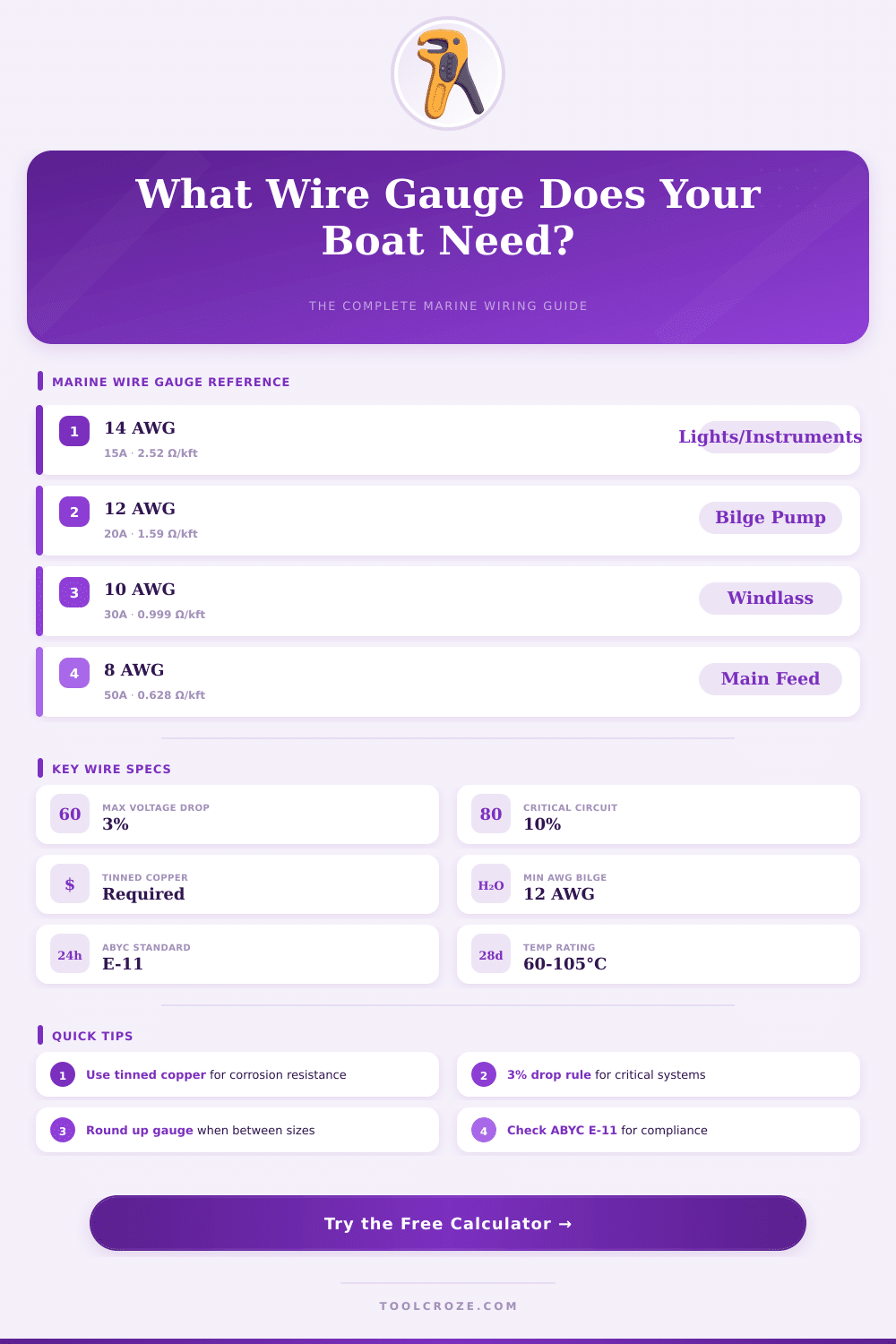
Choosing the right rating, the voltage drop plays a big role. Leads for main power, bilge fans, electronic devices and navigation lamps must have a size like this, that the voltage drop stays under three percent. For less important uses, like a stereo, it is possible to accept even 10 percent loss of voltage.
Worth recalling is, that on a 12-volt ship the usable length for estimating the right rating matches too the total length of the positive and ground wiring.
Practical methods for that exist. By means of a chart of wire gauge sizes, one finds the rating in the crossing point of the current and length values. That one chooses.
A simple formula also allows to compute the voltage drop for any circuit, according to length and flow, if one knows the resistance of the wire. Moreover, the size of the cable limits, how weak it can be for big current flows.
Marine wire differs from that for autos. SAE automotive wire indeed has a smaller rating than equal AWG marine wire. Solid wire does not find place on a ship.
The best choice is AWG wire of marine quality with tinned copper. For instance, 16 AWG marine wire bends a lot, and 12 AWG marine wire also bends well, made from tinned copper for long service. Both resist harsh marine conditions.
Marine wire comes even in multi-lead forms with two or three leads and outer covering.
For general wiring on a ship, like LED lamps, stereos, work lights and navigation gear, 16 rating works for almost everything. Even so, 18 rating is too weak for marine use, because it simply weighs little and needs extra support. The wiring from the battery to the fuse panel must be sized according to the whole circuit.
Wire of 12 rating serves well for 20 amps up to around 30 feet for regular circuits. In bigger systems with extra lamps and electronics, fat wire gauge ratings like 6 help tocontrol the voltage drop more well.