
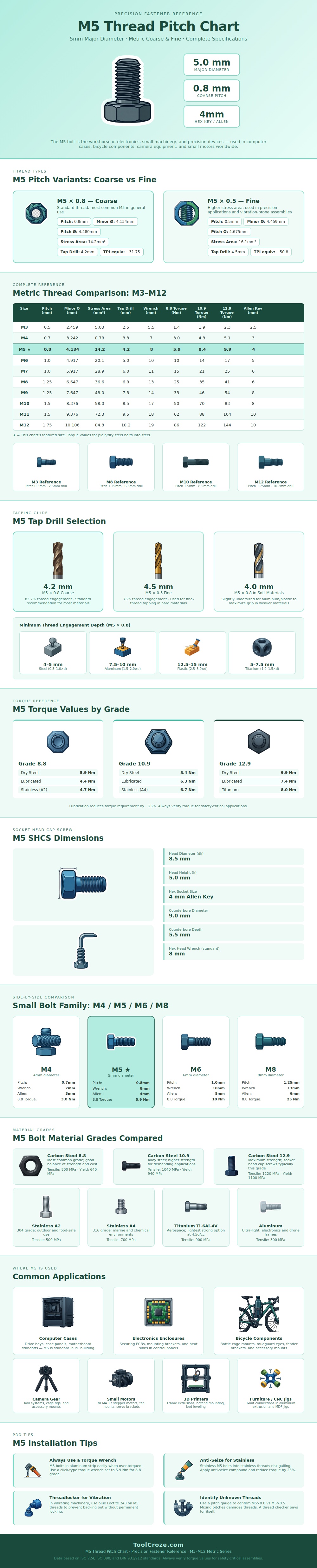
The M5 bolt is a common fastener that is used in many differently assembly tasks. The M5 bolt is a medium sized fastener. The M5 bolt is small enough to be used in electronics enclosures and bicycle frame.
The M5 bolt is strong enough to handle heavy loads. However, the M5 bolt must have the correct thread and you must tighten it proper to ensure that the M5 bolt will work correct. The M5 bolt is used in many different environment.
How to Choose and Use M5 Bolts
For example, M5 bolts is embedded in computer cases as well as camera rigs. Therefore, understanding the performance of the M5 bolt in these different environments is essential. One of the characteristic that will determine the performance of the M5 bolt after installation is the thread pitch.
The thread pitch can be coarse or fine. A coarse thread pitch will allow the M5 bolt to move quick through the material. This property of the M5 bolt make it suitable for many different everyday situations.
A fine thread pitch means that more of the threads of the M5 bolt are packed into the same length of the M5 bolt. This increase the surface area of the threads of the M5 bolt. An increased surface area improve the resistance of the M5 bolt against vibrations.
The thread pitch should be chosen based off the environment in which the M5 bolt will be use. A reference chart exists that provides information regarding the thread pitch option for the M5 bolt and the drill sizes needed for the M5 bolt. This chart can help you to find the correct drill size for your M5 bolt.
Additionally, the reference chart provide torque values for different strength grade of the M5 bolt. It is essential that you use the correct torque value for the M5 bolt. Using the wrong torque when tightening the M5 bolt may over-tighten the bolt.
An over-tightened M5 bolt may strip the threads of the M5 bolt. Using the torque value indicated on the reference chart allow you to use a torque wrench. Using a torque wrench ensure that you dont apply the wrong amount of force to the M5 bolt.
Another specification for the M5 bolt is the material in which it will be use. Steel is a strong material and will allow for a shorter engagement depth of the M5 bolt. Aluminum is a softer metal than steel.
Therefore, the engagement depth of the M5 bolt should be longer in aluminum than in steel. Plastic is softer than aluminum. Therefore, the M5 bolt should have an even longer engagement depth in plastic or you should make the use of inserts in the plastic part.
Many people make the mistake of assuming that all M5 bolts can be used interchangeably in a design. This isnt true. For example, a mid-grade M5 bolt will stretch the head of the bolt more before it reaches the same load that a high-grade M5 bolt will reach.
The strength grade of the M5 bolt will change the torque that the bolt require to reach these loads. Additionally, if you use lubrication on the M5 bolt, the torque that the M5 bolt will require will change. Therefore, you must take a design decision on whether lubrication will be used on the M5 bolt.
The access that you will have to the M5 bolt will also impact its design for your project. For example, if a socket head cap screw is used, a hex key will be required to engage with the recess of the M5 bolt. However, if a standard hex head bolt is used, you will need to use a different wrench.
You should of have the correct tools on hand for the M5 bolt that you will use in your project. If the M5 bolt will experience vibrations in operation, a fine thread pitch will help the M5 bolt to remain in place. However, a fine thread pitch may not be strong enough on its own to prevent the M5 bolt from vibrating out of place.
In this case, applying a medium-strength threadlocker to the M5 bolt will help to ensure that the M5 bolt remains in place. If the M5 bolt is made of stainless steel and the holes in the materials that it will be assembled to are also made of stainless steel, you should use anti-seize on the threads of the M5 bolt. This is because stainless steel can experience galling if it is not lubricated prior to assembly.
Galling of the threads will prevent the M5 bolt from being able to move in and out of the hole in the material. Therefore, using anti-seize will prevent the M5 bolt from getting stuck in its hole. Overall, the M5 bolt can be used in many different application.
The M5 bolt is large enough to handle a load yet small enough to allow for the M5 bolt to fit into tight spaces. Moreover, once you understand the property of the M5 bolt, you can use the reference chart to assist you with your projects that use M5 bolts. Using these specifications in your project will ensure that the M5 bolt is a reliable part of the project that you create.
