
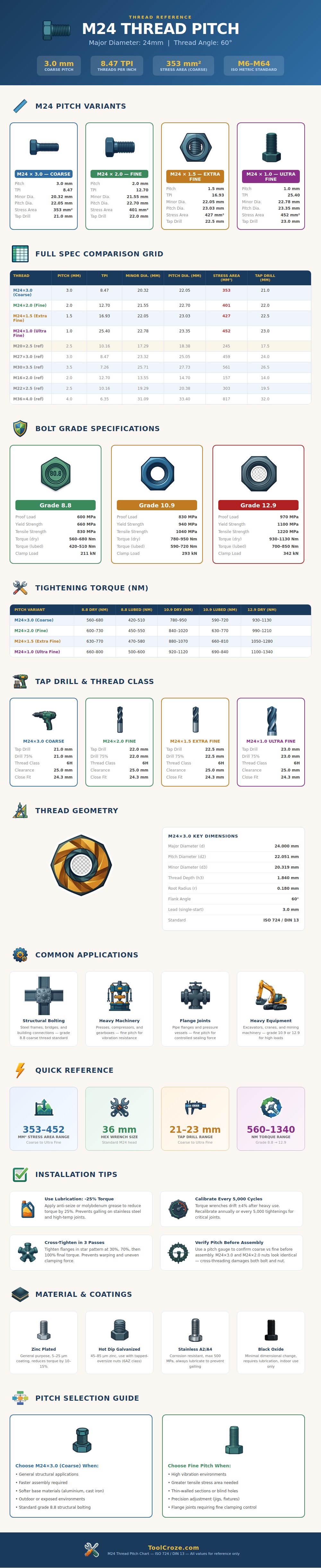
When you use M24 bolts for heavy equipment or structural steel applications, the M24 bolts performs significant work to hold the equipment or steel structure together. The M24 bolt size is used for significancy and heavy loads. The thread pitch for an M24 bolt will determine the behavior of the joint created by the bolt when the joint is subject to stress.
The difference between coarse and fine threads go beyond the speed with which you can tighten the M24 bolt. The thread pitch will determine the loads that the M24 bolt can carry and the resistance of the bolt against loosening over time. If you are to use the M24 bolt in a fabrication shop, the preference will generally be to use coarse threads for the M24 bolt because coarse threads are fast to assemble, and they are forgiving when dealing with soft metal materials.
How to choose the right M24 bolt
Coarse threads are a good choice for those who needs speed in their work operations. However, the potential downside of using coarse threads is that the M24 bolt may walk loose in equipment or structure that vibrate frequently. In such cases, locking features or retorqueing the bolt will be necessary.
Fine threads offer the advantage of providing more thread engagement in the same length of the bolt. Fine threads distribute the clamp load over a large area, which helps to keep the bolted joint tight when the machinery it is part of is running. The pitch of the threads on an M24 bolt will change the available strength of the bolt.
Using fine threads will increase the cross-sectional area on the bolt that can bear the load. An M24 bolt with fine threads can take a higher clamp load before it yield. If your equipment or structure requires a high amount of tension at the joint, using fine threads will be a betterer choice than using coarse threads.
The grade of the M24 bolt will work similar to the pitch of the threads. People use an 8.8 grade M24 bolt the most for structural applications. However, you can use a 10.9 or 12.9 grade M24 bolt if the joint will experience shock load or if you are trying to save weight in the surrounding structure.
Higher grades of M24 bolts require more care when you tighten the bolt with a wrench. More lubrication will be required when using higher grade of M24 bolts. If you dry assemble a 12.9 grade bolt, you will require more effort with the wrench than if you dry assembled an 8.8 grade bolt.
You must account for lubrication when assembling bolts. If you dont account for lubrication when tightening the bolt, you will tighten the bolt to a point at which the bolt yield without knowing it. The thread class and the tap drill size will affect the performance of the M24 bolt over a long period of time.
The 6H tolerance for M24 bolts is a good choice and one that most machine shops can achieve. Using a thread fit that is too tight will cause galling of the threads of the M24 bolt, especially with stainless steel fasteners. Choosing a fit that is too loose will reduce the fatigue life of the bolt.
Most people choose the drill sizes listed in the technical charts to provide 70% to 75% of the threads of the M24 bolt to balance the strength of the bolt and the chance of breaking the tap when drilling deep into the structure. Using the wrong size M24 bolt will cause damage to the bolt and the hole in the structure. Using an M24 coarse nut with an M24 fine bolt will cause the nut to bind after a few turn.
This will damage the threads of both the M24 coarse nut and M24 fine bolt. To avoid this problem, having separate bin for coarse and fine pitch M24 bolts will help. Additionally, using a pitch gauge will help avoid this problem.
Using different coatings on an M24 bolt will change the torque value. Using zinc will reduce the value of the torque that is required to assemble the bolt. Using hot-dip galvanizing will increase the friction between the threads.
This will require the use of oversized nut or changing the torque specification for the bolts to ensure that the joint is not under-clamp. The decision of which M24 bolt to use will depend on the environment in which the joint will be used. If the bolted assembly needs to be taken apart regularly or if speed is a priority in the assembly operation, then the coarse pitch of the M24 bolt is the better choice.
On the other hand, if the bolted joint will remain assembled for several year and will be exposed to vibration, fine threads will be a better choice. Refer to the technical chart to ensure that the pitch of the bolt is suited to the environment in which it will be used. Choosing the proper M24 bolt will ensure that the bolt performs the work for which it was sized and that the joint remain tight without maintenance.
