🪵 Lumber Board Feet Calculator
Calculate board feet for any lumber dimension — single boards, multiple pieces, or full projects
| Nominal Size | Actual Size (in) | Actual Size (mm) | BF per Linear Ft | Common Use |
|---|---|---|---|---|
| 1x2 | 0.75 x 1.5 | 19 x 38 | 0.167 BF | Trim, furring |
| 1x3 | 0.75 x 2.5 | 19 x 64 | 0.25 BF | Furring strips |
| 1x4 | 0.75 x 3.5 | 19 x 89 | 0.333 BF | Shelving, trim |
| 1x6 | 0.75 x 5.5 | 19 x 140 | 0.5 BF | Decking, shelves |
| 1x8 | 0.75 x 7.25 | 19 x 184 | 0.667 BF | Paneling, shelves |
| 1x10 | 0.75 x 9.25 | 19 x 235 | 0.833 BF | Wide shelves |
| 1x12 | 0.75 x 11.25 | 19 x 286 | 1.0 BF | Shelving, cabinets |
| 2x4 | 1.5 x 3.5 | 38 x 89 | 0.667 BF | Framing |
| 2x6 | 1.5 x 5.5 | 38 x 140 | 1.0 BF | Framing, decking |
| 2x8 | 1.5 x 7.25 | 38 x 184 | 1.333 BF | Joists, decking |
| 2x10 | 1.5 x 9.25 | 38 x 235 | 1.667 BF | Joists, beams |
| 2x12 | 1.5 x 11.25 | 38 x 286 | 2.0 BF | Stairs, beams |
| 4x4 | 3.5 x 3.5 | 89 x 89 | 1.333 BF | Posts |
| 4x6 | 3.5 x 5.5 | 89 x 140 | 2.0 BF | Beams, posts |
| 6x6 | 5.5 x 5.5 | 140 x 140 | 3.0 BF | Heavy posts |
| Project | Lumber Size | Pieces x Length | Net BF | BF w/ 10% Waste |
|---|---|---|---|---|
| Basic Bookshelf | 1x10 | 5 x 6 ft | 25 BF | 27.5 BF |
| Deck (12x12 ft) | 2x6 | 24 x 12 ft | 288 BF | 316.8 BF |
| Raised Garden Bed | 2x8 | 8 x 8 ft | 85.3 BF | 93.9 BF |
| Picnic Table | 2x6 | 6 x 8 ft | 48 BF | 52.8 BF |
| Fence (6 ft, 20 ft run) | 1x6 | 40 x 6 ft | 120 BF | 132 BF |
| 2-Car Garage Frame | 2x4/2x6 | Mixed | ~800 BF | ~880 BF |
| Small Shed (8x8 ft) | 2x4 | ~50 x 8 ft | ~267 BF | ~294 BF |
| Workbench | 2x4, 2x6 | Mixed | ~40 BF | ~44 BF |
| Thickness | Sheet Size | Board Feet | Weight (lb) | Best Use |
|---|---|---|---|---|
| 1/4" (6mm) | 4x8 ft | ~2.67 BF | ~22 lb | Drawer bottoms, backs |
| 3/8" (9mm) | 4x8 ft | ~4.0 BF | ~28 lb | Sheathing, subfloor |
| 1/2" (12mm) | 4x8 ft | ~5.33 BF | ~40 lb | Cabinet sides, sheathing |
| 3/4" (19mm) | 4x8 ft | ~8.0 BF | ~60 lb | Shelving, cabinets |
| 1" (25mm) | 4x8 ft | ~10.67 BF | ~80 lb | Countertops, heavy shelves |
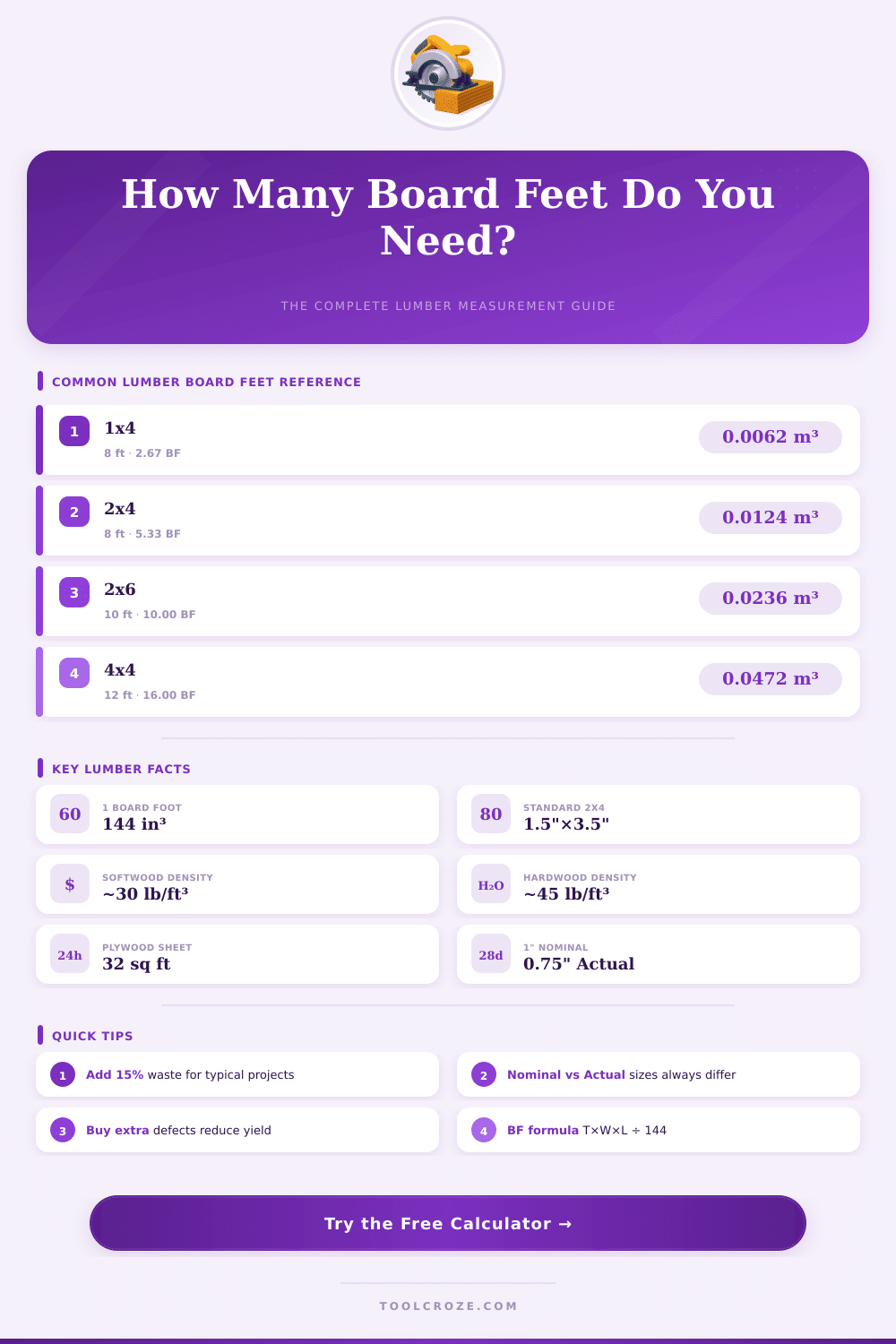
The board foot serves as a unit for measuring the volume of lumber. In the United States and Canada one usually measures it according to that standard. A piece of wood with 12 inches of width, 12 inches of length and 1 inch of thickness matches one such foot.
That gives exactly 144 cubic inches of wood. One commonly shortens it to BF, BDFT or FBM.
What is a Board Foot and How to Measure It
The board foot measures the whole volume rather than simply length. For instance, a board of 2 inches thickness, 12 inches length and 6 inches width also forms one board foot, because 2 times 12 times 6 reach 144 cubic inches. So boards of various shapes can store the same board foot.
For counting board feet, one multiplies the thickness in inches by the width in inches and by the length in feet, then divides by 12. Another way is to multiply the thickness by width by length, everything in inches, and divide by 144. Both ways deliver the same result.
There also exist online calculators that allow you to enter teh dimensions and receive the result quickly.
The practical effect for measuring wood is to note that two linear feet of board of 6 inches width and 1 inch thickness also forms one board foot. It is useful when one visits the lumber store.
Board feet have the most sense during buying of hardwood lumber. Because hardwood comes in many shapes and sizes, a simple price per linear foot would not work fairly. Linear foot works for shaped building lumber, but price according to board foot better helps with rough hardwoods.
One uses the board foot measure four both rough lumber and planned lumber.
Thicker supply costs much more. Lumber with thicknesses 4/4, 5/4 and 6/4 usually have similar price per board foot, but 8/4 costs much more and 12/4 even far more. Moreover, one normally counts board feet according to standard sizes.
When a board is shaped, the cost of that extra work adds up.
During buying of lumber, it helps to add around 20 to 25 percent for waste. The lumber store probably will not cut every board to exact sizes. Also width stays unpredictable.
When boards seem wider, the whole amount of board feet grows. A pile of 10 board feet could be made up of boards between three and eight inches wide and two to three feet long, andno two would have the same size.
At auctions, some local marks of lumber use BMF instead of BF. They are not the same, because BMF costs around 30 percent less than BF. That deserves to be kept in mind before bidding.