
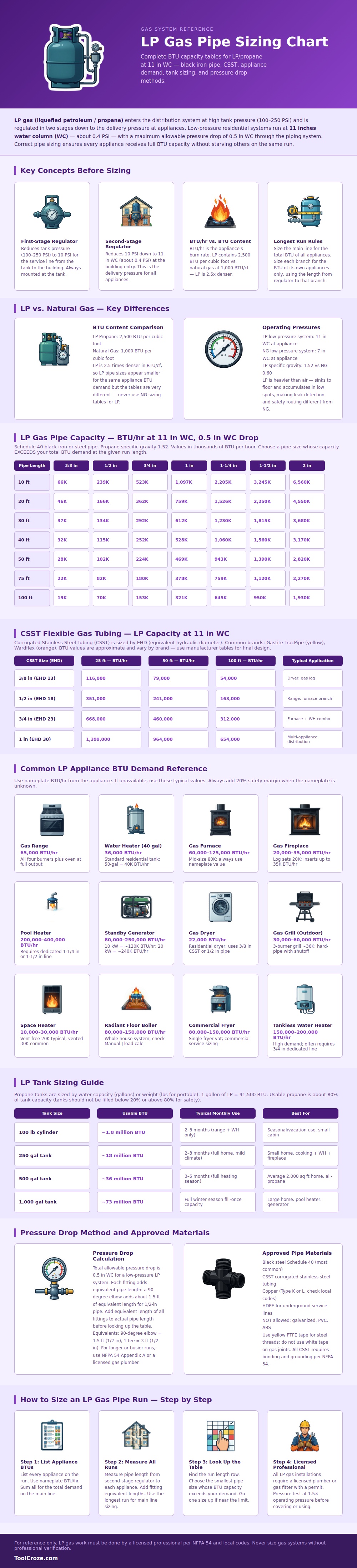
Hooking up a propane system means not only managing fuel; you also has to balance demands of appliances with distance and pressure. A frustrating experience in the kitchen is having your range burners sputter and die as the oven lights up, a clear indicator of an undersize gas line. Looking at the physics of how gas moves through a pipe can help you understand why; we start by looking at capacities of each pipe size in chart above.
Propane is dense, packing about two and a half times the energy of natural gas into every cubic foot. You may be tempted to assume this makes it OK to use a smaller pipe because less volume are required. It’s a dangerous assumption. Because propane is heavier and thicker, there is different friction losses within the pipe versus natural gas. Using a table designed for natural gas sizing will cause problems when sizing your propane system.
How to Size Propane Pipes Safely
At roughly 11-inch water column, your home system has light pressure for gentle flow. That’s just sufficient pressure to maintain a fuel stream on longer runs without loss of pressure. Only half an inch of water column drop between regulator and farthest appliance can be allowed, and it’s not much leeway. Each tee or elbow in your plumbing run are like several feet of additional straight line plumbing in terms of resistance. A single 90-degree elbow adds equivalent length that eats into your pressure budget. Homeowners do this all the time; they measure their walls but don’t account for corners, and there’s a reason. Accounting for that added equivalent length means you’ll have enough strength when gas reaches its destination to ignite properly.
The other decision: Will you use flexible corrugated stainless steel tubing or more-rigid black iron pipe? This chart lists capacity info for both materials. It shows what size you need to deliver specific BTUs over different run lengths, from twenty-five feet up to a hundred feet. While the flexible tubing makes installation easier. Snaking through joists without too many fittings. It’s also less secure, since each time you attach it there is a possible leak site. Fewer elbows creates a tighter run.
And if you’re installing a long run for a heavy-duty appliance such as a standby generator or a tankless water heater, that require far larger pipe sizes. Though a half-inch is probably big enough for standard dryer, a whole-house furnace coupled with a pool heater requires some much broader pipes. There’s no negotiating safety here. Because propane is heavier than air, it do not spread upwards but rather sinks down into low spots and basements where accumulations can form.
That’s why we route our lines the way we do and why guessing isn’t better than having your system tested for pressure. No eyeballing this stuff. It should of been done by a licensed professional who will test the system at a minimum of one point five times the operating pressure before anyone uses it. It is not because the government wants to make things hard on us, but because that protects our families from unseen leaks.
You must also respect the path of the fuel when sizing these pipes. What do you want to get out of the propane? How much do you need in each appliance? Measure the length of the longest run between regulator and the appliance, add up the penalty for fittings, and select a pipe sized above sum of those needs. If you are near capacity, go up a size. It won’t cost you a lot in materials, but it will pay off in reliability.
There is nothing like seeing each burner light on the first click, every time; you’ll know you got the sizing chart right if this happens. The quiet reward is that clean blue flame.
