Log Board Foot Calculator International
Estimate gross and net board feet with the International 1/4-inch log rule using small-end diameter inside bark, merchantable length, defect deductions, and species data.
International 1/4-Inch Scale Result
Density and hardness help plan handling and sawing effort; the International board-foot scale itself is driven by diameter inside bark and merchantable length.
| DIB small end | 8 ft log | 12 ft log | 16 ft log | 20 ft log |
|---|---|---|---|---|
| 6 in | 10 bd ft | 15 bd ft | 20 bd ft | 25 bd ft |
| 8 in | 15 bd ft | 25 bd ft | 40 bd ft | 50 bd ft |
| 10 in | 30 bd ft | 45 bd ft | 65 bd ft | 85 bd ft |
| 12 in | 45 bd ft | 70 bd ft | 95 bd ft | 125 bd ft |
| 14 in | 65 bd ft | 100 bd ft | 135 bd ft | 175 bd ft |
| 16 in | 85 bd ft | 130 bd ft | 180 bd ft | 230 bd ft |
| 18 in | 110 bd ft | 170 bd ft | 235 bd ft | 295 bd ft |
| 20 in | 140 bd ft | 220 bd ft | 300 bd ft | 375 bd ft |
| Scale rule | Assumption | Small-log behavior | Use in this calculator |
|---|---|---|---|
| International 1/4 | 0.25 in kerf, taper allowance | Most even common rule | Main result |
| Doyle | Large slab deduction | Low on small logs | Comparison only |
| Scribner approx. | Diagram-style log rule | Between Doyle and International | Comparison only |
| Cubic lumber | 1 board foot = 1/12 ft³ | Not a log scale rule | Handling estimate |
| Species | Green density | Hardness | Scale note |
|---|---|---|---|
| White oak | 63 lb/ft³ | 1360 Janka | Heavy butt logs |
| Black walnut | 58 lb/ft³ | 1010 Janka | Deduct metal carefully |
| Hard maple | 56 lb/ft³ | 1450 Janka | Watch end checks |
| Southern pine | 55 lb/ft³ | 870 Janka | Often scaled long |
| Douglas-fir | 34 lb/ft³ | 620 Janka | Common export log |
| Western red cedar | 23 lb/ft³ | 350 Janka | Light, lower hardness |
| Field condition | Typical deduction | Where to apply | Calculator input |
|---|---|---|---|
| Sound straight log | 0 to 3% | Net scale | Defect or sweep |
| Minor sweep or ovality | 3 to 8% | Net scale | Sweep deduction |
| End check or ring shake | 5 to 15% | Net scale | Defect deduction |
| Heart rot pocket | 10 to 35% | Net scale | Defect deduction |
| Metal stain or embedded iron | 15 to 50% | Net scale | Defect deduction |
Measure that log using your diameter tape and record its small end diameter within the bark.
The difference between hope and profit occur at this stage of your woodpile’s journey. It requires that you select a scaling rule. Most folks apply the Doyle rule (easy) but it understates small log volume. So, if you’re harvesting small trees, you’re leaving money in the wood.
How to Measure Your Logs Correctly
To fix this deficiency, we has the International 1/4-inch rule. It accounts for a quarter-inch loss of material when sawing, which means that it’s more accurate for today’s bandsaw-generated wood volumes. After measuring the length and diameter at the log’s small end (inside bark), the calculator does the rest: it doesn’t make you compute geometry of all those tapered cylinders.
It is more important to learn what the input values represent in the real world than to learn how to use the calculator. Most key among them are the DIB: the small-end diameter inside bark. That’s not the same as just measuring around the outside of a tree, over its bark, then stopping.
Bark thickness vary from species to species and even on each individual tree. When asked for the bark deduction per side, the tool want you to enter that value so it can turn your over-bark measurement into inside-bark number that the scale demands. If you fail to do that, you will guess the wrong number of gross board feet. And guess what happens when you try to sell that load?
Diameter isn’t all that counts; so is length. But not tree length, which would be all of the fallen tree. Instead, think merchantable length. This is the length of the part of the log that don’t have any defects that prevent use as lumber.
Too-small ends need to be trimmed off, and also anything that’s split or checks. There is usually waste at the end of a long log. Because of this, there is a trim allowance field in the calculator. Don’t count air as board feet. If you enter actual length without subtracting trim, you will be counting air as board feet.
The connection between theory and the real world of the forest are found in defects. Embedded metal, shake, sweep and rot all eat into your net volume. And like the pros do with their loads, the tool let you take percentage deductions for those things that don’t make the cut.
While 5 percent sounds low, on a big load that’s a lot of lost timber. So view the log and decide honestly what can be salvaged. Be conservative with your deductions or you will be surprised when the mill scale weight is lower than what you expected on the truck scale.
There are two factors at play here that revolve around species choice. One is wood density, or how dense it is when green. That impacts the weight estimate. And the other factor: what’s the recovery class (grade) of your wood? Does it come from a knot-filled hemlock destined for pallets or a clear-cut walnut destined for veneers?
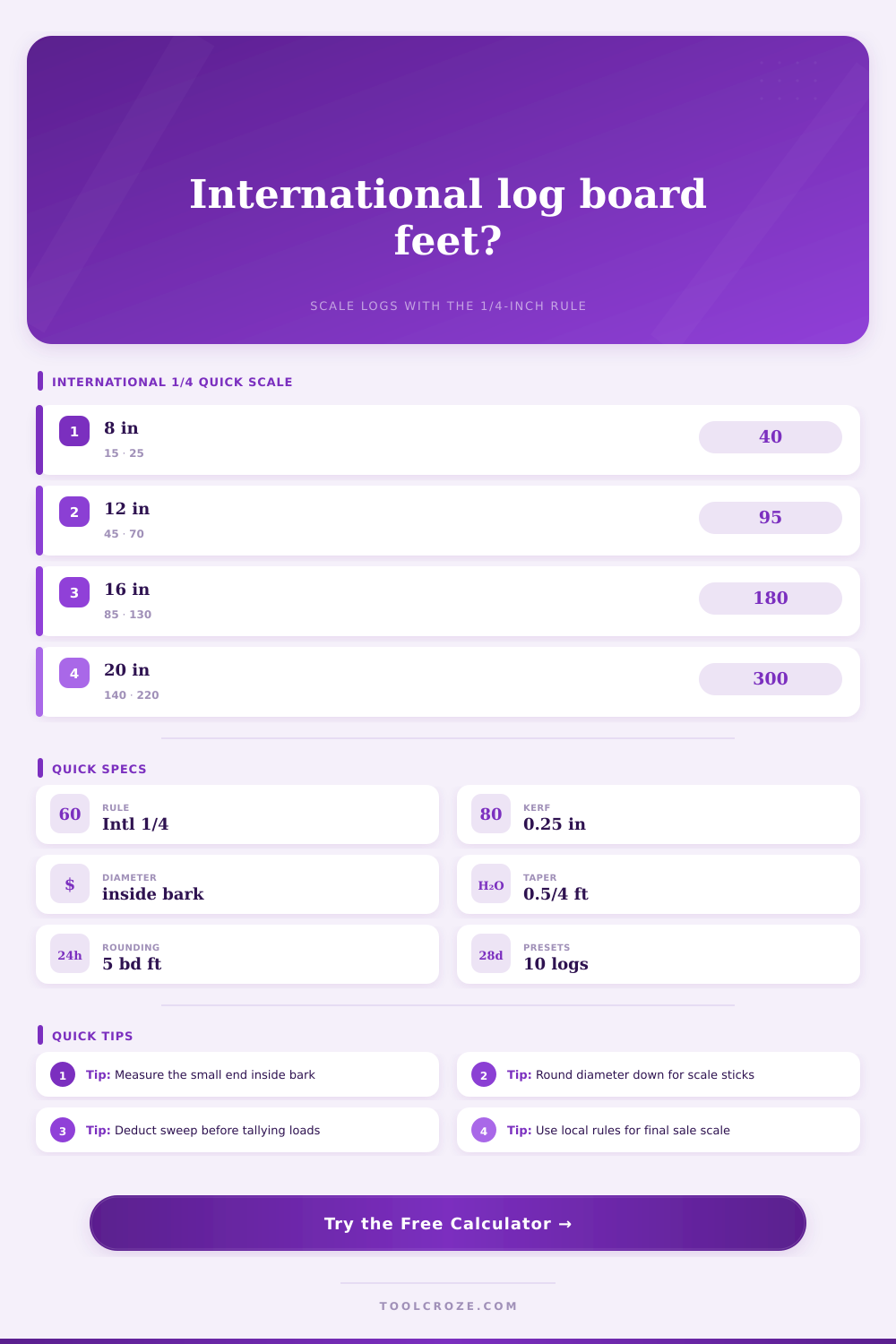
The calculator tacks those grades and updates resulting number of board feet accordingly, adjusting the figure to reflect actual lumber you’ll get out of the tree, not simply its raw round potential. This is what the international standard 1/4 inch system look like (from this page):
Notice how the volume leaps with each successive diameter in the table on the page. Why does that happen? It’s not just that a wider log has more inches; although slab and kerf cut into both an 8-inch log and a 12-inch log, they take up less of total volume in the bigger log. That’s the way larger logs gains a scaling benefit.
Measuring carefully, subtracting honestly, and selecting the rule that fits your sawmill’s reality is a measuring contest. It is an exercise in managing expectations. It is how to bridge the gap between clean mill lumber and the irregular shapes of the forest.
The tool gives us the numbers. We give it the judgment.
You should of seen the difference. When the scale matches the saw, we all make money.