Linear Feet to Yards Calculator
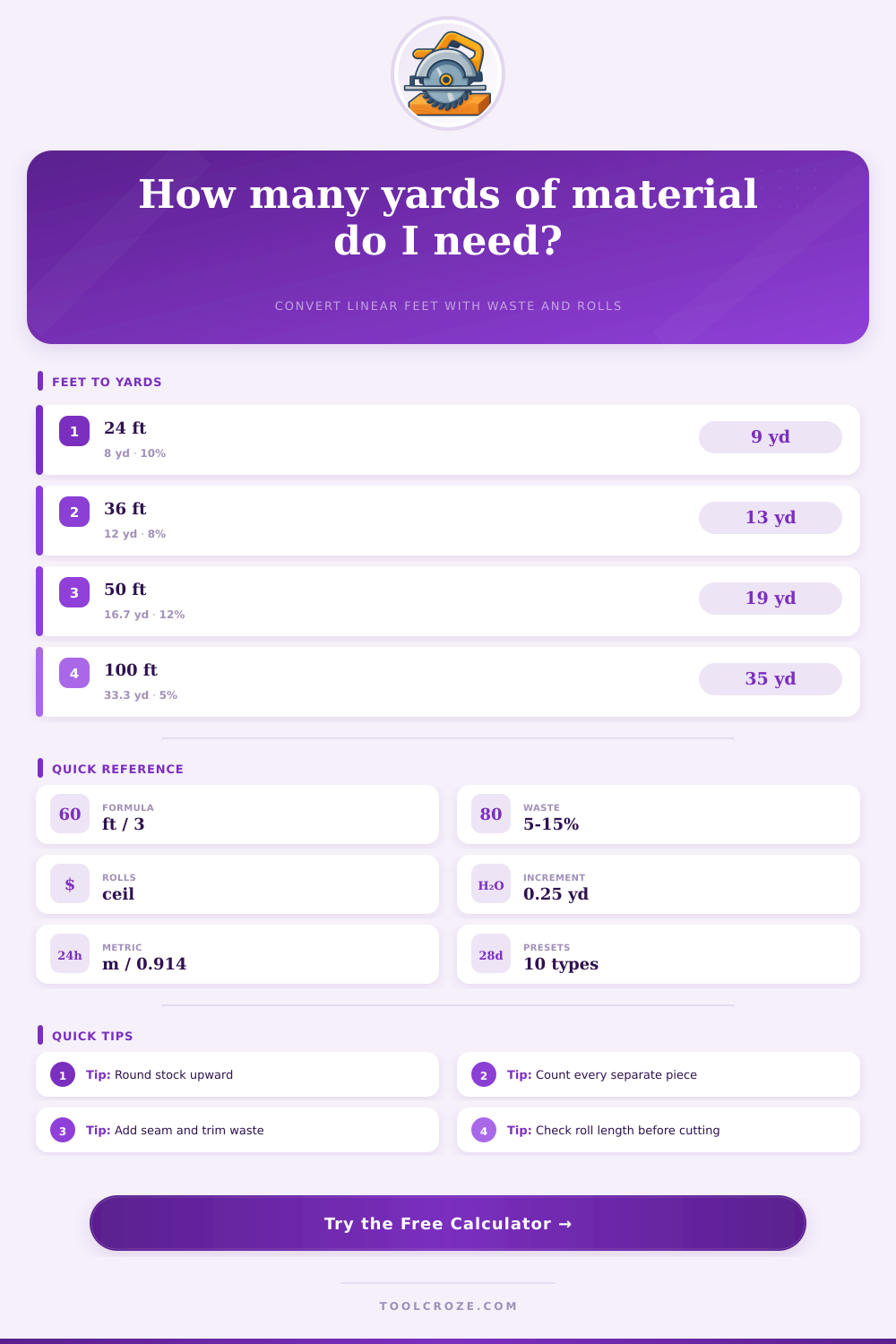
Convert linear footage into yards, add piece count and waste, round to stock increments, and check how many rolls or stock lengths to pull before cutting.
⚒Material presets
Choose a common material setup, then fine tune the length, waste, roll size, and rounding rule.
📏Project inputs
▣Selected material grid
📋Reference tables
Conversion reference
| Linear feet | Linear yards | Meters |
|---|---|---|
| 3 ft | 1 yd | 0.914 m |
| 12 ft | 4 yd | 3.658 m |
| 25 ft | 8.333 yd | 7.620 m |
| 50 ft | 16.667 yd | 15.240 m |
| 100 ft | 33.333 yd | 30.480 m |
Waste allowance guide
| Project | Typical waste | Why |
|---|---|---|
| Trim stock | 8-12% | miters |
| Carpet | 10-15% | seams |
| Fabric | 5-12% | repeat |
| Rope or cable | 5-10% | tails |
| Turf or mesh | 10-15% | layout |
Stock increment examples
| Material | Increment | Equivalent |
|---|---|---|
| Fabric cut | 0.25 yd | 9 in |
| Roll goods | 1 yd | 3 ft |
| 12 ft trim | 4 yd | 12 ft |
| 16 ft trim | 5.333 yd | 16 ft |
| 50 ft roll | 16.667 yd | 50 ft |
Common stock lengths
| Stock | Feet | Yards |
|---|---|---|
| Short stick | 8 ft | 2.667 yd |
| Standard trim | 12 ft | 4 yd |
| Long trim | 16 ft | 5.333 yd |
| Medium roll | 75 ft | 25 yd |
| Full coil | 100 ft | 33.333 yd |
Material preset data
| Preset | Typical stock | Waste | Increment | Best for |
|---|---|---|---|---|
| Broadloom carpet | 33.33 yd roll | 12% | 1 yd | rooms |
| Sheet vinyl | 25 yd roll | 10% | 0.5 yd | flooring |
| Upholstery fabric | 30 yd bolt | 8% | 0.25 yd | fabric cuts |
| Landscape fabric | 50 yd roll | 10% | 1 yd | beds |
| Artificial turf | 25 yd roll | 12% | 1 yd | strips |
| Baseboard trim | 12 ft stick | 10% | 4 yd | miter cuts |
| Rope or cord | 100 ft spool | 5% | 1 yd | lengths |
| Fence fabric | 50 ft roll | 8% | 16.667 yd | runs |
| Seam tape | 75 ft roll | 15% | 1 yd | seams |
| Cable or conduit | 100 ft coil | 10% | 1 yd | routes |
🔧Shop notes
A linear feet to yard calculator is an device that mathematicaly converts linear feet to linear yard. Because there are several factor that impact the number of yards of material that are necessary to complete a project, it can be difficult for an individual to accurately calculate that number without use of such a calculator. Factors to consider in the linear calculation of yards of material needed may include the length of each run of the project, the waste that may occur during the project, and the increment in which the supplier stocks the material.
The basic calculations that the linear feet to yards calculator utilizes are that three feet equal one yard; the calculator divides the number of feet to be measured by three to calculate the quantity of yards that are required for the project. In many cases, however, additional material will be required beyond that initial calculation. Thus, the use of a linear feet to yards calculator is required to consider the additional variable of the project that may impact the number of yards of material that is necessary for the project.
How to Use a Linear Feet to Yards Calculator
One of the additional variable in the calculation is the amount of waste that will be introduced into the project. Waste is material that will be cut during the project, but will not be utilize in the construction of the project; it may be due to mistake in the installation process, or may need to be cut to allow for the materials to fit around certain features of the project. A linear feet to yards calculator considers the amount of waste as a percentage of the total length of the project.
Considering the percentage of waste allow for the calculation to remain consistent regardless of the length of the project that is to be completed. The number of identical piece to be cut is another variable that the linear feet to yards calculator considers. If, for instance, there are four hallway run that are each fourteen feet in length, the length that is entered into the calculation is fourteen feet, but the number of identical pieces is entered as four.
The calculator multiplies the length by the number of identical pieces prior to the calculation of the number of yards of material that are necessary. Performing the multiplication of lengths and pieces prior to converting the unit prevents any error in the calculation. Additional variables to consider include the stock increment of the supplier.
Depending upon the supplier, the material may be stocked in increments of quarter yards, for instance, or may be stocked only in full length of material or in specific “stick” length. The linear feet to yards calculator may allow for the selection of whether the calculation of yards of material will be rounded up to the next available stock increment, or if the user will keep the number of yards of material to the calculated figure. Rounding up the number of yards of material will ensure that there is sufficient material for the project; however, avoiding rounding up of the calculated number of yards of material will reduce the amount of material that is purchase and therefore saved.
Within the online calculator of linear feet to yards, reference table are often provided to assist the individual in understanding the calculation of material needed for the project. These tables can provide information about the length of the materials of different type, for instance, or can provide information about common percentage of waste that may occur during the project. Though these tables are not rules, they may assist in the individual in selecting the appropriate percentage and counts in the calculation of linear feet to yards.
The linear feet to yards calculator may have certain field that are to be filled in before starting the calculation. The field for the number of identical piece may be used if all of the length to be measured are the same; if the lengths of the “runs” of the project may differ from one another by more than a few feet, it may be better to enter each of the lengths separately into the yardage calculator. The linear feet to yards calculator will provide more than just the number of yards of material that are necessary for the project.
In addition to the number of full length of material that will be purchased, the linear feet to yards calculator will indicate whether any material will be left over after the project is completed (or whether there will be a shortage of materials for the project). This output will allow for the individual to decide whether the measurement of the projects “runs” need to be change before ordering the materials. Finally, the length of the materials that are stocked on the rolls may be shorter than the length of the material that is cited on the roll; ensuring that the projects lengths are to the actual length of the roll will ensure that the project will be completed without any shortage in the materials.