Linear Feet to Square Yards Calculator
Convert roll length or repeated strips into square yards using usable coverage width, overlap, pattern repeat, trim loss, and waste allowance.
Choose a starting point for common roll goods, then adjust the actual label width, side lap, repeat, and strip count from your material.
Usable Square Yards
This grid recalculates the same entered length and strip count across common usable widths, so you can compare narrower and wider roll goods quickly.
| Usable width | Gross yd² | Usable yd² | Yd² per LF | LF for 100 yd² |
|---|---|---|---|---|
| Run the calculator to fill the grid. | ||||
| Material | Typical nominal width | Common waste | Overlap or repeat note |
|---|---|---|---|
| Carpet roll | 12 ft or 13.5 ft | 5-12% | Patterned goods need more layout waste |
| Sheet vinyl | 6 ft or 12 ft | 6-12% | Keep seam direction consistent across runs |
| Artificial turf | 12 ft or 15 ft | 8-15% | Side trimming and grain direction matter |
| Wallpaper | 20.5 in or 27 in | 12-25% | Repeat matching can dominate loss |
| Landscape fabric | 3 ft to 6 ft | 8-15% | Overlap rows by 3-12 inches |
| Conversion | Formula | Example | Result |
|---|---|---|---|
| Linear feet to yd² | LF x width ft / 9 | 30 LF x 12 ft / 9 | 40.0 yd² |
| Inches width to feet | in / 12 | 54 in / 12 | 4.5 ft |
| Square feet to yd² | ft² / 9 | 360 ft² / 9 | 40.0 yd² |
| Metric area to yd² | m² x 1.19599 | 30 m² x 1.19599 | 35.9 yd² |
| Planning factor | Typical range | Use when | Calculator effect |
|---|---|---|---|
| Side overlap | 0-12 in | Membranes, wrap, fabric, turf seams | Reduces effective coverage width |
| End overlap | 0-24 in | Splices, drop trimming, roll ends | Reduces usable length per strip |
| Pattern repeat | 0-36 in | Wallpaper, patterned carpet, printed vinyl | Rounds usable strip length down |
| Waste allowance | 5-25% | Cutting, damage, layout direction | Subtracts from usable square yards |
| Usable width | Square yards per linear foot | Linear feet for 10 yd² | Common material |
|---|---|---|---|
| 20.5 in | 0.190 | 52.7 LF | Wallpaper |
| 36 in | 0.333 | 30.0 LF | Fabric or underlayment |
| 54 in | 0.500 | 20.0 LF | Upholstery vinyl |
| 72 in | 0.667 | 15.0 LF | Geotextile or wide fabric |
| 144 in | 1.333 | 7.5 LF | Carpet or sheet vinyl |
When you order roll goods for a project, you have to consider more than just the length of the goods that you would like to order. The length of the material isnt the same as the area. You lose some of the material due to the width of the seams, the length that must be cut off of the rolls to allow for trimming, and additional material that may be lost due to mistake in laying the material.
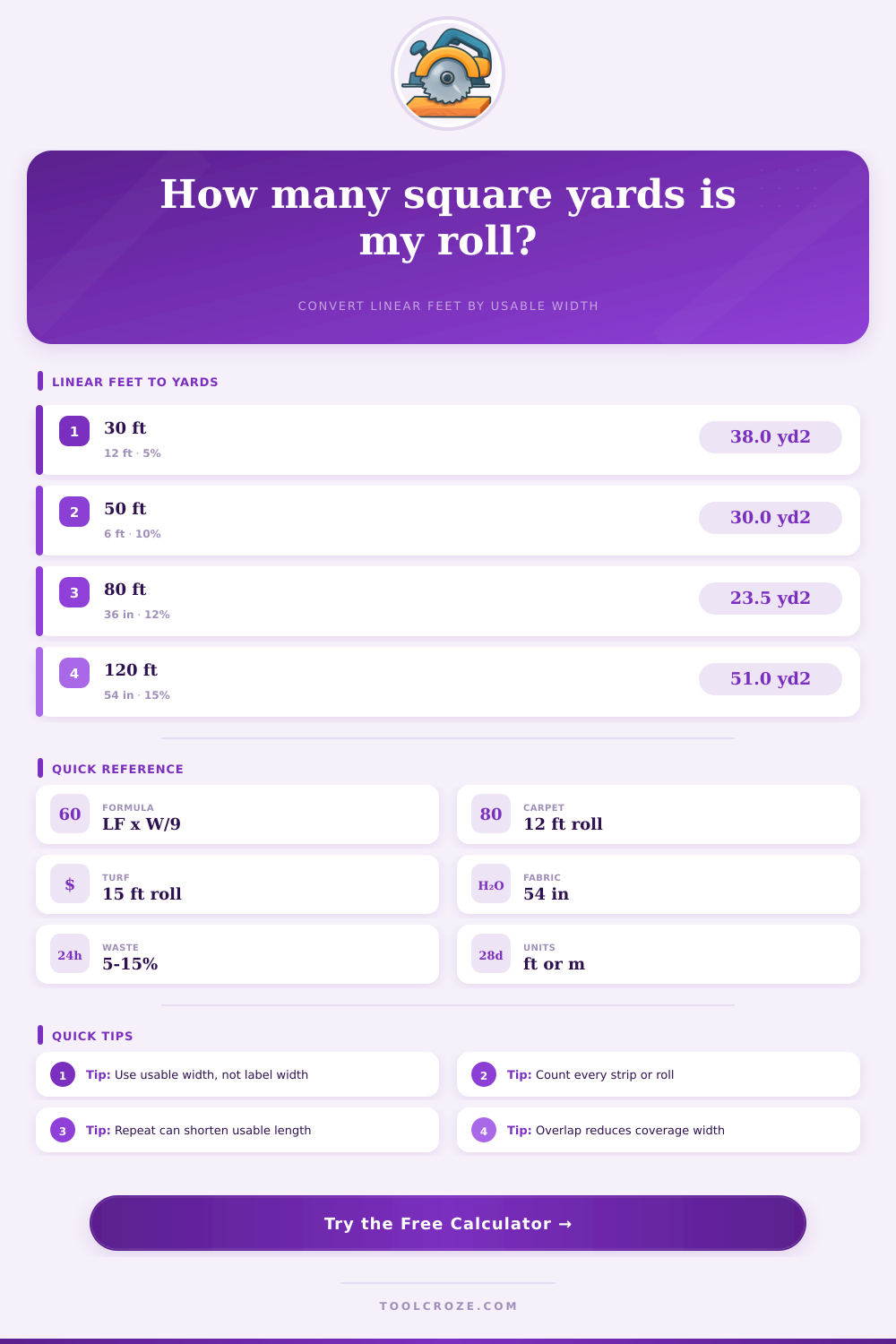
The number on the roll goods is often different than the area that can be installed. The reason for this difference are the potential for budget surprises. To calculate the usable area from the roll goods, you simply multiply the length of the material by the usable width of the material, then divide that number by nine to determine the area of the material in square yards.
How to Calculate Usable Area from Roll Goods
The usable width is often less than the width that is printed on the roll goods. The width can be less due to the loss of the width of the side laps, the loss of length due to the pattern repeats, and the loss of length at the ends of every strip of material. The calculator for roll goods account for these losses because it must account for both the gross area of the material and the area that is lost due to these factors.
The usable area of the material is essential to know if the material is expensive or if the project require high degree of accuracy in the placement of the material. For example, if the material is carpet, the length of the roll of carpet is not the same as the length of the area to be covered by the carpet due to the need to cut the carpet to allow for doorways. The same is true for artificial turf and wallpaper.
The material will not behave in the same way as a rectangle due to the physical properties of the material. The waste allowance must be adjusted for every project, but it is also a setting that many dont understand. A five percent waste allowance may seem small, but it must account for mistake in layout of the material.
A fifteen percent waste allowance may seem high for a project, but it may be necessary if the project include jogs in the room. The waste allowance that is used will change based off the other variables that are entered into the calculator. If you have already made the allowances for side overlap and pattern repeat, then the waste allowance can be less.
If you have not yet made the allowances for side overlap and pattern repeat, then the waste allowance must be higher. You can use the reference tables to compare roll goods of the same length but of different usable widths. A roll that is twelve feet in length and has a usable width of three feet may have a different price per linear foot than a roll that is twelve feet in length with a usable width of two feet.
The reference tables allow someone to determine the cost of the material with different usable widths without having to perform the calculations themselves. Finally, the roll goods calculator is not a tool that can account for the physical handling of the material. For instance, a roll of turf that is fifteen feet in width may be difficult to maneuver into a house that is being landscaped, despite the calculations made with the calculator.
A narrow roll of fabric may be easier to transport to a location that is to be covered with the fabric, but it may lead to more seams. Thus, no roll goods calculator can be used as a means of determining the physical requirements of the job; it doesnt take into consideration the conditions of the job site. Beyond ordering roll goods of the material that will be used in a project, the roll goods calculator can also be used to estimate the amount of material that will be needed for a project.
For projects in which the width of the area to be covered is approximate, it is often helpful to use the calculator to determine the effect of decreasing the usable width of the material. Additionally, it is also helpful in determining the effect of increasing the waste allowance for projects in which the pattern is particularly demanding of the material. These estimations can prevent any mistakes in ordering the material.
This calculator can be helpful in that it forces an individual to consider each of the variables that can impact the amount of roll goods that will be required for a project. By considering each of these variables, an individual can determine the difference between the roll of material that they thought would be needed for the project versus the actual roll that is needed. By understanding the difference between these two rolls, an individual will be able to remain within their budget for the project, and will avoid ordering too much of the material and experiencing an emergency reorder.