Linear Feet to Board Feet Calculator
Convert lumber linear feet into board feet using length, board width, thickness, quantity, waste, dressed or nominal sizing, species density, and unit mode.
▦Lumber Presets
Load a common lumber stack, then adjust the dimensions, board count, moisture, and waste factor for your actual takeoff.
⚙Lumber Inputs
Calculation Breakdown
▣Lumber Spec Grid
📋Reference Tables
| Formula | Use | Imperial Inputs | Notes |
|---|---|---|---|
| Board feet | Volume tally | thickness in x width in x length ft / 12 | Multiply by quantity, then apply waste. |
| Cubic feet | Weight and storage | board feet / 12 | A board foot is one twelfth of a cubic foot. |
| Face area | Coverage check | width in / 12 x total length ft | Useful for siding, decking, and shelving takeoffs. |
| Weight | Handling estimate | cubic feet x density | Moisture content changes the actual lifted weight. |
| Nominal Size | Dressed Actual | Board Feet per 8 ft | Board Feet per 12 ft |
|---|---|---|---|
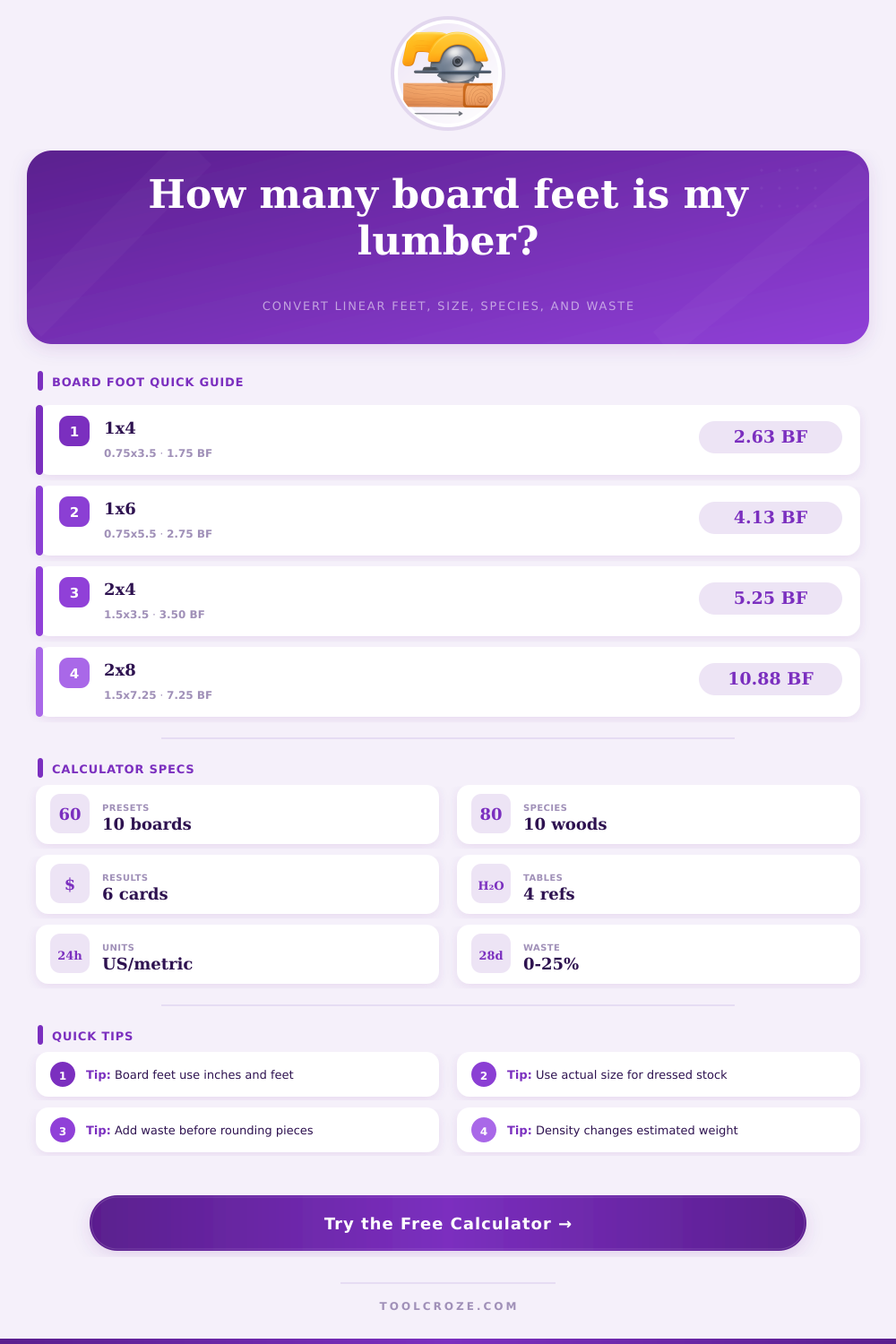
| 1x4 | 0.75 in x 3.5 in | 1.75 BF | 2.63 BF |
| 1x6 | 0.75 in x 5.5 in | 2.75 BF | 4.13 BF |
| 5/4x6 decking | 1.0 in x 5.5 in | 3.67 BF | 5.50 BF |
| 2x4 | 1.5 in x 3.5 in | 3.50 BF | 5.25 BF |
| 2x8 | 1.5 in x 7.25 in | 7.25 BF | 10.88 BF |
| 2x10 | 1.5 in x 9.25 in | 9.25 BF | 13.88 BF |
| Species | Typical Air-Dry Density | Use Case | Weight Note |
|---|---|---|---|
| SPF framing lumber | 28 lb/ft3 | Studs, plates, shop blocking | Light and common, varies by species mix. |
| Western red cedar | 23 lb/ft3 | Decking, outdoor boards, trim | Lightweight compared with most hardwoods. |
| Red oak | 44 lb/ft3 | Trim, furniture, stair parts | Dense boards add weight quickly by board foot. |
| Hard maple | 44 lb/ft3 | Benches, tops, cabinet parts | Similar weight class to red oak. |
| Black walnut | 38 lb/ft3 | Furniture and specialty stock | Rough boards are often tallied by board foot. |
| Ipe | 69 lb/ft3 | Dense exterior decking | Very heavy; check handling and support limits. |
| Waste Range | Best For | Typical Trigger | Calculator Effect |
|---|---|---|---|
| 0% to 5% | Exact tally or straight boards | Minimal trimming, stable sizes | Small addition to base board feet. |
| 8% to 10% | General shop and framing use | End cuts, knots, minor defects | Good default for common lumber stacks. |
| 12% to 15% | Furniture parts and visible faces | Grain selection, color matching | Raises order board feet before rounding. |
| 20% to 25% | Rough stock or heavy defects | Checks, sapwood, crooked boards | Use when yield is uncertain. |
ℹBoard Foot Tips
To determine how much lumber you need to purchase from the lumber yard, you must determine the exact amount of lumber you want to purchase. Many people will begin to think about how much lumber they needs for there projects. However, many people will become confused by the measurements of lumber, specifically linear feet, board feet, and waste.
Linear feet and board feet is two different measurements of lumber. To understand lumber measurements, you must understand the difference between linear feet and board feet. Linear feet will tell you the length of the lumber that you need for your project.
How to Figure Out How Much Lumber You Need
Board feet will tell you the volume of lumber that you need. If you purchase the lumber but do not calculate the volume properly, you might have to go back to the lumber yard to purchase more lumber. Alternatively, you might buy too much lumber for your workshop project.
Linear feet is the measurement of the length of lumber that you need. This is a useful measurement if all of the lumber has the same thickness and the same width. Board feet is the measurement of the thickness and the width of the lumber.
This is a more detailed measurement that allows lumber buyers to calculate the volume of lumber that they will recieve from the lumber yard. For example, an eight-foot 2×4 can contain 5.25 board feet of lumber. You calculate this by taking the three dimension of the 2×4 and dividing it by twelve.
If you change the thickness or the width of the lumber, the measurement of board feet will change. Therefore, two stacks of lumber that appear to be the same might not have the same number of board feet. Many builders need to know the difference between the nominal dimensions of lumber and the actual dimensions of the lumber.
The nominal dimensions of lumber are the measurements that are printed on the price tag of the lumber. The actual dimensions of the lumber are the measurements of the lumber after it has been planed and dried. If you use the nominal dimensions in your lumber calculations, you might end up with an incorrect amount of lumber for your project.
You must decide whether you will use the nominal dimensions or the actual dimensions for your lumber tally calculator. Accurate lumber tallies will allow you to understand the wood grain of the lumber you are planning to purchase. Additionally, accurate lumber tallies will allow you to calculate the total weight of the lumber you are buying.
A third measurement that you must consider when purchasing lumber is the waste allowance. Waste allowance is the percentage of lumber that you will have to purchase that might have defects in it that will render part of the lumber unusable for your project. Five percent waste allowance is a good allowance for framing lumber.
However, five percent waste allowance might not be enough for hardwood that you will use for tabletops. If you use a small allowance of waste for your hardwood, you might run out of hardwood for your project. Fifteen percent waste allowance will ensure that you have enough lumber for your project, even if some of it has defects.
By using a waste allowance calculator, you can see how the order quantity might change before you purchase the lumber from the lumber yard. The density of the wood species that you purchase from the lumber yard will impact the total weight of the lumber. The weight of the lumber will impact the lumber buyer in terms of how much lumber they can store in their workshop.
For example, heavy wood species like ipe or hard maple will weigh alot when you have many board feet of it. In this case, the buyer will have to plan their lifting equipment for the lumber and the capacity of the floor structures in their workshop. The moisture content of the lumber will also play a role in the weight of the lumber.
If the lumber that you order is straight from the kiln, it will have less water in it than wood that is air-dried. Therefore, the moisture setting in the lumber calculator will impact the weight of the lumber that you order from the lumber yard. When you purchase lumber for a project that requires the lumber to cover a surface, you will need to calculate the face area that the lumber will cover.
The face area will allow you to calculate how many square feet that the lumber will cover for your project. When you purchase lumber, it will not be the exact size of the lumber. When you joint the lumber, it will change the width of the lumber.
Therefore, when you calculate the face area of your lumber, you will have to take into account the width of the lumber after it is jointed. The reference tables on this page will show common conversions from nominal lumber dimensions to actual lumber dimensions. Another set of reference tables will show the densities of the wood species that you might purchase from the lumber yard.
These reference tables will also show the waste percentages that will make your total lumber purchase be the quantity you order. These reference tables will allow you to decide whether you would like your lumber to be custom lengths or standard lengths from the lumber yard. Finally, you should run the lumber calculator twice to ensure the accuracy of your calculations.
First, calculate the amount of lumber using the dimensions that you think that you have for your project. Then, calculate the amount of lumber that you need using the actual dressed dimensions of the lumber and a waste allowance that you plan to use for your project. By calculating the lumber twice, you can ensure that you order the correct amount of lumber for your project.
If you use board feet as a lumber planning tool, you will reduce the gap between the amount of lumber you order from the lumber yard and the amount of lumber that you end up using for your project.