57 Limestone Gravel Calculator
Estimate #57 limestone project volume, drainage base, compaction allowance, waste, bulk tons, cubic yards, and bag counts from real site dimensions.
#57 Limestone Material Estimate
| Preset | Typical footprint | Main depth | Base depth | Allowance |
|---|---|---|---|---|
| Garden Walkway Base | 20 ft x 4 ft | 3 in | 0 in | 8% waste |
| Paver Patio Bedding | 12 ft x 16 ft | 4 in | 2 in | 10% waste |
| Light Driveway Top | 50 ft x 10 ft | 4 in | 0 in | 12% waste |
| Driveway Drainage Base | 60 ft x 12 ft | 6 in | 3 in | 12% waste |
| French Drain Fill | 80 ft x 1 ft | 18 in | 0 in | 15% waste |
| RV Parking Pad | 35 ft x 12 ft | 6 in | 4 in | 15% waste |
| Measure | Formula | Typical #57 value | Use in calculator |
|---|---|---|---|
| Cubic feet | Area x depth | Project ft³ | Raw volume before yards |
| Cubic yards | ft³ / 27 | Bulk order unit | Main output volume |
| Tons | yd³ x density | 1.30 to 1.40 tons/yd³ | Bulk stone weight |
| Bags by volume | order ft³ / bag ft³ | 0.4 to 0.5 ft³ | Small project count |
| Bags by weight | total lb / bag lb | 40 to 50 lb | Checks volume bags |
| Application | Main #57 layer | Drainage base | Planning note |
|---|---|---|---|
| Walkway or garden path | 2 in to 3 in | 0 in to 2 in | Use fabric over soft soil |
| Paver patio | 3 in to 4 in | 2 in to 4 in | Confirm paver system requirements |
| Residential driveway | 4 in to 6 in | 3 in to 6 in | Increase depth for weak subgrade |
| Drain trench | 12 in to 24 in | 0 in | Keep stone clean and wrapped |
| Retaining wall backfill | 12 in zone | As designed | Follow wall engineer details |
| Output | Best rounding | When to use | Check before ordering |
|---|---|---|---|
| Cubic yards | Round up to 0.25 yd³ | Small bulk pickup | Truck or trailer rating |
| Tons | Round up by load increment | Quarry or yard delivery | Scale ticket units |
| Bags | Whole bags only | Repairs and small pads | Bag volume and weight |
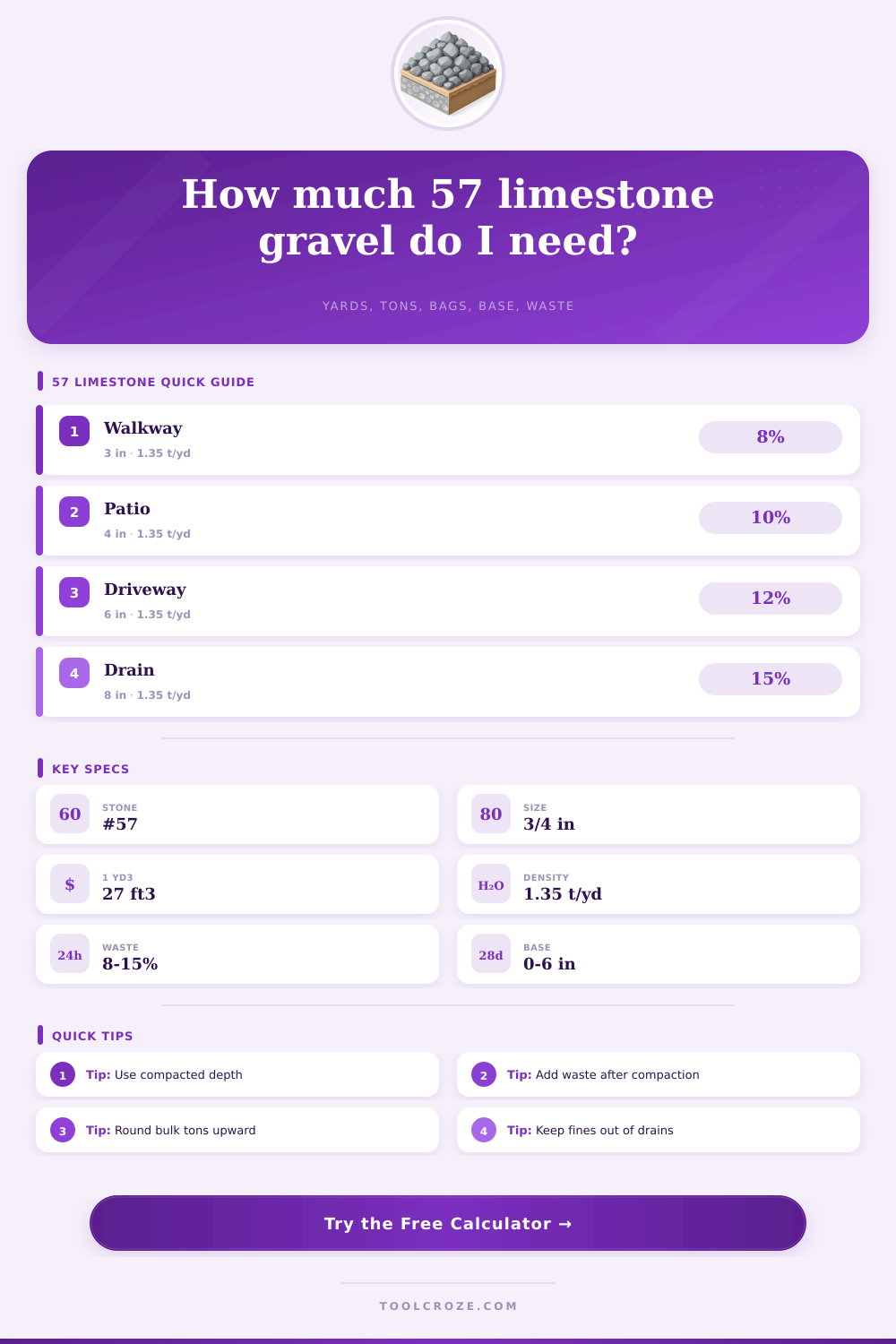
| Waste factor | 8% to 15% | Overdig, edges, grade loss | Irregular area shape |
I think one of the mistakes people make at home improvements is not knowing how much gravel to order. Measure the length, eyeball the width, choose a depth that seems right on paper. Wait for the dump truck. Halfway into spreading, the load are exhausted and there’s a patch that doesn’t seem finished. It’s not about choosing which stone color to get; it’s about figuring out volume before you call the supplier so you avoid that frustration. Once you know those dimension, just plug ’em into this handy calculator (above) and let it do the math.
It will take your lengths, widths, and depths and turn them into tons and cubic yards. No more guessing at conversion factors or coefficients. But again, it is only as good as the assumptions it makes.
How to Calculate the Right Amount of Gravel
Gravel isn’t solid ground, and most people assume it is. A pile of gravel are really a bunch of voids between the rock that shifts with weight. The biggest factor here is depth, since you have to determine whether your measurement is for loose-poured depth, or what it’s going to be once it’s compacted. The calculator assumes you’re looking for finished depth and then throws in a little compaction allowance. Limestone settles, which means if you don’t plan for it, your nice 4″ layer turn out to be 3″ after the first rain storm.
There’s another hidden variable at play: density. Depending on how wet the crushed stone is when it arrives and where it was sourced from, it might have different densities. Number fifty-seven limestone is typically estimated to be about one point three five tons per cubic yard. This assumes an average bulk weight for that type of limestone, which is only accurate if it correctly balance the weight of the rocks and the amount of air between them. If your local quarry produces a denser aggregate different than that, then you’ll need more tonnage even though you may use exactly the same volume. A slight variation in the assumed density versus what your supplier provides can result in ordering either half a ton too little or half a ton too much. Check carefully what density they’re assuming and see whether it matches actual delivery.
That’s where waste comes in: Seems like an afterthought? Not so much. First off, real driveways aren’t perfect rectangles. There is slopes for drainage and curves with even more slopes. They also meet curbs in all sorts of awkward ways. Add a certain percentage for waste to your calculations above to cover these gaps and extra amounts. Maybe eight percent will do if it’s just a simple garden path, but on a complex patio with irregular borders twelve or even fifteen percent would be wiser. Better to come away with a little bag too many than go back out to the yard.
But you will layer differently depending off what you are building too. Angular stone packs and holds up to tire pressure (like a driveway), while clean stone allow water to seep through (as in a french drain). Both work well with number fifty-seven, a correct combination of coarse aggregate and fines. The larger stuff give it structure; the smaller stuff helps it bind. The page includes a reference table laying this all out by use as well as depth. You can see from this that a pad for an RV would require six inches or more (it’s going to be carrying a lot of weight) while a walkway could get away with just three. This is why there are guidelines…because we’ve seen where it fails, and the thinner the layer, the less it hold up under point loads. The thicker the layer, the more unnecessary and expensive it is.
For minor fixes, bulk delivery is overkill. For instance, a delivery truck might be more than necessary, but that doesn’t mean you don’t need a few bag. The calculator will turn your desired amount into an estimated number of typical 50-pound bags. It will also check the weight just in case you are dealing with something denser or less dense. It will let you know if you have underestimated what will fit in the back of the trailer or truck.
With gravel, it’s all about the material (and expectations) to make a surface that lasts while remaining non-muddy. How much gravel? Use enough to reach a clean finish, but not so much that you would of had to scramble at the end; it’s the difference between a DIY mess and a job you’re proud of. First, measure correctly; second, build in some allowance for settlement and waste; third, rely on the numbers. Give your stone room to breathe and let it do the rest.