Landscape Aggregate Calculator
Estimate decorative rock, gravel, decomposed granite, mulch, weed fabric overlap, edging loss, compaction, waste, bags, tons, and cubic yards for garden beds or paths.
🌱Real Garden Presets
📏Calculator Inputs
Landscape Aggregate Estimate
🪨Landscape Material Grid
📊Depth Guide by Landscape Use
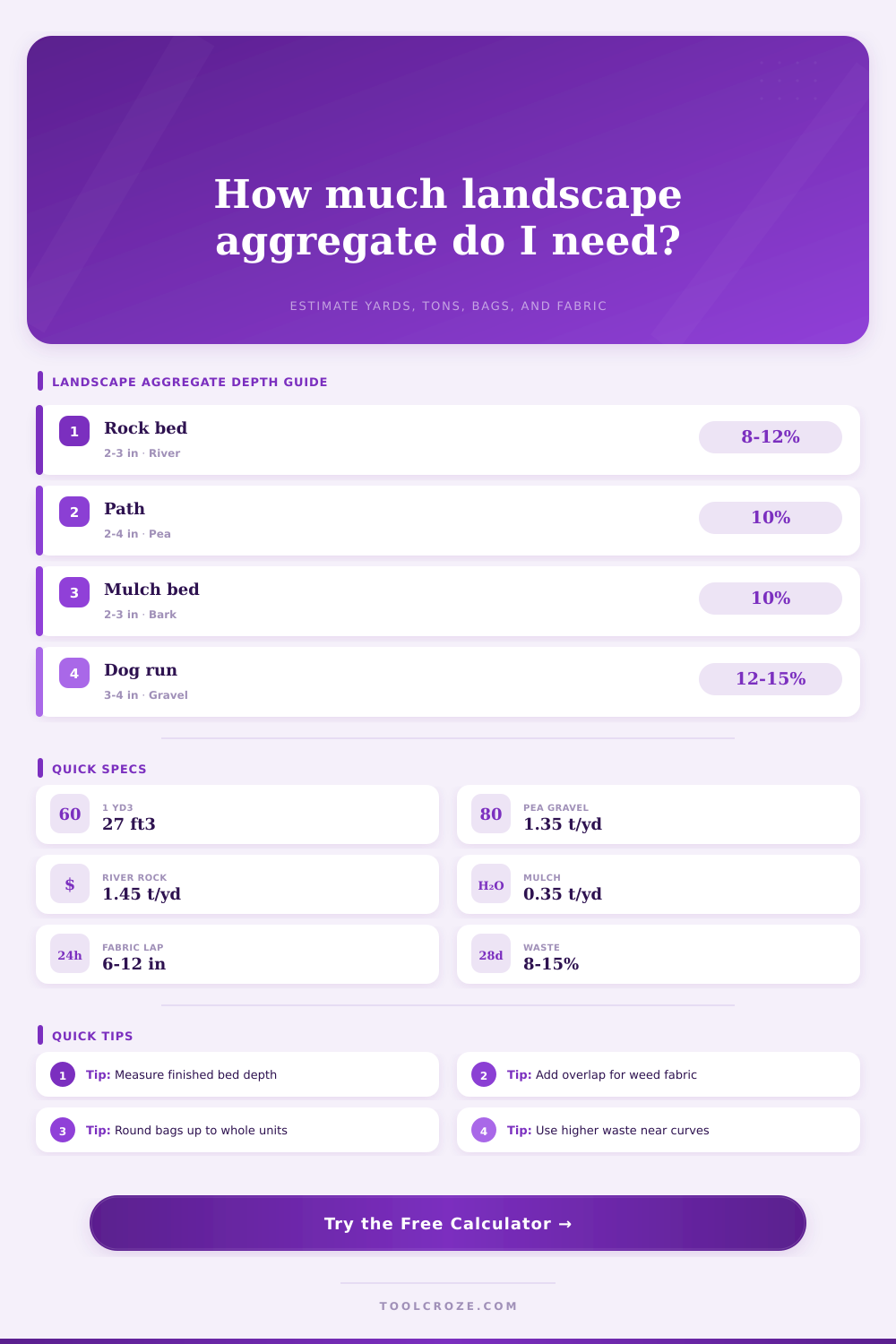
| Landscape use | Typical depth | Best material size | Planning allowance |
|---|---|---|---|
| Decorative rock bed around shrubs | 2-3 in | 3/4 to 2 in washed stone | 8-12% waste plus edging loss |
| Garden path with casual foot traffic | 2-4 in | 3/8 pea gravel or DG | 10-15% for compaction and raking |
| Dry creek or swale accent | 4-8 in | Mixed river rock sizes | 15-20% for irregular placement |
| Mulch over weed fabric | 2-3 in | Bark mulch or wood chips | 8-12% for settling |
| Dog run or utility strip | 3-4 in | Pea gravel or crushed gravel | 12-15% for compaction |
⚖Material Density Reference
| Material | Common stone size | Bulk density | Best calculation use |
|---|---|---|---|
| Pea gravel | 3/8 in rounded | 100 lb/ft³ | Paths, dog runs, drainage beds |
| River rock | 1-2 in rounded | 108 lb/ft³ | Decorative beds and dry creeks |
| Crushed gravel | 3/4 in angular | 105 lb/ft³ | Firm walks, utility pads, edging zones |
| Decomposed granite | Fines to 3/8 in | 95 lb/ft³ | Compacted paths and side yards |
| Lava rock | 3/4 to 1-1/2 in | 50 lb/ft³ | Light decorative beds |
| Bark mulch | Shredded | 26 lb/ft³ | Shrub beds and tree rings |
🛍Bag Coverage Reference
| Bag size | Approx volume | Coverage at 2 in | Coverage at 3 in |
|---|---|---|---|
| 0.5 ft³ stone bag | 0.019 yd³ | 3.0 ft² | 2.0 ft² |
| 0.75 ft³ stone bag | 0.028 yd³ | 4.5 ft² | 3.0 ft² |
| 1.0 ft³ mulch bag | 0.037 yd³ | 6.0 ft² | 4.0 ft² |
| 2.0 ft³ mulch bag | 0.074 yd³ | 12.0 ft² | 8.0 ft² |
| 50 lb gravel bag | about 0.5 ft³ | 3.0 ft² | 2.0 ft² |
🧵Weed Fabric and Edging Reference
| Planning item | Typical value | When to increase | Calculator input |
|---|---|---|---|
| Fabric seam overlap | 6-12 in | Loose stone, slopes, or many seams | Fabric seam overlap |
| Fabric roll width | 3-6 ft | Wide beds where fewer seams help | Weed fabric roll width |
| Edging trim/spill | 2-8% | Curved beds or hand-placed rock | Edging trim allowance |
| Compaction | 5-20% | DG, angular gravel, or walked paths | Compaction allowance |
| Irregular bed waste | 10-20% | Tree roots, slopes, plants, dry creek bends | Waste allowance |
💡Estimating Tips
Landscape material ordering is an exercise in regret. You almost always regret it within an hour or two of the dump truck’s arrival. This happens after you discover that you ordered enough pea gravel to build a small mountain, or barely enough to fill half of the path. Stone volume is not forgiving mathematics. A cubic yard may sound like a lot, but then you attempt to distribute it across a broad bed three inches deep…and you’re left wondering how many times you will need to make that trip to the garden center. We all eyeball it; we all get it wrong. Twice.
Enter the calculator. This one do the hard work for you, turning your back-of-the-napkin sketches into precise bags and exact tons. Knowing what those numbers mean helps you save much more then another shopping trip.
Why You Need a Landscape Calculator
Don’t forget compaction: This is probably the largest pitfall in landscape math. Rock settles. Decomposed granite packs down when you rake it. That’s why the tool includes an allowance for compacted material, typically between five and twenty percent (depending on what kind of stone). That means that if you’re doing a path that will get stepped on, you’ll need all of that space. Otherwise, you’ll end up with a half-finished looking path after only a few days of walking and rain. Why? Because stone moves. Yes, I said it. It settles, it moves, it fills the spaces between big rocks. The waste allowance deals with some of that reality.
Beds that are curved take more stone than rectangular ones. There are cuts to make around curves. You spill material when edging and lose bits to uneven ground. Ten to fifteen percent for waste isn’t being negative.
Another thing that trips up DIYers is density. A cubic yard of river rock (about 3,000 lbs.) weigh vastly more than a cubic yard of bark mulch (around 350 lbs.). Knowing the difference between the light, airy feel of wood chips and the heavy, dense nature of crushed gravel helps you plan not just what you buy, but how you move it. The calculator converts volume to weight based off density, key, since you’re paying by the ton, not by the yard. Order by volume without knowing its density, and you may find yourself surprised come delivery day, as the driver inquires whether you own a crane.
What’s the difference between the heavy, dense quality of crushed gravel versus the lighter, airier one of wood chips? That’s part of planning not only what you purchase, but also how you’ll move it.
One more thing: weed fabric. Most people don’t think beyond “throw some over the dirt”. Beyond throwing it over the dirt, there are seams to contend with. So what do you do if your bed is wider than your roll of fabric? You overlap the edges! The longer the width of your bed, the faster those six inches will add up. Enter your bed dimensions and desired overlap, and this tool will calculate the fabric for you. This way, you won’t run out of fabric halfway across the yard which ruins a clean finish. It will even give you an estimate of edging length, so you can plan how many yards of border stuff you’ll want.
Little details like these is what separates looking professional from looking like, “oh yeah, I did this…”
Depth matters, as in how thick you mulch, which is partly aesthetic and partly functional. Two inches of mulch is sufficient for moisture retention, but three inches gives a cleaner, more uniform appearance that hides soil stains. Three inches is cleanest and most even, concealing any stains on the soil beneath. For pathways: To avoid getting mud all over my hands and feet, I make paths deeper. This stops the gravel from mixing with the soil below. Mixing them would turned the path into mud. So: The chart at left, really just a guideline, not hard-and-fast law, is a reminder of what works where. No need to under-mulch, or overpave!
At the end of the day, aggregate is all about control. It is about making texture, establishing edges, and defining the ground. But how can you shape something if you don’t know what it is? Knowing the measurements will help you save money by avoiding waste. It will also help you estimate accurately and lessen the physical task of carrying around extra materials. After all, who wants their yard to appear rushed, instead of finished? Getting the math correct before breaking ground means getting exactly what you envisioned to the very last bag. A little bit of up-front time invested should of paid off big later on with a more precise, clean-looking landscape.