Lag Screw Withdrawal Calculator
Estimate NDS-style lag screw withdrawal from wood specific gravity, shank and thread diameter, threaded penetration, service factors, and screw group demand.
Lag screw withdrawal results
| Wood species or product | Typical G | Relative withdrawal | Notes for lag screws |
|---|---|---|---|
| Western Red Cedar | 0.32 | Low | Use longer penetration and watch crushing. |
| Spruce-Pine-Fir | 0.42 | Baseline | Common framing and deck ledger substrate. |
| Douglas Fir-Larch | 0.50 | Medium-high | Good beam and header reference species. |
| Southern Pine | 0.55 | High | Dense latewood can need careful pilot holes. |
| Red Oak | 0.63 | Very high | Pre-drilling is especially important. |
| LVL or dense engineered lumber | 0.58 | High | Confirm manufacturer fastening limits. |
| Nominal lag screw | Shank D | Approx. thread root | Common use range |
|---|---|---|---|
| 1/4 in | 0.250 in | 0.175 in | Light brackets and trim blocking |
| 5/16 in | 0.313 in | 0.219 in | Small cleats and shelf rails |
| 3/8 in | 0.375 in | 0.263 in | Beam hangers and track rails |
| 1/2 in | 0.500 in | 0.350 in | Deck ledgers and heavy brackets |
| 5/8 in | 0.625 in | 0.438 in | Post bases and large hold-downs |
| 3/4 in | 0.750 in | 0.525 in | Timber hardware and heavy framing |
| Adjustment | Calculator input | Typical range | What it changes |
|---|---|---|---|
| Load duration CD | Permanent to wind | 0.90 to 1.60 | Shorter load duration increases adjusted value. |
| Wet service CM | Dry to wet | 1.00 to 0.70 | Moisture reduces the withdrawal estimate. |
| Temperature Ct | Normal to hot | 1.00 to 0.80 | Sustained heat can reduce wood fastener values. |
| Grain condition | Side, sloped, mixed, end | 1.00 to 0.67 | End grain and angled grain reduce reliability. |
| Pilot-hole quality | Correct to oversized | 1.00 to 0.75 | Poor drilling changes thread bite and split risk. |
| Named application | Common wood | Typical lag | Withdrawal check focus |
|---|---|---|---|
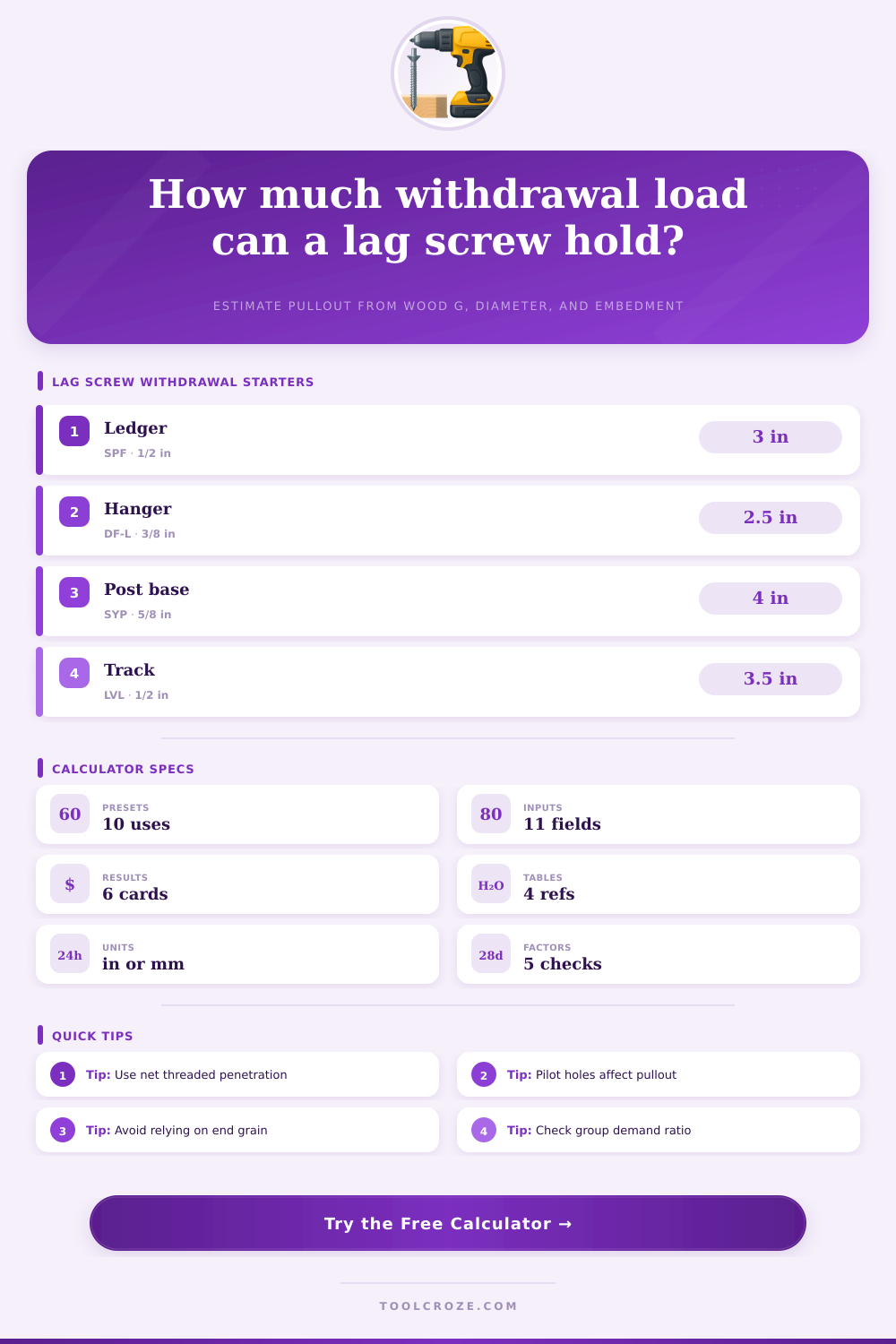
| Deck ledger to rim joist | SPF or Hem-Fir | 1/2 in x 3 in embed | Group demand and wet-service factor |
| Glulam beam hanger | Douglas Fir-Larch | 3/8 in x 2.5 in embed | Bracket uplift and edge distance review |
| Pergola post base | Southern Pine | 5/8 in x 4 in embed | Wind uplift and group efficiency |
| Barn door track header | LVL or DF-L | 1/2 in x 3.5 in embed | Rolling load eccentricity and pilot fit |
| Dock cleat blocking | Southern Pine | 1/2 in x 3 in embed | Wet service and short duration pulls |
Lag screw withdrawal calculator quickens shop connection inspection by estimating withdrawal capacity based off service factors, thread penetration, shank diameter, and wood specific gravity.
Stood beside a ledger or a beam holding some lag screws in your hand thinking the screws arent going to hold because the load is pulling them straight out? There’s a difference between shear strength and withdrawal strength. A screw can resist lateral forces but slip out because the threads isnt gripping the wood fibers anymore. Before hammering that first fastener, know the numbers.
How to Use Lag Screw Withdrawal Calculator
Specific Gravity is the core of the math: Hardwoods such as Southern Pine at 0.55 has tighter, denser fibers that grip well; soft woods such as cedar at 0.32 have less material for the threads to bite into. That’s only part of the story. How long do you have buried in the main member? Enough length of thread. The calculator subtracts a realistic tip allowance so you dont count the pointed tip as full thread engagement. Three inches of thread in six inches of screw isnt as good as having six full inches of bite. That makes the difference between safe connections and those that loosen with time.
Diameter plays two roles. Larger shanks increase withdrawal resistance roughly to the three-quarter power, which means you get decent gains without jumping to ridiculus sizes. It also must correspond to the diameter of the hole you drill. If you are not careful, you can split the wood, particularly in a dense piece of engineered lumber or oak. Too big a hole lets the threads cut less wood so capacity drops quicker than most think. The sweet spot sits around half the thread diameter for many species, though exact target shifts with density. Getting this one right will mean a connection that either lives up to the math or lets you down on the jobsite.
Strength values are based on service conditions. So that dry bracket inside your house may be rated to carry full value. Put the same connection outside in the elements where it will see moisture cycles and youll drop off something noticeable. Long-term exposure to temperatures over 100 degrees Fahrenheit will do similarly. You’ll also want to adjust the picture according to how long any given load is expected to last. Seismic events or wind allow you to apply a greater factor since these loads occur very quickly; whereas a permanent dead load requires more conservative numbers. And all of this stacks. That’s why one connection can appear strong on paper and then you multiply by everything and suddenly its sitting right up against the edge.
And then there’s grouping (adding a whole other layer). It’s not necessarily four times as strong if you use four screws rather than one; the intervening piece of wood might split or be crushed by their collective force. Up through perhaps eight fasteners the reduction isnt too bad, but it increases rapidly thereafter. Even at withdrawal-only check, spacing matter, and edge distance and end distance do as well. The calculator incorporates a simple grouping factor that prevents you from seeing the rosy straight-line sum; you get to see what the actual total should be. That’s usually enough to explain why your seemingly adequate connection, upon further sketching, now requires that extra screw or that bigger diameter.
End grain remains the quiet troublemaker. Everybody knows not to use it, but there’s still alot of gate hinges, post bases, deck ledgers and more out there relying on end grain anyway. It reduces severely, in some cases to only two-thirds the capacity of side grain, and loosens up quicker when subjected to moisture changes or vibration. When the calculator alerts you to any end-grain conditions, consider it a yellow light, not a green one. Running the numbers past a structural engineer will make you sleep better than hope the wood holds.
No calculator takes into account real-world conditions; Real projects rarely match the idealized conditions in any calculator. Outside the math is wood moisture content when installed, the cleanliness of the pilot hole drill, and whether the threads are fully formed or slightly burred from driving. For this reason, I consider the tool a sort of screening device, it will tell you immediately whether your original thought is in the ballpark, or if you should increase a size, add some fasteners, or switch to a different species. From there you can layer on the practical checks no software sees: How does the load transfer through the ledger or bracket? Are there knots or checks present? What’s the slope of the grain at the hole?
Run those changes and watch how quickly the demand ratio spikes. That exercise teaches you, in real time, what matters most and what doesnt on your specific job. You’ll begin to see that penetration and wood density tend to have more impact than using a slightly bigger screw, or that pilot-hole quality can erase the benefit of switching from Douglas fir to Southern pine.
Simple fasteners called lag screws deserve our respect. When they’re driven home they look stout; they feel like they’re strong… but their real strength lies in the invisible grip between thread and fiber. Knowing what controls that grip means we go to work with confidence, not guesswork. Drill the pilot holes carefully; run the numbers; understand the adjustments, because the connection relies on all these things. And then know that when you drive those screws home, the math already did the worrying for you.