Labyrinth Seal Leakage Calculator
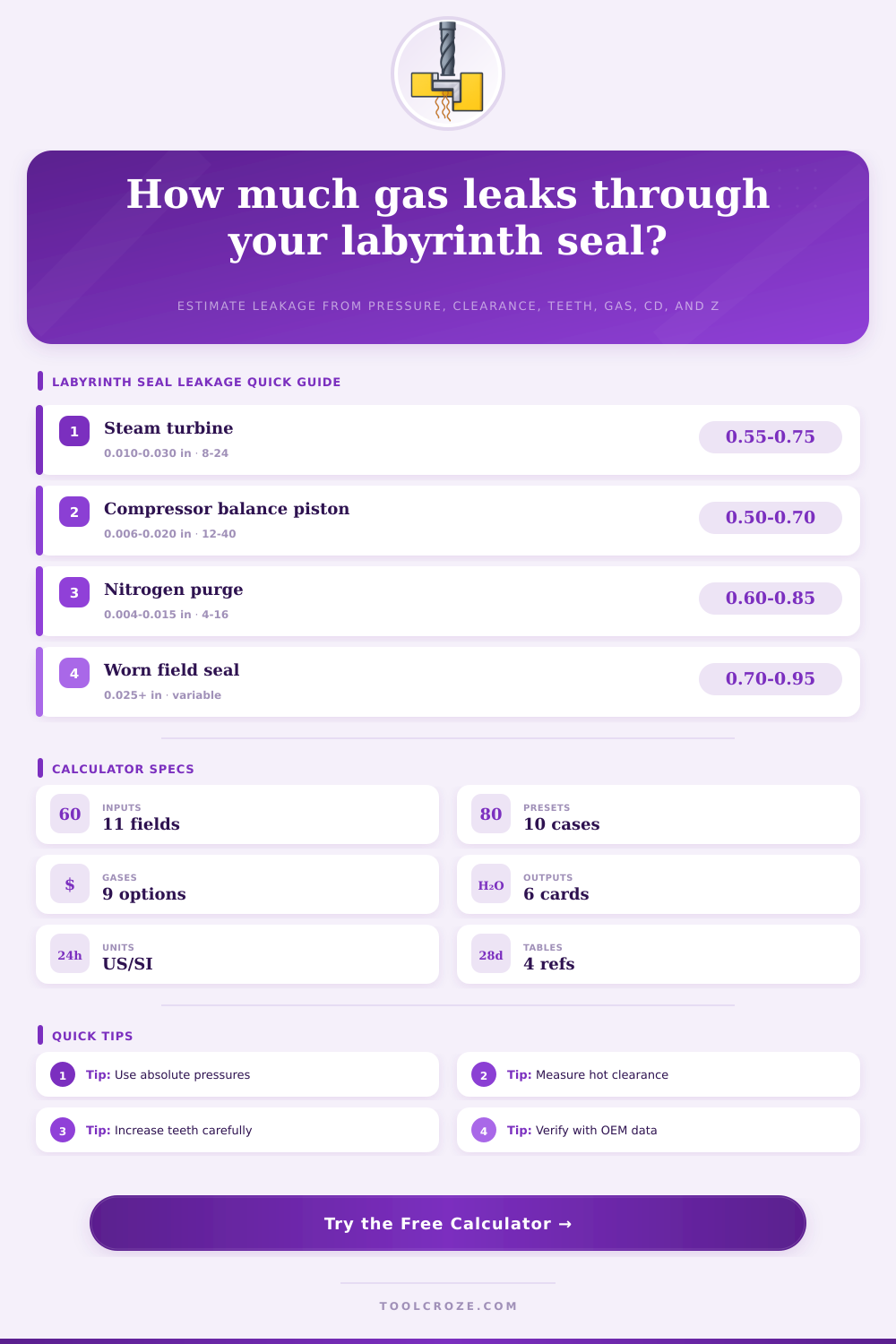
Estimate compressible gas leakage through a straight-through or stepped labyrinth seal using inlet and outlet pressure, gas properties, temperature, clearance, teeth, diameter, discharge coefficient, and compressibility factor.
01 Seal Presets
Pick a common seal case, then overwrite the values with measured clearances, actual pressures, and the gas used in your machine.
02 Leakage Inputs
Calculation Breakdown
03 Seal Geometry Snapshot
04 Reference Tables
| Gas | R, J/kg-K | Gamma | Notes |
|---|---|---|---|
| Air | 287 | 1.40 | Default for shop air, bearing air, and many purge estimates. |
| Steam | 462 | 1.30 | Use superheated condition when possible; wet steam needs specialist review. |
| Hydrogen | 4124 | 1.41 | Low density gives high volumetric leakage; strict safety controls apply. |
| CO2 | 189 | 1.29 | Compressibility can vary strongly near dense phase conditions. |
Gas constants are screening values. Use project fluid properties for final engineering work.
| Seal pattern | Carryover factor | Typical use | Leakage comment |
|---|---|---|---|
| Straight-through | 1.00 | Simple glands | Baseline leakage with higher kinetic carryover. |
| Stepped or staggered | 1.18 | Turbines and compressors | Usually improves throttling for the same tooth count. |
| Honeycomb or swirl brake | 1.32 | Stability-sensitive rotors | Can reduce leakage and improve rotordynamic behavior. |
| Worn rounded teeth | 0.76 | Field-run seals | Higher Cd and lower tooth effectiveness are common. |
| Clearance guide | Small shaft | Medium shaft | Large shaft |
|---|---|---|---|
| Tight new build | 0.003-0.008 in | 0.006-0.014 in | 0.010-0.020 in |
| General industrial | 0.006-0.014 in | 0.010-0.025 in | 0.018-0.040 in |
| High heat or rub margin | 0.010-0.020 in | 0.018-0.035 in | 0.030-0.060 in |
| Worn inspection trigger | Above target by 50% | Trend leakage | Inspect teeth and rotor runout |
| Result check | Low | Moderate | High |
|---|---|---|---|
| Pressure ratio Pin/Pout | Less than 2 | 2 to 5 | Above 5 or choked |
| Mach screen | Below 0.35 | 0.35 to 0.75 | Above 0.75 |
| Clearance ratio c/D | Below 0.25% | 0.25% to 0.75% | Above 0.75% |
| Action | Verify tolerance | Review heat and wear | Confirm with CFD, test, or OEM method |
05 Practical Tips
Labyrinth seal are components that are situated between rotating shafts and stationary housings in machines such as turbines, compressors, and pumps. Labyrinth seals is designed to throttle the amount of gas that will leave the seal, but labyrinth seals will never completely stop the gas from leaking out of the seal. The gas will travel through the narrow annular path that is established between each tooth of the labyrinth seal.
The amount of gas that passes through the labyrinth seal is dependent upon the inlet and outlet pressures, the temperature of the system, the clearance between the labyrinth seal components, the number of teeth included in the labyrinth seal, the properties of the gas that passes through the labyrinth seal, and the way in which the cavities between the teeth of the labyrinth seal dissipate the kinetic energy that is created by moving machine. If a person chooses the wrong number of teeth for the labyrinth seal or if the clearance is set to the wrong value, then the labyrinth seal will either allow too much gas to exit the labyrinth seal, or it may become too complex and costly to construct. In order to operate the labyrinth seal calculator, a person must input the inlet pressure for the labyrinth seal, the outlet pressure for the labyrinth seal, the temperature of the labyrinth seal, the clearance between the labyrinth seal components, and the number of teeth for the labyrinth seal.
Labyrinth Seals: How They Work and How to Use the Calculator
Additionally, that person must also select a pattern choice for the labyrinth seal. Each pattern choice will impact the dissipation of the kinetic energy created by the machine. For example, choosing a honeycomb pattern will cause the labyrinth seal to dissipate more kinetic energy than if the labyrinth seal has worn and rounded teeth.
The discharge coefficient and the compressibility factor for the gas within the labyrinth seal must also be entered into the calculator. The labyrinth seal calculator will provide a number of different outputs from the inputs that the designer of the labyrinth seal requires. For instance, one output will calculate the mass flow of gas that crosses the labyrinth seal.
Additionally, a number of other outputs will allow a designer to calculate the volumetric flow, determine the leakage class of the labyrinth seal, calculate the pressure that is applied to each tooth of the labyrinth seal, calculate the velocity of the gas as it exits the labyrinth seal, and a number of other features. Clearance is one of the variables that most people will underestimate when designing a labyrinth seal. When a person first installs a labyrinth seal, the clearances will be small.
However, over time, due to thermal growth and rubs between components of the machine, the clearances will expand to the point that the labyrinth seal is no longer performing as it was designed to perform. Thus, it is important to use the labyrinth seal calculator to determine how the clearance will affect the area through which the gas can pass, and to understand that if the clearance is doubled, for instance, the area through which the gas can pass will also be doubled. Thus, it is important to use field measurements of the clearance when the labyrinth seal is operating at full speed (hot running clearance) instead of the clearances when the labyrinth seal is not rotating (cold clearance).
Each additional tooth that is included in the labyrinth seal will create diminishing returns beyond a certain point. Each additional tooth improves the throttling of the gas within the labyrinth seal, but the cavities between each tooth must be sized in a way that does not allow for the kinetic energy of the gas to be carried over from one tooth to the next. If the labyrinth seal has a pitch that is too tight, or if the teeth are worn, there will be diminishing returns to adding more teeth to the labyrinth seal.
The pattern factor within the labyrinth seal calculator accounts for this diminishing return. For example, straight teeth will have less resistance to the movement of the gas through the labyrinth seal than teeth that are staggered or in the honeycomb pattern. The properties of the gas will have a greater impact on the outcome of the labyrinth seal calculator than most engineers appreciate when they are switching from air to hydrogen or steam as the gas.
Hydrogen gas is much less dense than air, and has a high specific gas constant. Thus, for the same pressure drop across the labyrinth seal with the same clearances, more hydrogen gas will flow than air. Steam behaves similarly to an ideal gas at modest superheat temperatures, but the compressibility of steam decreases at saturation temperatures.
Thus, in addition to using the gas selector for the constants for steam, it is also important to review the steam tables to ensure that the steam data is entered into the labyrinth seal calculator. The pressure ratio will determine if the gas that is moving through the labyrinth seal reaches a choked state. Once the outlet pressure ratio reaches the critical ratio, the outlet pressure will no longer have any impact on the mass flow of the gas through the labyrinth seal.
This information can be used to determine if the last few teeth of the labyrinth seal are performing any useful work. High ratios will also increase the exit velocity of the gas through the labyrinth seal, and high exit velocities may lead to problems with the labyrinth seal teeth, or the gas that exits the labyrinth seal. The reference tables will provide a person with context for the numbers that the labyrinth seal calculator calculates.
For instance, the clearances table will provide examples of the clearances that exist in small, medium, and large shafts. The gas table will provide information about the value of the specific gas constant (R) and the ratio of specific heats (gamma) for a variety of different gases. Finally, the result check table will allow a designer to determine if the pressure ratio, the Mach number, or the clearance to diameter ratio of the labyrinth seal is outside of normal ranges that require additional scrutiny by the designer.
Some of the most common mistakes that people make when using the labyrinth seal calculator are entering the gauge pressure of the labyrinth seal instead of the absolute pressure of the labyrinth seal, using the cold clearance instead of using the hot running clearance of the labyrinth seal, or treating the discharge coefficient as a constant when it is, in fact, a variable of the labyrinth seal that changes with the wear of the teeth of the labyrinth seal. Additionally, the design margin option can be used to determine if the calculations of the labyrinth seal can be applied to the situation and if the design allows for the growth of the clearances over time. It is normal for labyrinth seals to not achieve zero leakage of the gas within the labyrinth seal.
The goal of the labyrinth seal is to ensure that the amount of gas that leaks out of the labyrinth seal is within an acceptable limit. Thus, by using the labyrinth seal calculator with the measured clearances and the actual gas that will pass through the labyrinth seal, a designer can establish an acceptable limit for the leakage of the gas, and then determine what other design elements can be used to minimize the leakage of the gas beyond that acceptable limit.