
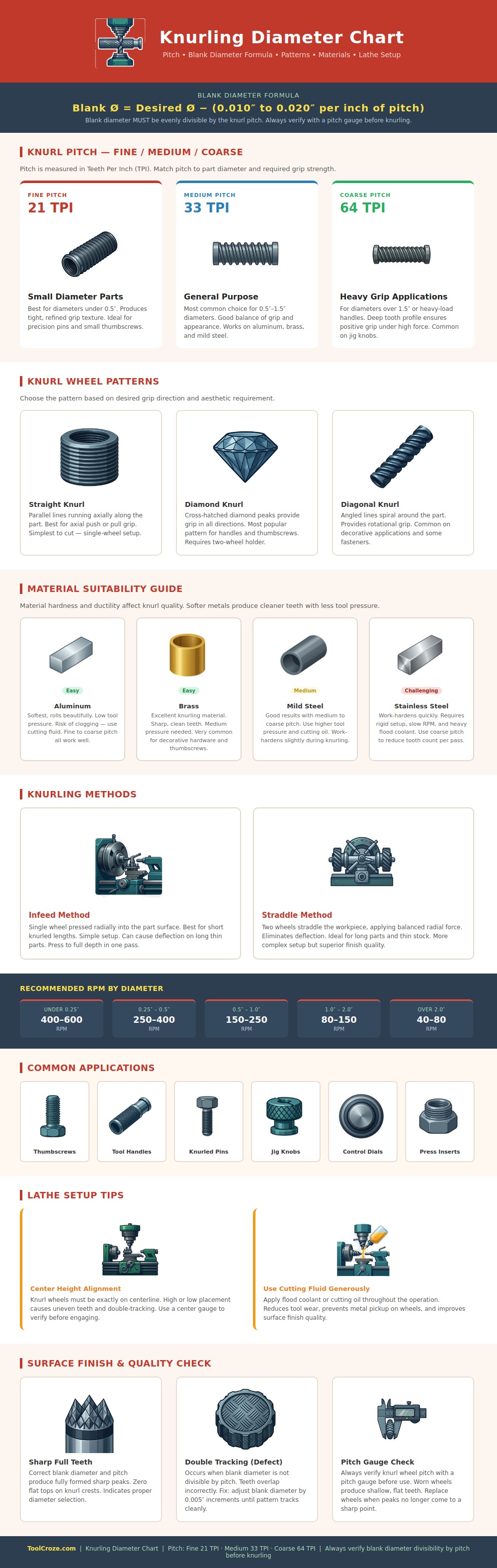
The single most important variable in knurling is one you’ve likely already overlooked: the starting diameter of the blank. If you don’t pay attention to this number, the teeth won’t line up and you’ll end up with a nice pile of ruined metal. That ugly double tracking is when the pattern runs over itself, sort of like an off-centered zipper. And if you’re trying out different blanks on expensive stock, you’ll end up wasting good shafts before long.
Fortunately, there’s a simple formula to calculate your blank diameter (as seen in the chart above) so you can avoid all that trial and error. The math is simple, but it seems counterintuitive. Take the size you want the thing to be and subtract a little bit for every tooth on the knurl. This leave room for the teeth to bite into metal. That forces the metal to expand just enough to have a nice peaky shape, but not enough to push it past its tolerances. If it starts off bigger than that, you’re over on dimensions. Start smaller than that and the teeth won’t have any effect because they’ll be shallow and ineffective. What you’re doing here is making sure that the starting diameter are evenly divisible by the pitch of whatever tool you’re using. Why? Because that way, as the work piece turns around, the pattern doesn’t drift in or out of alignment.
The Most Important Step in Knurling
Pitch selection is just as important and depends entirely on size of the part you are holding. Fine pitch tools is very nice with a light texture that feels delicate in your hand. Medium pitch balances aesthetics well with grip and covers most general purpose parts. And then there’s coarse for those big handle parts that need to survive some serious torque. The chart above shows how the pitches fits together. You can see that large teeth on a coarse thread would be ridiculous on a small pin and wouldn’t provide enough biting surface. It’s simple ergonomics, make sure the tooth size corresponds with the part diameter.
But then there’s material selection, that also influences how you’ll go about it. Aluminum is very ductile and soft, so knurls up nice but you really have to be careful of build up on the edge. Brass is super easy to get nice sharp teeth out of without much fuss at all, it’s a popular metal for decorative hardware. Mild steel you’ll want to apply some cutting oil and a bit more pressure, otherwise you just end up pushing the tool along surface. Finally, stainless steel can actualy be a real bear because it tends to work harden quickly. Here you’re going to need plenty of coolant and a slower speed to avoid digging in and glazing over on the wheel. Don’t try to knurl stainless like aluminum or you’ll be mad and your tools will be ruined.
Material selection isn’t everything; setup mechanics is equally important. Make certain that your wheels sits right along the centerline of the workpiece. Anything less than perfect will cause uneven pressure, which can damage the lathe spindle or distort the teeth. There’s no room for negotiation when it comes to center height alignment. Finally, use lots of cutting fluid. This helps reduce friction, carry away heat and prevents metal chips from welding onto knurl wheel. A dry knurling job is a slow move towards tool failure.
Form follows function, even with pattern choice. Control knobs, thumbscrews, etc., benefit from diamond patterns that grip in multiple directions. Straight knurls running parallel to the axis are simple to cut but they do not provide much rotation resistance. Diagonals wrap spirally around the part (sometimes for decorative flair) or can be designed for mechanical engagement. Each serves its purpose; however, diamonds is the workhorses for general gripping tasks because they can grip fingers no matter which direction they approach the surface from.
And lastly, make sure it’s correct before popping the champagne corks. If there are nice sharp teeth, all good. If they’re flat on top or if the lines overlap, then either the diameter calculation was wrong or the wheels got worn down. Dull wheels can be replaced, but scrapped parts cannot. So if you think it might of drifted off, pull out the pitch gauge and make sure those teeth are spaced correctly.
Half of knurling is math, the other half is art. Do the math well. Center your tools well. Don’t let them get hot. Doing this will result in something that feels purposeful and stands up to force. You’ll take what was once a slick, slippery cylinder and turn it into something that has not only character, but use as well. And that journey begins with one number; the diameter of the blank.
