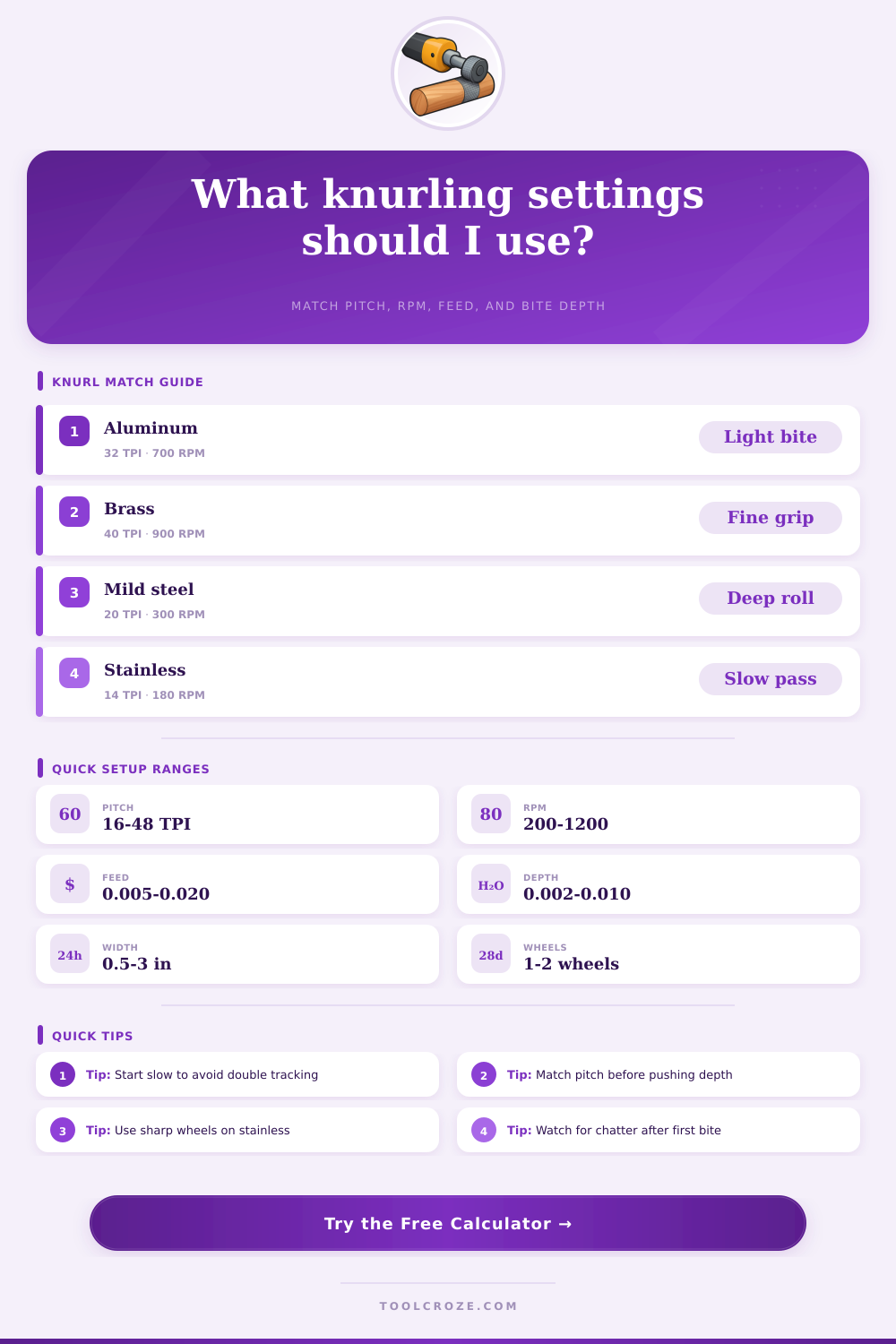
🔨 Knurling Calculator
Match pitch, RPM, feed, and bite depth for lathe knurling
| Material | SFM | Pitch | Note |
|---|
| Wheel | Pitch | Style | Use |
|---|
| Pitch | Dia Band | Repeats | Result |
|---|
| Job | Material | RPM / Feed | Time |
|---|
Knurling is a making method that you mostly do on a lathe where you roll straight, sloping or crossed lines into the material. This special machining process creates textures on the surface of the workpiece usually for better grip or for looks. The tool presses against the workpiece and causes plastic deformation that forms raised elements on the surface
You use it mainly to stop slipping and increase torque although some engineers add it only for beauty. Look at the crossed grip of a barbell, the ridges on the handle of a tool or the patterned knob of a stereo, everything is a sample of knurling. Knurling forms straight, diamond or raised patterns on metal workpieces with lines, angles or interlocking designs.
What is knurling and why we use it
The knurling tool itself is not a cutter but a forming tool that works like gears. Basically, you take a gear, the knurling wheel, and press it into the cylinder material until it matches and becomes a gear itself. You can apply the process either by hand or through machining on a lathe.
Getting a knurl track is commonly difficult. In machining you reckon that the diameter of the workpiece should match the round distance between two grooves on the knurling wheel. Control of diameter matters a lot for certain tool types.
On big diameters it works well but little bits are more tricky.
Various kinds of knurling tools are availabl. For little lathes bump tools do not work. Better use the clamp type with double wheels.
There are also sharp diamond tools that give clear results. For diamond knurling you grip the handles, apply a tiny side force so that the tool twists a bit and screws down the part. For that you need a lot of lubricant.
Knurled surfaces show up on many tools. Thumb wheels of pliers, spark plug sockets, automatic punches and testers all have knurling. The marked knurling on handles of a screwdriver feels nice in the hand.
Good knurling on a barbell feels good in the hand, too slim and it slips, too thick and it feels like a rasp.