
When selecting components for your drive system, be careful about selecting one with a proper key-way. A poor fit result in slippage when used. You’d think it couldn’t happen, but more often then not, it does. That little rectangle of steel connect the hub to the shaft. Shear strength plus friction keeps everything in place. And if there’s no proper fit? Torque fail to transfer.
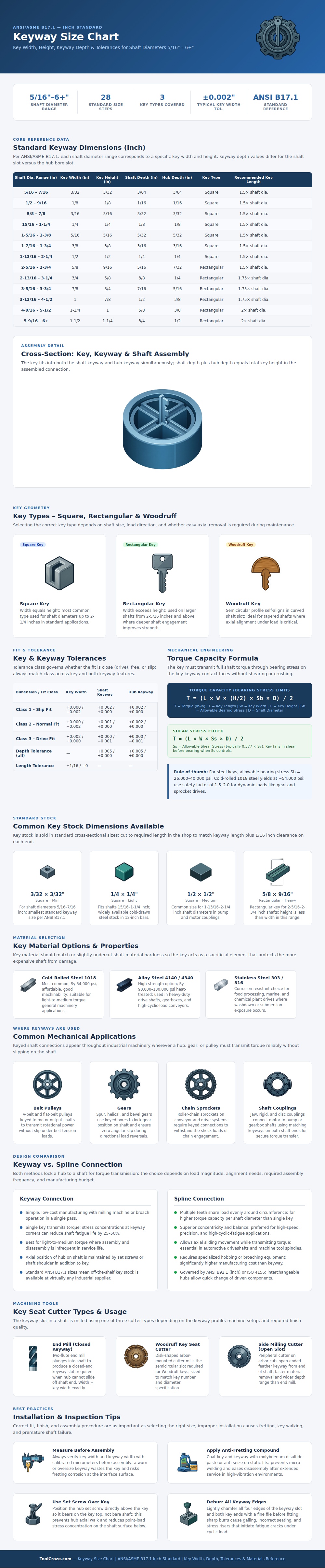
To prevent this, you need to know how the ANSI/ASME B17.1 standard work. This eliminates guesswork from a mechanical interface that look uncomplicated but actualy requires some serious engineering. As the shaft size increases so does the size of the key as seen on the chart. That means you won’t put a square key into something that needs a rectangle because of heavier loads. Square keys is only used on smaller shafts where both height and width of the key match. This makes it more compact.
How to Choose and Use Keys for Shafts
At two inches or greater in diameter, the norm change from square to rectangular keys. This provide stronger engagement without making slot too wide, which would weaken the shaft wall. It’s an important change but subtle in big equipment. The assembly will only last through its first season if you select appropriate material. A shop can pick from many different materials but most opt for cold-rolled steel 1018 due to low cost and good machinability. This material are fine for general purpose applications where the load is predictable and constant.
But take into account the operating environment of your machinery. If you run it in a saltwater or food processing plant, stainless steel are the way to go. You want the shaft to fail before the key, that’s why. Machining a replacement axle or pulling a seized motor is far more expensive then swapping out a couple bucks worth of stock.
The longevity of a joint comes as much from the installation technique as it does from the design. Most techs fail to deburr the edge around the keyway slot. They think that doesn’t matter, but sharp edges produce stress risers which starts fatigue cracks under repeated loading. The result is abrupt failure at the worst time, full bore. Thirty seconds of filing those corner edges will pay off big down the road.
Also use an anti-fretting compound so that you don’t have a micro-welded connection between the slot surface and the key. That way when maintenance time rolls around you can disassemble without spending hours fighting welded pieces of metal out of place. That’ll save your sanity and hours of frustration.
There are more tolerance classes which do not get enough attention in most shops. For example, a slip fit will assemble easy but may rotate slightly under a shock load. A drive fit is a tight connection. It must be installed with force, which may damage delicate components unless proper care is taken. The application requirements determines which tolerance class should of been chosen along with the number of times this unit will be disassembled. The tolerance must also match across the hub, shaft, and key all at once. Mixing the tolerance classes will result in either looseness or interference which degrade the entire mechanical link.
So what’s better, Splined or Keyed? The answer lies in capability and cost. First, splines disperse the load on more than one tooth. This means that they are better centered and can carries higher torque for high speed applications. Additionally, splines transmit power while allowing some axial sliding, necessary when driving a driveshaft in an automobile. Splines is much more expensive to produce as special equipment must be used to manufacture them. A well-sized keyway is the least costly option for most industrial machinery. You get a strong connection with very little need for any complex machining steps or expensive tooling.
The little things make all the difference. Measure twice, cut once. And use accurate measuring equipment to double check before you assemble anything. Use set screws positioned squarely on top of the key to achieve proper axial alignment. Make sure the length of your key is the correct multiple of your shaft size. While each may not feel like a big deal in isolation, they compound into a solid mechanical system. Getting all this right can mean the difference between a good drive and a bad one.
You won’t know if you have a perfect fitting key because it isn’t flashy, it just stays put as everything else revolves around it. Knowing that is worth the extra time spent getting a good fit.
