Intermittent Weld Calculator
Estimate stitch count, skip spacing, end returns, effective weld length, throat area, load capacity, and utilization for intermittent fillet or seam weld layouts.
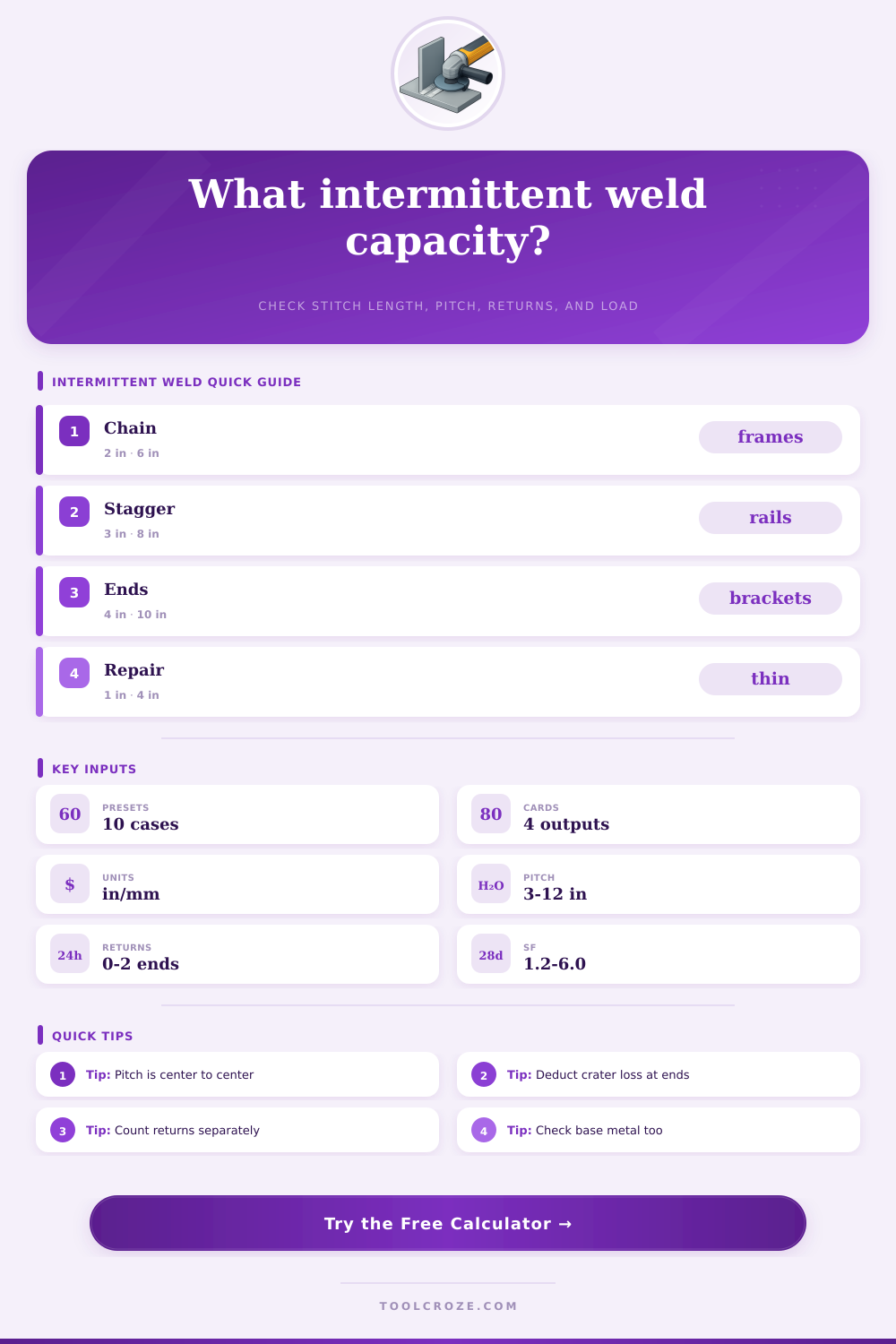
Choose a common stitch weld layout. Each preset fills weld length, pitch, end returns, throat size, pattern, load, and strength assumptions.
| Pattern | Layout meaning | Typical use | Calculator factor |
|---|---|---|---|
| Chain intermittent | Stitches align on both sides of the joint | Balanced rails, frames, and stiffeners | 1.00 load sharing factor |
| Staggered intermittent | Stitches alternate from side to side by half pitch | Long laps, sheet attachments, distortion control | 0.92 load sharing factor |
| End-loaded pattern | First and last stitches are forced near the ends | Brackets, tabs, and localized transfer | 0.96 load sharing factor |
| Single-side line | Only one weld line is counted | Light sheet, access-limited details | 0.85 eccentricity allowance |
| Repair stitches | Short field stitches with added uncertainty | Noncritical repair comparisons | 0.78 field uncertainty factor |
| Equal leg size | Effective throat | Common stitch length | Common pitch range |
|---|---|---|---|
| 1/8 in or 3 mm | 0.088 in or 2.1 mm | 1 to 2 in | 3 to 6 in |
| 3/16 in or 5 mm | 0.133 in or 3.5 mm | 2 to 3 in | 4 to 8 in |
| 1/4 in or 6 mm | 0.177 in or 4.2 mm | 2 to 4 in | 6 to 10 in |
| 5/16 in or 8 mm | 0.221 in or 5.7 mm | 3 to 5 in | 8 to 12 in |
Intermittent welds is used in many different location on trailers or even on teh equipment that trailers are attached to. Intermittent welds exist because a continuous weld will use up all of the filler metal needed to make a weld, and also it will use up all of the heat that is needed for that joint. An intermittent weld layout allow welders to place stitches of the required length at specific spacings between the welds.
The intermittent weld layout can handle the same amount of load as a continuous weld if the intermittent weld layout is sized correctly. The main inputs that must be made for the intermittent weld calculator are the length of each stitch, the pitch between each stitch, the number of weld line that will share the load, and whether or not there will be end returns at each of the ends of the weld. The pitch is measured from one center of a stitch to the next center of the stitch.
How to Calculate Intermittent Welds
The clear gap between each stitch is calculated by taking the length of each stitch from the pitch length. This gap between each weld is important in that the gap will determine the amount of distortion that will result from the weld, the amount of heat that will be applied to the joint, and the behavior of that weld under the load. An end return is a short segment of weld that is added at each of the ends of the intermittent weld.
The end return will help to better transfer the load into the base metal structure. It will help to prevent a crack from initiating at one of the ends of each weld. The end returns are calculated separately from the intermittent weld stitches because they are in a different orientation to the joint, and they carry a greater portion of the load than the individual weld stitches.
If they are not accounted for in the calculation, the load will be under-specified for the joint. The throat size is a dimension that is used to calculate the strength of the weld. The welder can enter the leg size of the weld into the calculator or the effective throat size of each weld can be entered.
The throat size is the dimension that will be multiplied by the effective length of the weld to calculate the throat area of the weld. The throat area is automatically adjusted to account for the selected weld pattern. For chain welds, the load is distributed more evenly throughout each weld than it is for weld patterns that are staggered or applied only on one side of the structure.
The angle of the load that is to be transferred by the weld will affect the strength of the weld. Loads that are applied that are parallel to the weld will have the full strength of the weld, but loads that are transverse will have less of the strength of the weld. An angle factor is built into the calculator to account for this factor.
For angles above sixty degrees, the strength of the joint will decrease to the same strength as a transverse fillet weld. The materials that will be used for the joint will affect the strength of the weld. For mild steel, the weld calculations will be accurate as specified.
For aluminum or thin sheets of metal, there could be issues with burn-through and heat-affected zones softening the metal prior to welding. The weld metal capacity is only one of many factors that will affect the strength and success of a joint. The output of this calculator is the effective length of the weld, the throat area of the weld, the allowable capacity of that joint, and the utilization of the joint.
The effective length of the weld is the length that will be multiplied by the throat size. The length can be reduced due to the cratering that occurs at the beginning and end of each weld. The more welds that are performed in a structure, the more metal will be lost due to cratering at each weld.
The allowable capacity is calculated by the throat area times a factor for the joints geometry. The utilization of the weld is a representation of whether or not the joint will fail, if the utilization is near or above one hundred percent, it means that the weld is close to or at its capacity. In this case, either more welds will be needed, the throat size will need to be increased, or the base metal will need to be assessed for its strength.
Many welders make mistakes with intermittent weld calculations. For instance, the pitch between the welds may be set to a value that is less than the length of each individual stitch. This will make the calculation behave as if it is a continuous weld.
Welds that are only applied to one side of the metal structure will have issues with eccentricity that can be accounted for in the weld pattern. Each stitch will place a load on the base metal structure, and that metal must be able to handle those loads. The reference tables for this intermittent weld calculator show the typical sizes of the legs of welds and the corresponding sizes of the throat of each weld.
Another table shows the length of each weld and the pitch between each weld. These tables are starting points for welders to set the parameters for their designs. However, they are not rules for weld design.
For instance, a fillet size of one quarter inch every six inches may work well for railroad car trailers. However, it may cause more distortion in a thin-walled metal tube than a weld that is one quarter inch but with a pitch of one foot. This calculator will automatically convert the values from imperial to metric and from metric to imperial units.
Each of the following will be converted: lengths, stresses, and loads. This can be helpful for those structures whose drawings are in metric units but whose metal specifications are in ksi. The unit system will be converted automatically in this calculator.
However, the welders will need to make a choice as to in what system the design will be made. The safety factor will reflect the uncertainty of the weld metal calculations. The safety factor will be high if there is a great deal of uncertainty in the metal.
However, no amount of increasing the safety factor will replace the need for proper fit-up of the weld metal, proper procedures for making the weld, or inspection of the completed weld. Intermittent welds are successful if the spacing between each stitch, the length of each stitch, the size of the throat, and the base metal can handle the loads that will be placed on the weld. These factors will all work together to determine the success of intermittent welds used on trailer designs.
Actualy, most welders should of checked the math twice. Youre going to want to make sure the pitch is correct so that the results is accurate. It is important to realize that more metal will be lost due to cratering at each weld than if you did a continuous weld.
If you use too many stitches the heat can becomes an issue.