Impact Wrench Torque Calculator
Estimate delivered working torque, nut-busting torque, clamp load, and tool margin using live pressure, extension loss, socket fit, friction factor, bolt size, grade, and trigger time.
⚙Job Presets
Load realistic impact wrench and fastener setups, then adjust the pressure, extension, bolt, and friction values to match the job at hand.
🔧Torque Inputs
Calculation Breakdown
📊Live Correction Snapshot
🔩Torque, Drive, and Bolt Comparison Grid
| Impact drive class | Typical working torque | Typical nut-busting torque | Common bolt range | Best calculator check |
|---|---|---|---|---|
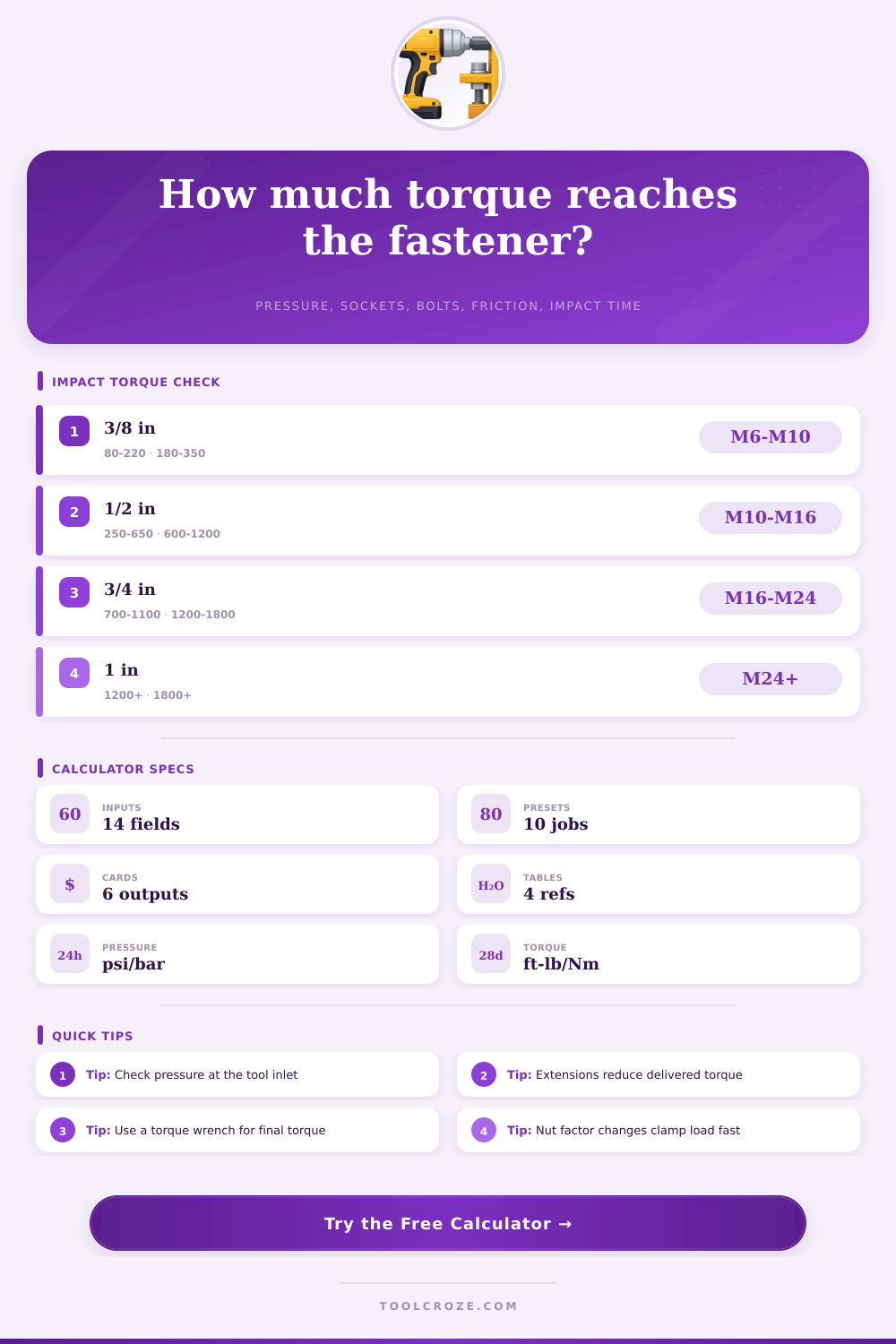
| Compact 3/8 in drive | 80 to 220 ft-lb | 180 to 350 ft-lb | M6 to M10, 1/4 to 3/8 in | Prevent over-torquing small brackets |
| Mid-torque 1/2 in drive | 250 to 500 ft-lb | 500 to 900 ft-lb | M10 to M14, 3/8 to 1/2 in | Wheel hardware and suspension work |
| High-torque 1/2 in drive | 500 to 800 ft-lb | 900 to 1400 ft-lb | M12 to M18, 1/2 to 5/8 in | Breakaway margin with extensions |
| 3/4 in drive | 700 to 1100 ft-lb | 1200 to 1800 ft-lb | M16 to M24, 5/8 to 3/4 in | Heavy chassis and truck hardware |
| 1 in drive | 1200 to 2200 ft-lb | 1800 to 3000 ft-lb | M24 and larger, 7/8 in and larger | Large nuts with high friction demand |
📐Bolt Grade Reference
| Grade or class | Proof stress used | Usual clamp target | Impact wrench concern |
|---|---|---|---|
| SAE Grade 2 | 55 ksi | 50% to 65% proof | Low strength; easy to over-stretch |
| SAE Grade 5 | 85 ksi | 60% to 75% proof | Common service hardware |
| SAE Grade 8 | 120 ksi | 65% to 75% proof | Needs better sockets and pressure control |
| Metric Class 8.8 | 87 ksi equivalent | 60% to 75% proof | Common automotive and equipment bolts |
| Metric Class 10.9 | 120 ksi equivalent | 65% to 75% proof | Often found on wheel and suspension studs |
| Stainless A2-70 / A4-70 | 65 ksi equivalent | 45% to 65% proof | Galling can raise torque without clamp |
🧮Friction Factor Reference
| Thread condition | Nut factor K | Torque effect | Use in this calculator |
|---|---|---|---|
| Lubricated steel threads | 0.12 | Lower torque for same clamp | Use only when lubricant is specified |
| Plated threads with light oil | 0.15 | Moderate torque reduction | Good for clean zinc-plated hardware |
| Clean wheel hardware | 0.18 | Typical service estimate | Default for lug nuts and studs |
| Dry plain steel | 0.22 | Higher torque for same clamp | Use for dry structural fasteners |
| Dirty or rough threads | 0.28 | Torque may become mostly friction | Clean threads before final torque |
🔗Extension and Socket Loss Reference
| Setup | Base loss used | Length sensitivity | Practical note |
|---|---|---|---|
| Impact socket, no extension | 1% | None | Best repeatability at the fastener |
| Deep impact socket | 3% | Low | Normal loss for wheel and flange work |
| Rigid impact extension | 6% | 0.16% per inch | Long bars twist before the fastener moves |
| Wobble extension | 10% | 0.24% per inch | Useful access, weaker torque transfer |
| Impact universal joint | 18% | 0.30% per inch | Large angle changes make torque erratic |
💡Practical Torque Tips
An impact wrench can be fast and loud, but it’s also easy to misjudge how much torque an impact wrench will actualy deliver to a bolt. When you pull the trigger on an impact wrench, it’s common for the tool to make a rattle as the drive shaft begins to rotate, which indicates that the tool has begun to deliver torque to the fasteners. However, the torque that an impact wrench delivers is typically less than what is represented by the tool’s rating.
The following factor contribute to the loss of torque that many impact wrench user experience. One of the factors that contribute to the loss of torque that an impact wrench delivers is the air pressure that is provide to the tool. The air pressure that the pressure rating that is printed on the side of an impact wrench typically assume that the tool is receiving a supply of 90 psi of air, with no obstructions to the air line.
Why your impact wrench gives less torque than expected
If an air hose of significant length is used, if the coupler for the air line is sticky, or if a regulator to the air line has not been adjusted recently, the air pressure that is provided to the impact wrench may be significantly more less than what is represented by the tool’s rating. The impact wrench may still spin, but the amount of torque that it can deliver to the fastener will diminish as the air pressure to the tool diminish. It’s important to check the air pressure while the user is pulling the impact wrench’s trigger, as opposed to when the tool isnt receiving air to the tool.
Another of the factors that contributes to the loss of torque that is delivered by an impact wrench are the extensions and the condition of the socket that is attached to the impact wrench. Rigid extension bar may twist under heavy loads, and wobble extensions or universal joints will consume some of the energy provided to the fastener before it can be delivered to the fastener. A calculator is available to allow users to enter the length of the extension and the type of extension that is used with the impact wrench.
Additionally, if the socket that is used with the impact wrench is worn, it will reduce the amount of torque that can be delivered to the fastener. This reduction in the torque that is delivered to the fastener can result in under-torqued hardware, which can loosen over time. The size and grade of the bolt that is being torqued also plays a factor into the torque requirements of that bolt.
Bolts of larger size are able to handle more load, but require more torque to achieve the same percentage of the proof strength of the bolt material. Bolts of grade 8 or 10.9 require more control during installation than bolts of grade 5 or 8.8. Additionally, the condition of the threads on the bolt can change the way in which the torque is applied to the bolt.
If the threads are dry or dirty, most of the torque that is applied to the bolt is consumed in generating friction between the threads. Because of this friction, it is essential to ensure that the correct nut factor is selected in the impact wrench tool. An additional factor that will play a role in the work that is to be performed with the impact wrench is the priorities of that work.
For tasks that involve the removal of fasteners, it may be necessary to apply more torque to loosen the fastener than was used to initially install the fastener. The reverse torque that the impact wrench provides can be compared to the estimated amount of torque that is required to loosen the fastener. Based off this comparison between the two number, it is possible to determine whether the impact wrench will successfully free the fastener, or whether it will round off the bolt.
The length of time in which the trigger of an impact wrench is held down also plays a role in the amount of torque that is delivered by the impact wrench. Within the first period of time that the trigger is pulled down, the impact wrench will rapidly gain torque. After this initial period, however, the gains in torque will level off.
Small fasteners will require short burst of the impact wrench to deliver the required torque, while large fasteners will require longer pulls of the trigger. This difference in required trigger time can be accounted for in the impact-seconds calculation that is provide in the calculator. Although it may be tempting for many users to always use the largest impact wrench available to the user, the use of such an impact wrench can lead to the stretch or crack of thin metal component.
To use an impact wrench appropriately to a given task, it is important for the user to understand the type of fastener that is to be installed, as well as the capability of the impact wrench. The reference tables that are provided can assist in the user in understanding if an impact wrench of a particular size is appropriate for the fastener of a particular size. Finally, it is recommended that the user employs an impact wrench to reach the required torque for the fastener, but employs a calibrated torque wrench to deliver the final tighten of that fastener.
This calculator will give the user an idea of the torque levels that will be experienced with the impact wrench, which can then be used as an estimate in the use of the final calibrated torque wrench.