
There are thousands of pounds per square inch that want to force themselves through tiny openings in a hydraulic system and they need precision. When a fitting doesn’t seat right you might get panicked, thats more of a geometric problem than a strength one. And this is part of the industrial machinery fitting standards.
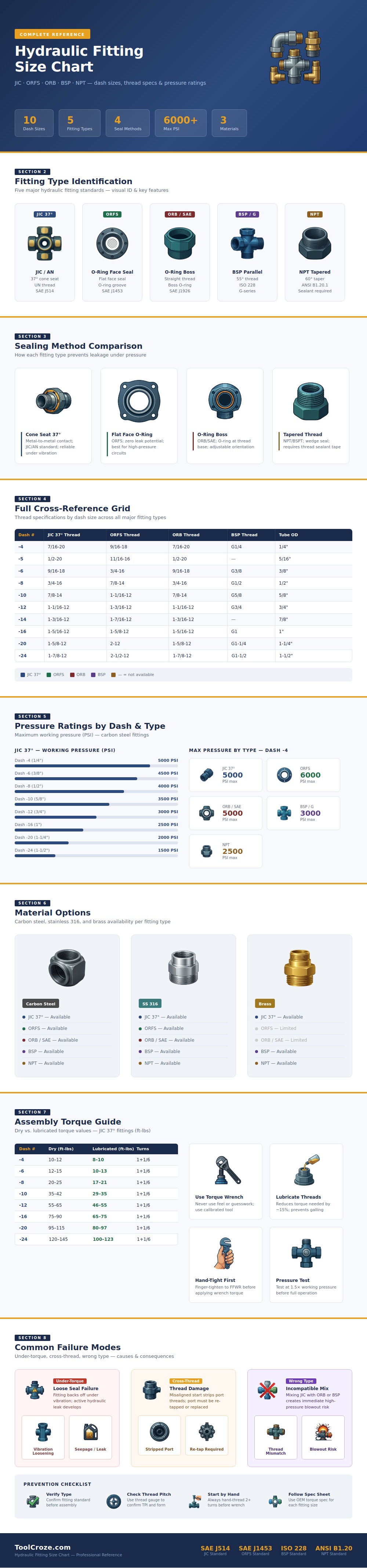
The infographic above shows five main standards with a map to explain where they leak (see below). This is a kind of reference chart for all things fitting, but it’s also a helpful guide if you’ve ever been called on to patch a leaking elbow.
Why Fittings Leak and How to Fix Them
The first source of confusion are the thread form. Because threaded fittings look similar; like a metal cylinder with ridges… You may assume one is like any other; however, each type seals different.
A JIC fitting is a metal-to-metal seat with a thirty-seven-degree flare. Because it’s more rugged, this connection resist vibration, which is important for heavy gear that shakes.
An ORFS (O-Ring Face Seal) is a flat-face fitting with an elastomer ring, unlike thread deformation. Fitting this wrong will damage the port and cause leaks. Chart displays visual cues to tell the difference between parallel and tapered threads before applying wrench.
Most folks don’t realize there’s a curve to pressure ratings. That small dash fitting can withstand more pressure then a big one. It simply has less surface area, and its thicker walls relative to flow path will allow more pressure. Based off data, I could of had a dash four fitting that holds five thousand PSI and a dash twenty fitting that drops the rating down considerably.
That doesn’t mean the bigger fitting isn’t good. It just means the engineering trade-off move from containing force to having flow capacity. So you know when selecting the size for your circuit, you’re not grabbing the first thing that physically fits.
Torque ties theory to the shop floor. Most of the time, technicians relies on a quick ratchet snap or feel to get tightness right which means they are guessing. Guessing leads to failures under mechanical stress or temperature changes. Torqued correctly, fittings don’t slip; they hold under pressure.
The guide offers specific foot-pound numbers for both lubricated and dry threads, and it’s a big difference. Lubricating the threads reduces friction, allowing you to achieve necessary clamp load without over-stressing the metal. That means no more galling, a.k.a. Seizing is caused by grinding steel against steel where there’s no buffer. First hand tighten to align parts then use a calibrated tool to make sure you get the seal under pressure.
There’s also the issue of material selection. For the general industry, carbon steel is strong, cheap, and does the job. If you need something corrosion resistant, like in a food plant or marine application, you want stainless steel 316. If you have a situation needing fluid compatibility, spark resistance, etc., you might see brass used more in lower pressure applications. According to the infographic, there are limited high-pressure ORFS design options with brass. Match the material to the environment, not simply the pressure.
Three mistakes account for most failures: incorrect fitting type, improper installation (cross threading) and under-torque. Under torque allow the fitting to loosen with vibration, causing slow leaks which degrade over time. Cross threading tears out the threads instantly and will cost you money to fix. Incompatible standards are risky as they can cause a catastrophic blowout when the seal fails under pressure.
Verification begins with prevention. Always verify the thread pitch by checking with a gauge. Ensure the standard match before mating. Never rely on your gut; use the spec sheet. Every part has to play by the same set of rules for the system to function.
Understanding that it is about physics helps you get your connections right. You do this by getting the line right; respect the physics of the line. Understand torque becomes clamp force, understand seal formation and then understand the relationship between pressure drop and size. It’s not an accident that the fitting holds… It’s the result of design.” Understanding the chart before turning it down the last quarter turn gives peace of mind.
