⚙️ Hydraulic Cylinder Weight Calculator
Calculate the exact weight of any hydraulic cylinder by bore, rod, stroke, wall thickness, and material type.
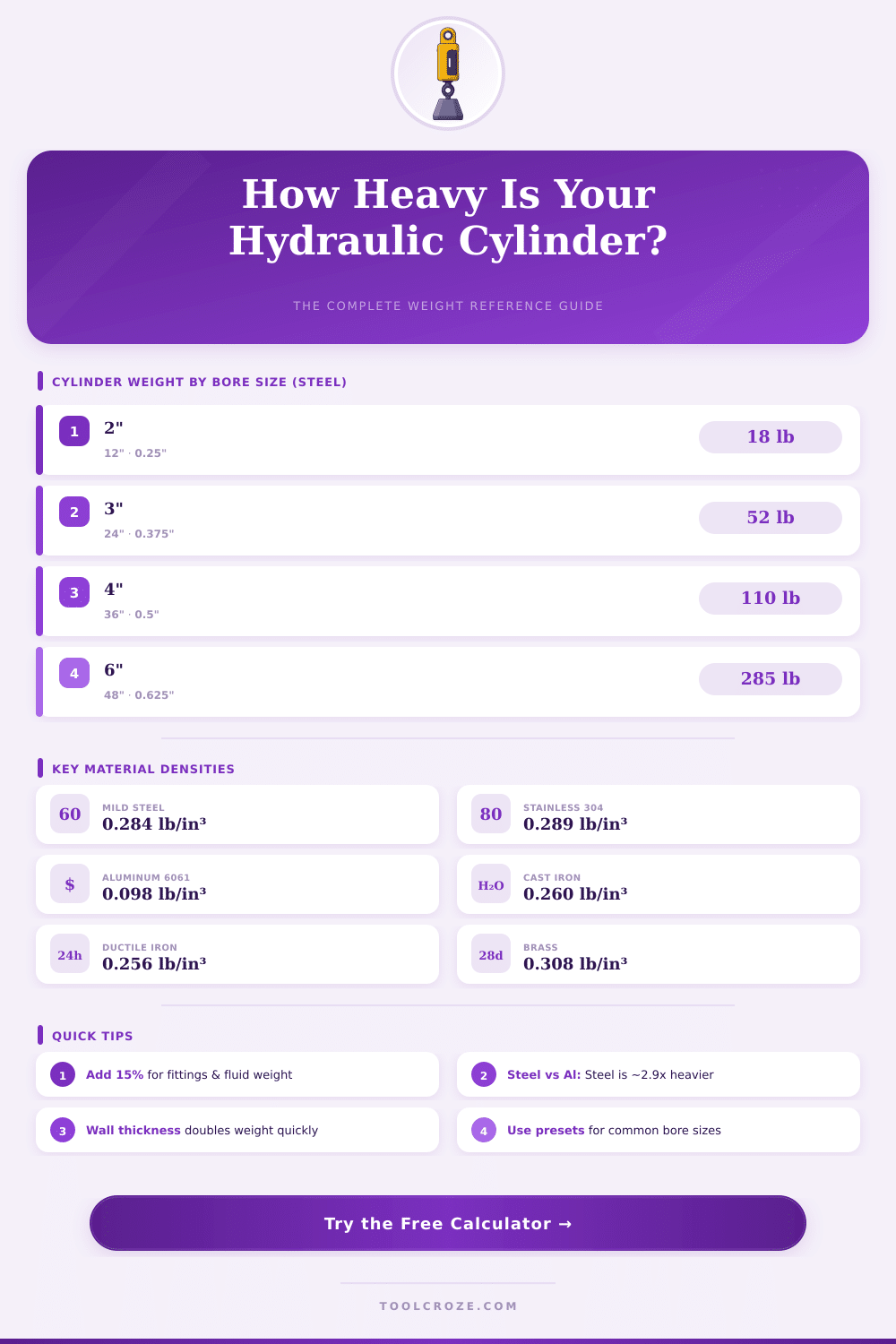
| Bore (in) | Wall (in) | Stroke (in) | Rod Dia (in) | Approx Weight (lb) | Approx Weight (kg) |
|---|---|---|---|---|---|
| 1.5 | 0.25 | 12 | 1.0 | 10 – 14 | 4.5 – 6.4 |
| 2.0 | 0.25 | 12 | 1.25 | 16 – 22 | 7.3 – 10.0 |
| 2.5 | 0.313 | 18 | 1.5 | 30 – 40 | 13.6 – 18.1 |
| 3.0 | 0.375 | 24 | 1.75 | 50 – 65 | 22.7 – 29.5 |
| 4.0 | 0.5 | 36 | 2.0 | 100 – 130 | 45.4 – 59.0 |
| 5.0 | 0.5 | 36 | 2.5 | 150 – 200 | 68.0 – 90.7 |
| 6.0 | 0.625 | 48 | 3.0 | 260 – 340 | 117.9 – 154.2 |
| 8.0 | 0.75 | 48 | 4.0 | 450 – 580 | 204.1 – 263.1 |
| Application | Typical Bore (in) | Typical Stroke (in) | Material | Est. Weight (lb) |
|---|---|---|---|---|
| Log Splitter | 4 | 24 | Mild Steel | 80 – 110 |
| Mini Excavator Arm | 2.5 | 18 | Mild Steel | 35 – 50 |
| Loader Lift Arm | 4 | 30 | Mild Steel | 110 – 145 |
| Dump Truck Hoist | 6 | 48 | Mild Steel | 280 – 360 |
| Tractor 3-Point | 3 | 12 | Mild Steel | 40 – 60 |
| Industrial Press | 5 | 24 | Chrome-Moly | 140 – 180 |
| Marine Steering | 2 | 10 | Stainless 316 | 18 – 28 |
| Aircraft Ground Support | 3 | 20 | Aluminum 6061 | 22 – 35 |
| Snow Plow Angle | 2.5 | 12 | Mild Steel | 28 – 38 |
| Fluid Type | Density (lb/gal) | Density (kg/L) | Common Use |
|---|---|---|---|
| Petroleum Hydraulic Oil (ISO 46) | 7.17 | 0.86 | General machinery |
| Petroleum Hydraulic Oil (ISO 68) | 7.20 | 0.864 | High-load systems |
| Biodegradable (Vegetable) | 7.50 | 0.90 | Environmental use |
| Water-Glycol | 8.75 | 1.05 | Fire-resistant |
| Phosphate Ester (Fyrquel) | 9.25 | 1.11 | Aviation / high-temp |
| Mineral Oil (AW32) | 7.10 | 0.851 | Mobile equipment |
Hydraulic cylinders fit to bring or push some really massive loads. The maximum weight that a hydraulic cylinder can handle depends mainly on two things: the inner pressure and the diameter of the bore. Those two things together set the power that the hydraulic cylinder can deliver.
Simply the push or raise weight matches the pressure from the pump, multiplied by the surface of the hydraulic cylinder.
How Much Weight a Hydraulic Cylinder Can Lift
Hydraulic pressure shows the energy per unit of surface inside the hydraulic cylinder. One measures it in pounds per square inch or simply PSI. The stronger the pressure, the bigger the force for raising.
To estimate how much weight the hydraulic cylinder can bear, there are easily usable formulas that convert PSI into force. One estimates the cross area of the hydraulic cylinder bore and then multiplies it by the close power of teh hydraulic pump.
Concrete numbers will help to explain that. A hydraulic cylinder with 2-inch bore at 2,500 PSI fits to raise around 7,800 pounds. With 4-inch bore at 3,000 PSI it can bring about 37,700 pounds.
And for 6-inch bore at 3,000 PSI the force reaches around 84,800 pounds. The broader the bore and the higher the pressure, the bigger wait it can handle.
Important details to know are that a hydraulic cylinder in retract has much lower force. Here is the reason: the rod takes up space and shrinks the real internal surface. Even so, the size of the rod does not affect when the hydraulic cylinder extends.
With the right pump of the right size and a hydraulic cylinder with a wide enough diameter, hydraulic systems can bring almost everything possible. One designs them almost always for a particular task, with pressure and sizes adapted to the needs of the work. For instance, a 50-ton press uses a 6-inch diameter hydraulic cylinder with a 2.5-inch rod.
Only that hydraulic cylinder weighs around 150 pounds. The whole press, including hydraulic pump and valves, moved by a 2-horsepower electrical engine, weighs ultimately around 1,350 pounds, when everything is done.
In most practical uses, the own weight of the hydraulic cylinder and rod is so tiny compared to the load, that one can ignore it. Even so, if one lays the hydraulic cylinder on its side and extends it, the total weight slightly changes, when more hydraulic oil flows in from outside. Also positions matter more.
Good arrangement avoids raising the body of the hydraulic cylinder itself, it only must move the arm with the load, together with theweight of the internal fluid.
One can estimate the right pressure at the lever side of the hydraulic cylinder and check it against known weights, to turn a hydraulic system into a rough scale. The results will stay only approximate, because of losses and the impact of mechanical efficiency on the accuracy.