🔧 Hydraulic Cylinder Lift Calculator
Calculate extend/retract force, flow rate, cycle time, and power for any hydraulic cylinder
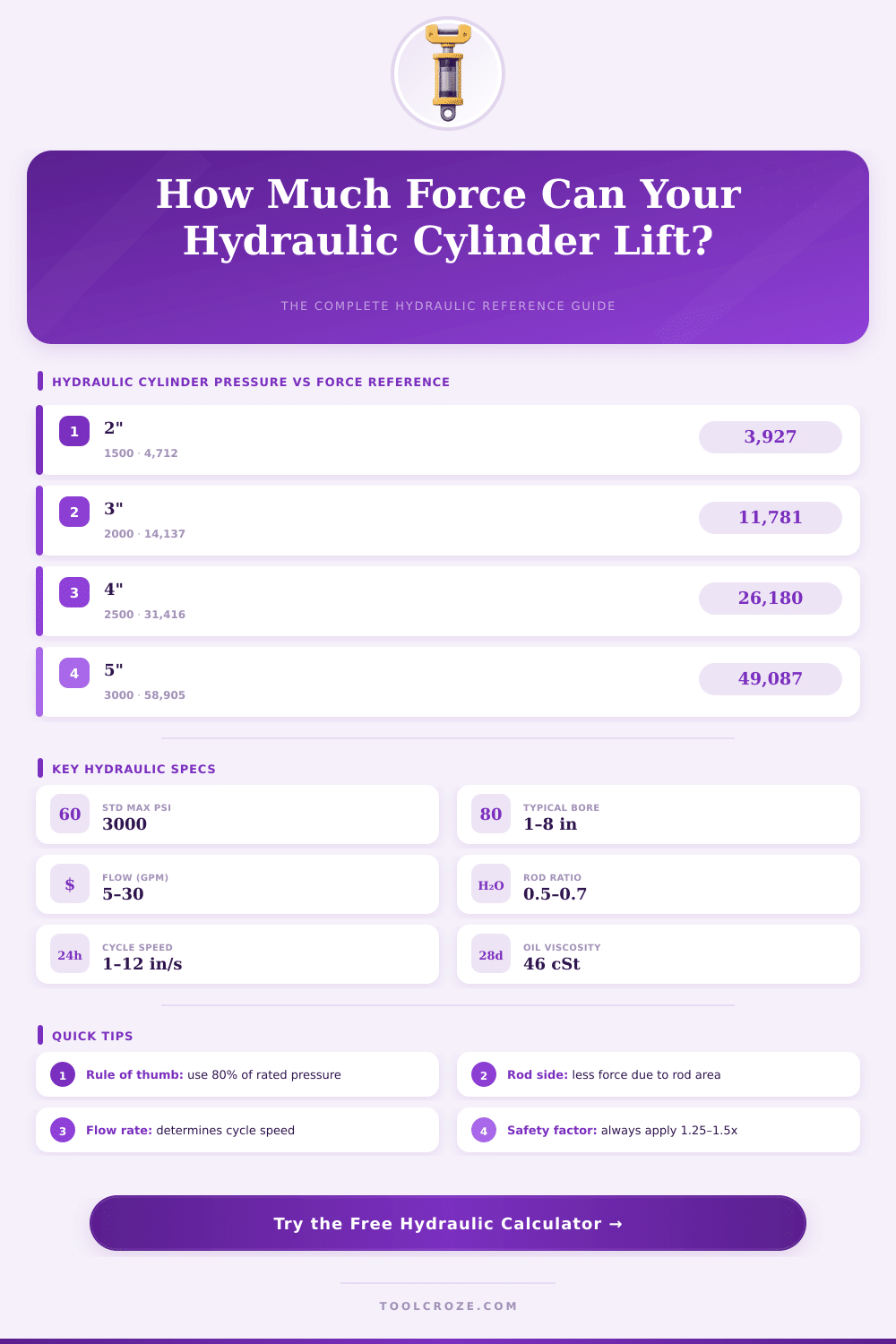
| Bore (in) | 1000 psi (lbf) | 2000 psi (lbf) | 3000 psi (lbf) | Bore Area (in²) |
|---|---|---|---|---|
| 1.5" | 1,767 | 3,534 | 5,301 | 1.77 |
| 2.0" | 3,142 | 6,283 | 9,425 | 3.14 |
| 2.5" | 4,909 | 9,817 | 14,726 | 4.91 |
| 3.0" | 7,069 | 14,137 | 21,206 | 7.07 |
| 3.5" | 9,621 | 19,242 | 28,863 | 9.62 |
| 4.0" | 12,566 | 25,133 | 37,699 | 12.57 |
| 5.0" | 19,635 | 39,270 | 58,905 | 19.63 |
| 6.0" | 28,274 | 56,549 | 84,823 | 28.27 |
| Application | Bore (in) | Pressure (psi) | Stroke (in) | Typical Force |
|---|---|---|---|---|
| Small Log Splitter | 3.0" | 2000 | 24" | 14,137 lbf |
| Large Log Splitter | 4.5" | 2500 | 24" | 39,761 lbf |
| Dump Trailer Hoist | 4.0" | 1500 | 60" | 18,850 lbf |
| Tractor Loader | 3.5" | 2500 | 18" | 24,053 lbf |
| Shop Press 20T | 4.0" | 3200 | 8" | 40,212 lbf |
| Mini Excavator | 3.5" | 3000 | 20" | 28,863 lbf |
| Car Lift (per cylinder) | 3.0" | 1800 | 72" | 12,723 lbf |
| Snow Plow | 2.0" | 1500 | 12" | 4,712 lbf |
| Flow (gpm) | Bore 2" Speed | Bore 3" Speed | Bore 4" Speed | Bore 5" Speed |
|---|---|---|---|---|
| 2 gpm | 5.88 in/s | 2.61 in/s | 1.47 in/s | 0.94 in/s |
| 5 gpm | 14.7 in/s | 6.53 in/s | 3.68 in/s | 2.36 in/s |
| 10 gpm | 29.4 in/s | 13.1 in/s | 7.35 in/s | 4.71 in/s |
| 15 gpm | 44.1 in/s | 19.6 in/s | 11.0 in/s | 7.07 in/s |
| 20 gpm | 58.8 in/s | 26.1 in/s | 14.7 in/s | 9.43 in/s |
Hydraulic cylinders for elevators find use in many kinds of machines and tools. Those systems convert the energy of liquids into mechanical force, which allows moving heavy objects easily. The main idea itself is fairly easy to understand.
Pressed hydraulic liquid pushes against the piston inside the hydraulic cylinder and that pressure spreads across the surface of the ram. The bigger that surface, the bigger load it can bear.
Hydraulic Cylinders for Elevators: Types and Safety
The most many hydraulic setups use oil to create the needed pressure and at the same time keep the parts of the hydraulic cylinder smooth by means of lubricant. The piston sits inside the hydraulic cylinder and connects to the lift floor. If one applies enough pressure by means of the pump and picks a hydraulic cylinder with a fairly broad diameter, almost everything can be raised by means of hydraulics.
Scissor elevators form one of the most commonly used types. In them, hydraulic cylinders handle the raising and lowering of the platform. To run two hydraulic cylinders in a scissor elevator at the same time, you need precise timing.
A simple T-shaped valve commonly does not work for that. When the load weighs more on one side, that side moves more slowly, which can cause tilt of the whole structure. Valves to control the flow at both ends of the hydraulic cylinders help to manage the speed during rise and decent.
There already exists a new style, called “chain-above” hydraulic cylinder for elevator. It works well in spaces with low ceilings, because by means of a shorter hydraulic cylinder one reaches the maximum height. A roller fixed at the end of the piston drags the chain.
One end of the chain is set to the base of the column, while the other clips to the carriage. When the piston moves upward by one inch, the carriage rises by two inches. This way the piston never goes past the top of the column.
Also, for commercial two-stop ground elevators, the direct hydraulic cylinder action stays the best solution.
Telescoping hydraulic cylinders represent another type. They provide strong lift in tight spaces, ideal for heavy tasks. One finds them in flatbed trucks, moving trailers, rolling containers and waste handling vehicles.
An interesting feature of those telescoping hydraulic cylinders is the fact, that as every section extends and the diameter drops, the move speeds up, if the flow from the pump stays the same.
Rough terrain forklifts use strengthened steel hydraulic cylinders to raise and tilt the masts, as well as to drive. They are built to handle rough surfaces and big weights. The hydraulic cylinders for elevator range based on the height involved.
A multi-section mast requires a very different hydraulic cylinder than a low lift device. Pumps set the hydraulic cylinders in motion. Many devices come with whole manual or foot pumps, but standalone manual or electrical versions work equally well.
Safety matters most when one deals withsuch systems. Never mess with hydraulics under load.