⚙️ HTD Belt Length Calculator
Calculate exact HTD synchronous belt length for any pulley system — supports 3M, 5M, 8M & 14M pitches
| Pitch | Tooth Height (mm) | Land Width (mm) | Belt Widths (mm) | Max Load (kW) | Max Speed (m/s) | Typical Use |
|---|---|---|---|---|---|---|
| 3M | 1.17 | 1.14 | 6, 9, 15 | 0.5–1.5 | 50 | 3D printers, robotics, small servos |
| 5M | 2.06 | 1.19 | 9, 15, 25 | 1.5–5.0 | 50 | CNC machines, lathes, light industrial |
| 8M | 3.36 | 2.69 | 20, 30, 50, 85 | 5.0–25.0 | 40 | Go-karts, drill press, e-bikes, CNC |
| 14M | 6.02 | 3.45 | 40, 55, 85, 115 | 25.0–150.0 | 35 | Heavy conveyors, industrial drives |
| Belt Code | Pitch | Length (mm) | Number of Teeth | Common Application | Approx. Center Dist. (mm)* |
|---|---|---|---|---|---|
| 375-3M | 3M | 375 | 125 | 3D printer axes | 150–170 |
| 450-3M | 3M | 450 | 150 | Robotics, small servos | 190–210 |
| 600-5M | 5M | 600 | 120 | Small CNC X-axis | 260–280 |
| 750-5M | 5M | 750 | 150 | Lathe drive | 330–360 |
| 900-5M | 5M | 900 | 180 | Bandsaw, drill press | 400–430 |
| 800-8M | 8M | 800 | 100 | Go-kart short drive | 340–370 |
| 1000-8M | 8M | 1000 | 125 | E-bike, CNC router | 440–470 |
| 1200-8M | 8M | 1200 | 150 | Industrial drive | 540–570 |
| 1400-14M | 14M | 1400 | 100 | Heavy conveyor | 600–640 |
| 2100-14M | 14M | 2100 | 150 | Large industrial | 940–980 |
| Teeth | 3M PD (mm) | 5M PD (mm) | 8M PD (mm) | 14M PD (mm) | Min Rec. Pitch |
|---|---|---|---|---|---|
| 12 | 11.46 | 19.10 | 30.56 | — | 3M min |
| 16 | 15.28 | 25.46 | 40.74 | 71.30 | Any |
| 20 | 19.10 | 31.83 | 50.93 | 89.13 | Any |
| 24 | 22.92 | 38.20 | 61.12 | 106.95 | Any |
| 30 | 28.65 | 47.75 | 76.39 | 133.69 | Any |
| 36 | 34.38 | 57.30 | 91.67 | 160.43 | Any |
| 48 | 45.84 | 76.39 | 122.23 | 213.91 | 5M+ |
| 60 | 57.30 | 95.49 | 152.79 | 267.38 | 5M+ |
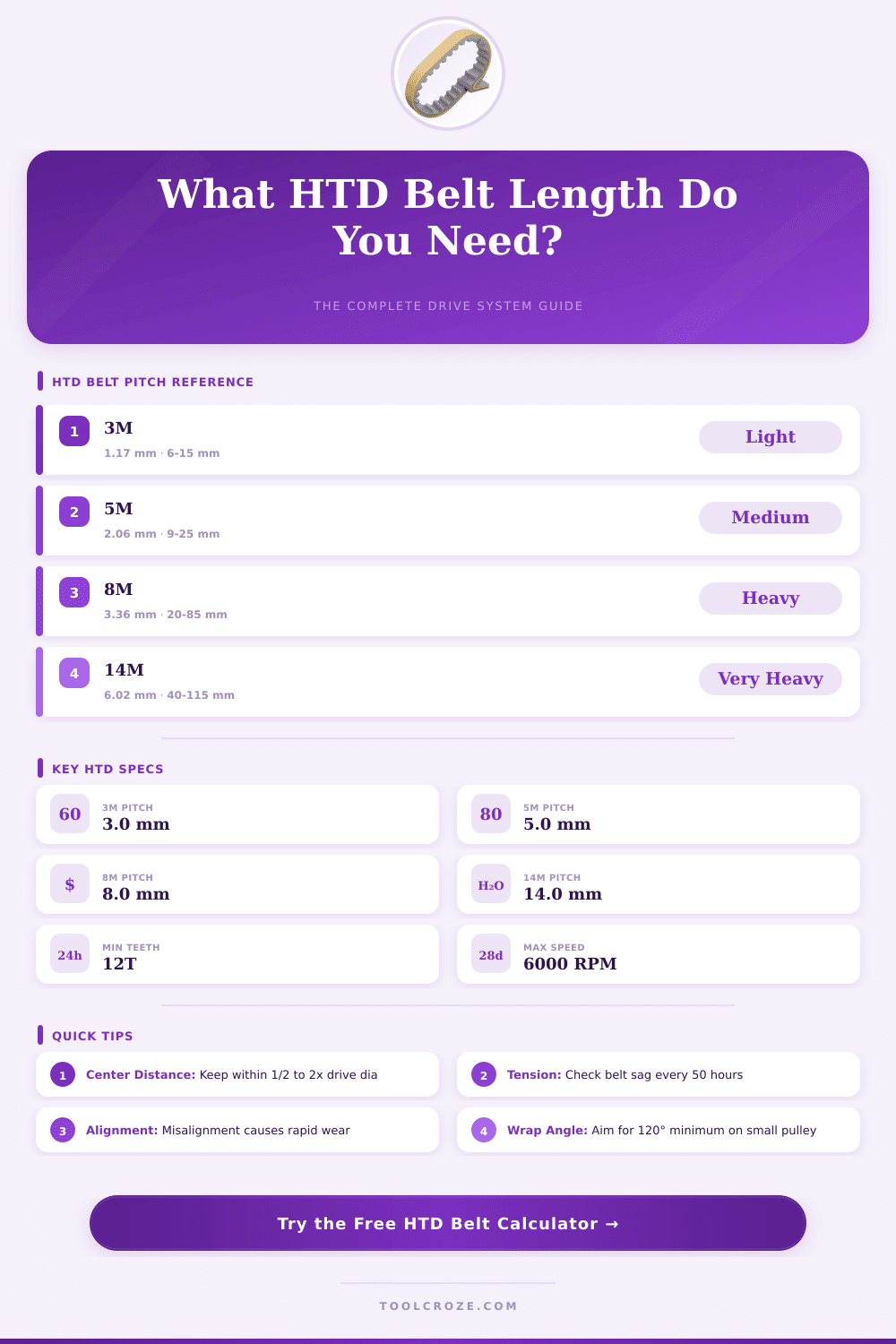
HTD Belt covers a wide kind of sizes. More than 230 standard lengths for HTD Belt are available, and they have various widths. Choices for the pitch include 3 mm, 5 mm, 8 mm and 14 mm.
So there are many options for various designs and setups.
HTD Belt Basics
The body of an HTD Belt is made up of neoprene, that keeps it safe against dirt, fat, oil and moisture. The tooth cover is made from nylon what gives it strong resistance against wear, that lasts for a long time. Some belt models with 5 mm pitch in high temperature use include glass fiber threads inside, that almost fully removes stretching during use.
Pitch identifies the belt. In robotic uses commonly appear pitches like HTD 5 mm, HTD 3 mm and GT2 3 mm. Profile HTD of 5 mm works very well in applications of the First Robotics Contest, because its deep tooth form spreads load more effectively.
Compared to HTD Belt of 3 mm, pitch of 5 mm fits to handle bigger twisting moments without skidding or jumping teeth.
Very important is counting the right length of the belt. One way is draw the circle of pitch diameter at the centre of every pulley, then draw a line around all of them and measure the path length. That helps to find the wanted belt length.
There are also online calculators, that help perform the precise measure. An extra easy method is take string, lead it along the right path of the pulley setup and tie it at the end. Like this one gets an almost precise internal diameter for the belt.
If the distance between centres of pulleys does not divide evenly or well by means of 5 mm, probably you kneed some kind of tensioner for the belt. Length of the belt can range according to the number of teeth on the used pulleys.
HTD Belt offers a wide range of speed and bigger ability to bear load. They ensure steady moving speeds by means of smooth and compact drive system. Such belts work at high efficiency and do not need oiling.
Also they keep stable length and avoid regular stretching, what reduces the care. Timing belts, like all these, do not need changes of tension, weigh less and work better then chains.
Details of a belt usually appear right on it. For instance, a belt can say “HTD 425 15W 5M“, what shows that it has tooth form HTD, is 425 mm long, 15 mm wide and has a pitch of 5 mm. It is best to avoid false or thirdparty HTD Belt, because they commonly cause crashes like skidding under load.
Always best is to use the right tooth form for matching pulleys, because they were made for a particular belt form.