⚡ House Generator Size Calculator Ireland
Calculate the exact generator kW you need to power your Irish home — enter your appliances and get an instant recommendation
| Appliance | Include? | Running W | Surge W | Qty | Category |
|---|
| Generator Size | Running kW | Best For | Fuel Use (L/hr Diesel) | Approx. Runtime Full Tank |
|---|---|---|---|---|
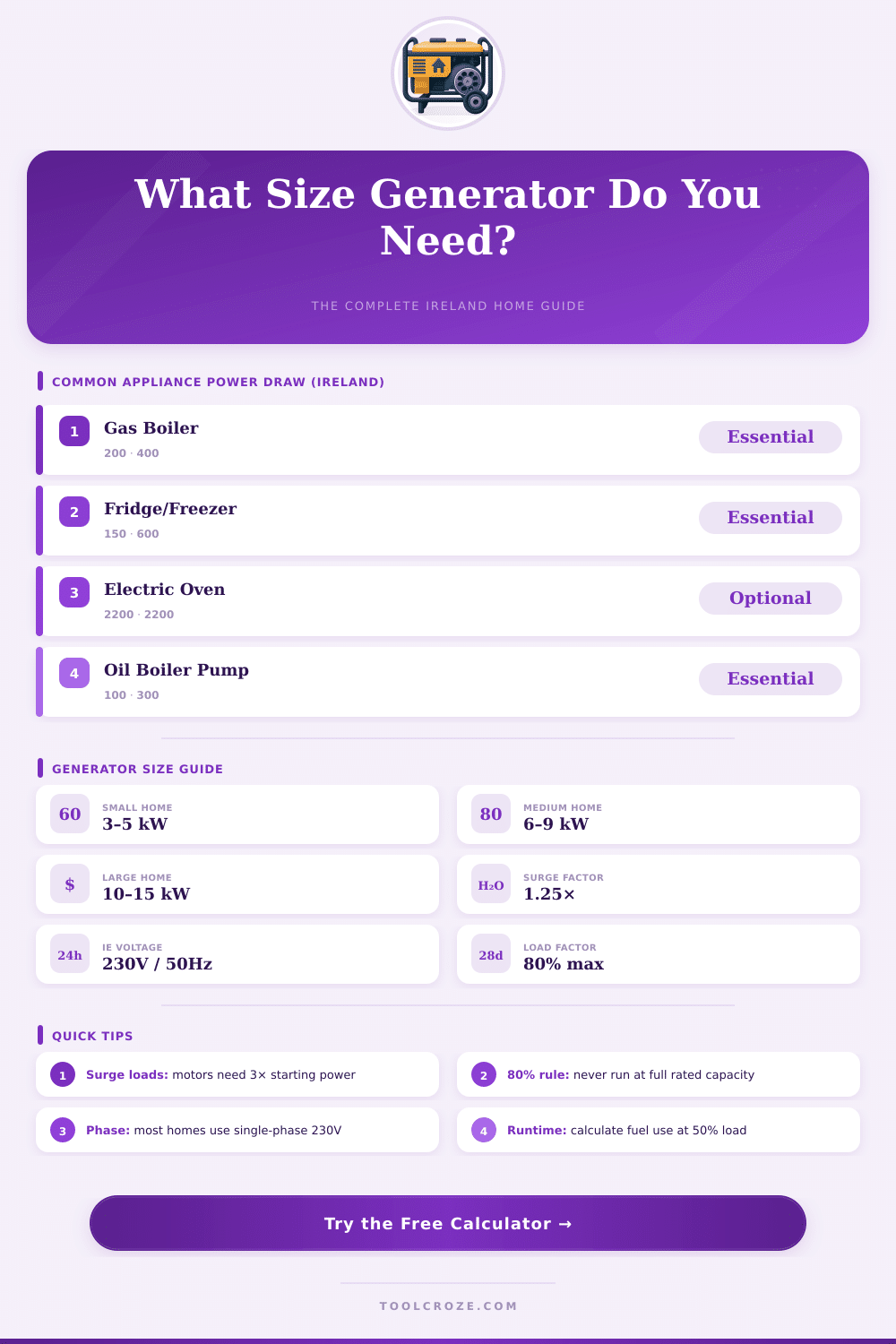
| 2–3 kW | 1.6–2.4 kW | Essentials: lights, boiler pump, phone/laptop | 0.4–0.6 L/hr | 10–14 hrs (6L tank) |
| 4–5 kW | 3.2–4 kW | 2-bed home: boiler, fridge, TV, lights, router | 0.7–0.9 L/hr | 8–12 hrs (8L tank) |
| 6–8 kW | 4.8–6.4 kW | 3-bed home: above + washing machine or oven | 1.0–1.4 L/hr | 7–10 hrs (10L tank) |
| 10–12 kW | 8–9.6 kW | 4-bed home: full household load exc. shower | 1.6–2.2 L/hr | 6–9 hrs (15L tank) |
| 14–16 kW | 11–12.8 kW | Large home + electric shower or heat pump | 2.4–3.0 L/hr | 5–7 hrs (15L tank) |
| 20–25 kW | 16–20 kW | Farm / large property with multiple circuits | 3.5–5.0 L/hr | 4–6 hrs (20L tank) |
| Appliance | Running Watts | Surge Watts | Surge Factor | Priority | Notes |
|---|---|---|---|---|---|
| Gas Boiler (condensing) | 150–300W | 400–600W | 2–2.5× | Essential | Controls + pump; most common in Irish homes |
| Oil Boiler (Riello etc.) | 100–200W | 300–500W | 2–3× | Essential | Common in rural Ireland |
| Fridge / Freezer | 100–200W | 400–800W | 3–4× | Essential | Surge on compressor start |
| Chest Freezer | 100–150W | 400–600W | 3–4× | Essential | Vital for rural food storage |
| LED Lights (per bulb) | 8–12W | 8–12W | 1× | Essential | No surge; allow 100W per room |
| Internet Router | 10–30W | 10–30W | 1× | Essential | Critical for remote workers |
| Television (55") | 80–150W | 80–150W | 1× | Comfort | LED TV; OLED slightly less |
| Washing Machine | 1800–2200W | 3500–4000W | 2× | Comfort | Surge on motor start + heating element |
| Tumble Dryer | 2000–3000W | 3000–4000W | 1.5× | Optional | High continuous draw |
| Electric Oven | 2000–2500W | 2000–2500W | 1× | Optional | Resistive load; no surge |
| Electric Shower (9.5kW) | 9500W | 9500W | 1× | Optional | Very common in Ireland — major load |
| Heat Pump (air source) | 1500–3000W | 4000–9000W | 3× | Essential (if primary heat) | High surge; needs dedicated generator |
| EV Charger (7kW EVSE) | 6500–7200W | 7200W | 1× | Optional | Not recommended on portable generators |
| Laptop / PC | 50–300W | 50–300W | 1× | Essential (WFH) | Allow 150W per workstation |
| Microwave | 700–1200W | 800–1400W | 1.1× | Comfort | Short bursts; manageable |
| Kettle | 2800–3100W | 2800–3100W | 1× | Comfort | High short-term draw; Irish essential! |
| Water Pump (borehole) | 750–1500W | 2000–4500W | 3× | Essential (rural) | Very high surge; size generator for this first |
| Sump Pump | 400–800W | 1200–2400W | 3× | Essential (flooding) | Critical during Irish storms |
| Generator Size | 25% Load (L/hr) | 50% Load (L/hr) | 75% Load (L/hr) | 100% Load (L/hr) | CO2 (kg/hr @ 50%) |
|---|---|---|---|---|---|
| 3 kW | 0.25 | 0.45 | 0.65 | 0.90 | 1.19 |
| 5 kW | 0.40 | 0.70 | 1.00 | 1.40 | 1.85 |
| 8 kW | 0.55 | 1.00 | 1.45 | 2.00 | 2.65 |
| 10 kW | 0.65 | 1.20 | 1.75 | 2.40 | 3.18 |
| 15 kW | 0.90 | 1.65 | 2.40 | 3.30 | 4.37 |
| 20 kW | 1.15 | 2.10 | 3.10 | 4.20 | 5.56 |
Election of the right size for generator can be hard. Various generators have different amounts of watts, and the right size depends on what you intend to power. Little models work for some devices, while a standby generator for whole home fits to provide energy to the whole home.
Even so, to figure out which one works for your case, you need a bit of thought.
How to Choose the Right Generator Size
Many folks mess up when they only consider the whole number of watts and assume that a 5300-watt generator works for powering a home. The main secret is to notice which devices you use at the same time. It does not work to simply guess the everyday energy use to count the right size.
If everything is used in one single hour, then you need a much more big generator. Rather, if the use spreads evenly over 20 hours, then even a little portable generator could work well.
For two compact refrigerators a generator of 1 500 to 2 500 watts works. Two big modern refrigerators need at least 2 000 to 3 500 watts, and one suggests 3 500 watts. A generator of 2 200 watts barely can cover basic loads, while a unit of 3 000 watts helps more easily.
The price diffrence between those two is not too big.
Not the size of the house decides, but which devices you want to use. A person with a home of 2 200 square feet and all gas devices shared that a generator of 9 500 running watts was enough for around 90 percent of their needs. Other folk with a four-bedroom, five-room house installed a 7 500-watt generator, that worked well, because they used gas heat and a gas kitchen.
A generator of 22 kW is really impressive. In a house under 2 100 square feet, 22 kW could be two much. If you have 100-amp service and want to use everything almost normally, then around 22 kW makes sense.
To match a 200-amp main panel one would need 48 kW, which is a pointless cost for most people. The main task is to add the watts of everything that you want to use at the same time.
At the size of 7 500 watts, the portability starts to drop. Such units commonly weigh more than 200 pounds. Even so those extra watts let you power a whole workshop with lamps, heaters and several power tools at the same time.
Because one uses tools one after the other, usually 1.5 to 2 kVA is enough. While you use a generator, always mind its limits and avoid using several heavy devices together. A good habit is tosizing generators like this, that they work at 30 to 50 percent of load.