Hose Size Calculator
Estimate hose inside diameter, flow velocity, pressure loss, fitting allowance, Reynolds number, and remaining working pressure for water, oil, coolant, fuel, and air hose planning.
Load a realistic hose scenario, then adjust the flow, velocity target, pressure, hose ID, length, fluid type, pressure loss limit, and fitting allowance.
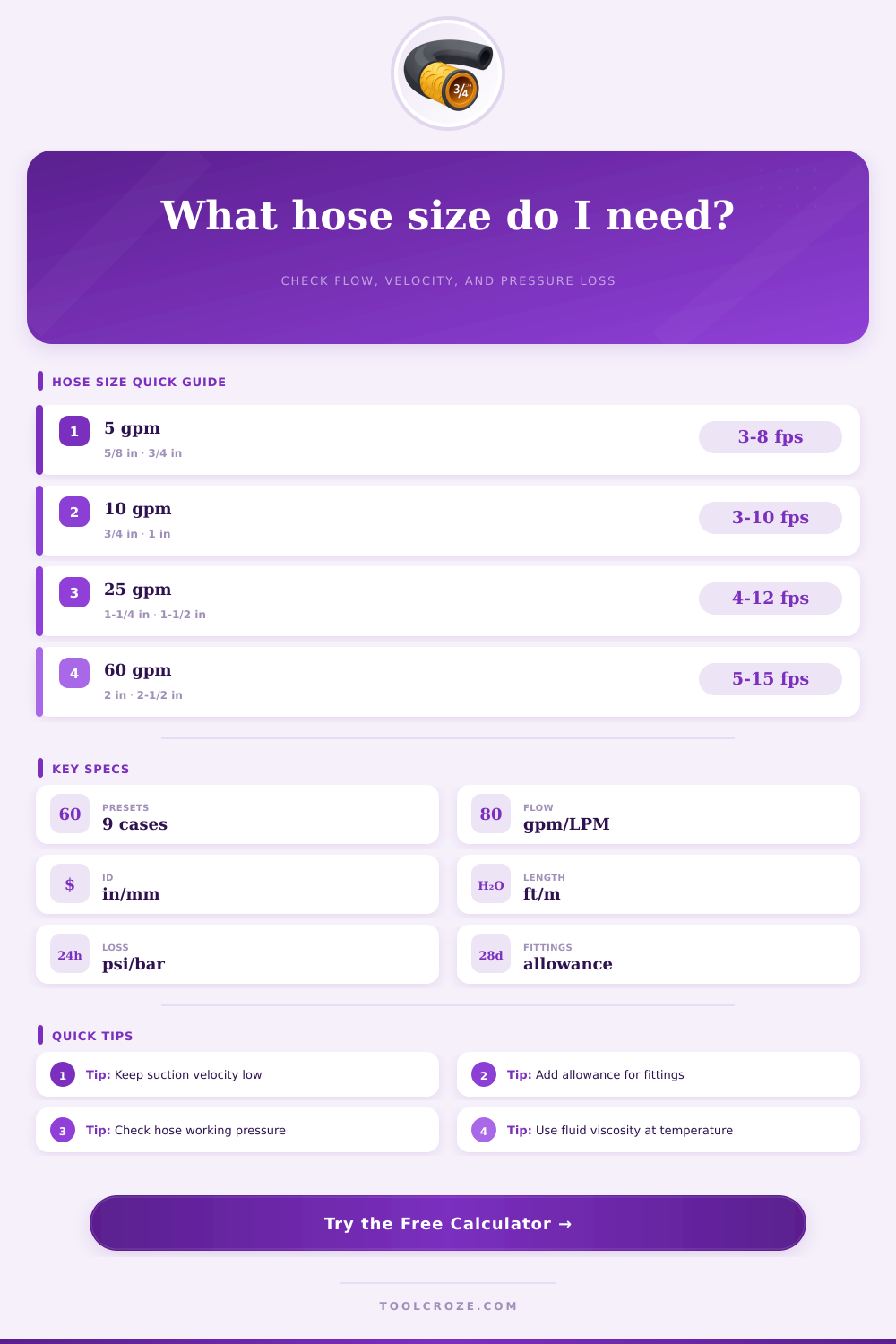
| Service | Typical velocity | Pressure loss priority | Sizing note |
|---|---|---|---|
| Pump suction or inlet | 2 to 4 ft/s | Very high | Use larger ID to reduce cavitation risk, noise, and inlet vacuum. |
| Hydraulic return | 4 to 10 ft/s | High | Keep return backpressure low enough for filters, coolers, and tank lines. |
| Hydraulic pressure | 10 to 20 ft/s | Medium | Short pressure lines can run faster if pressure loss and heat are acceptable. |
| Water transfer | 4 to 12 ft/s | Medium | Long garden, washdown, and pump hoses usually benefit from upsizing. |
| Fuel or chemical transfer | 3 to 8 ft/s | High | Use conservative velocity for viscous fluids, static control, and suction lift. |
| Compressed air tools | 20 to 40 ft/s | Medium | This calculator gives planning loss only; compressible flow needs final checks. |
| Nominal hose ID | Metric ID | Typical use | Watch point |
|---|---|---|---|
| 1/4 in | 6.4 mm | Small air tools, grease, compact hydraulic lines | Pressure drop rises quickly at higher flow. |
| 3/8 in | 9.5 mm | Air tools, small water pumps, medium hydraulic pressure | Check coupler ID because fittings can dominate loss. |
| 1/2 in | 12.7 mm | Washdown, coolant, fuel transfer, general shop hose | Long runs may need 5/8 in or 3/4 in hose. |
| 5/8 in | 15.9 mm | Garden hose, utility water, moderate transfer | Thin-wall hose may have smaller actual ID. |
| 3/4 in | 19.1 mm | High-flow water, hydraulic return, larger air supply | Confirm working pressure and bend radius. |
| 1 in | 25.4 mm | Pump discharge, fuel transfer, return manifolds | Fittings, reels, and strainers add equivalent length. |
| 1-1/2 in | 38.1 mm | Bulk transfer, suction hose, dewatering pumps | Corrugated liners increase roughness and loss. |
| 2 in | 50.8 mm | Fire, irrigation, pump bypass, tank transfer | Use manufacturer charts for lay-flat and fire hose. |
| Fluid type | Density used | Viscosity used | Practical sizing note |
|---|---|---|---|
| Water at 68 F / 20 C | 998 kg/m³ | 1.0 cP | Good baseline for washdown, irrigation, and pump discharge hose. |
| 30% glycol coolant | 1040 kg/m³ | 2.2 cP | Higher viscosity raises loss, especially in small coolant lines. |
| Hydraulic oil ISO 32 | 860 kg/m³ | 30 cP | Warm oil flows easier; cold starts can need much larger hose. |
| Hydraulic oil ISO 46 | 870 kg/m³ | 43 cP | Return and suction lines often need conservative velocities. |
| Diesel fuel | 830 kg/m³ | 3.0 cP | Keep velocity modest for suction, static control, and filter loss. |
| Compressed air | 12 kg/m³ | 0.018 cP | Approximate only; final air systems should use compressible-flow data. |
| Fitting or layout | Typical allowance | Extra K range | Use when |
|---|---|---|---|
| Straight hose with two full-flow ends | 0 to 10% | 0.2 to 1.0 | Short smooth hose, large-bore couplings, minimal adapters. |
| Normal hose with quick couplers | 15 to 25% | 1.0 to 3.5 | Shop air, garden hose, small hydraulic lines, general service. |
| Elbows, valves, strainers, reels | 30 to 50% | 3.0 to 8.0 | Compact equipment plumbing or hose wound partly on a reel. |
| Corrugated suction assemblies | 40 to 80% | 4.0 to 12.0 | Suction hose, foot valves, camlocks, strainers, and sharp bends. |
| Nozzles or restrictions | Separate check | 8.0+ | Nozzle pressure is intentional and should be handled outside hose loss. |
Hose sizing is an process that requires the consideration of three factor: the diameter of the hose, the length of the hose, and the type of fluid that will move through the hose. If these three factors isnt considered when sizing a hose for a particular job or flow rate, the hose may drop the pressure of the fluid that passes through it, or the fluid may exit the end of the hose with weakly force. The calculator allow for the entry of the flow rate, length of the hose, type of fluid, and the starting pressure of the fluid to determine the inside diameter of the hose that is required to achieve the target fluid velocity.
In addition, the calculator can also display the performance of a hose that has already been purchased. It is likely that many customer are buying hoses that is either on the shelf or on a reel. Therefore, the calculator will allow the user to determine whether the hoses that they already own will perform the required function, or if they will fail to meet the requirements of those customer.
How to Size a Hose
Flow velocity is a critical variable in the sizing of a hose. Too slow a velocity for the fluid movement can result in the hose being too large for the job, costing the customer extra money and adding extra weight to the system. Too fast a velocity for the fluid movement can create noise in the system, erode the fitting that connect the hoses, and create extra heat in the system due to the rapid movement of the fluid.
Service type allow the user to alter the velocity requirement for the system due to the different required velocities for suction lines, pressure lines, and return lines. For example, return lines can have higher flow velocities than suction lines, but there is an allowance for these difference within the calculator so that customers dont have to remember each of these different rule. Fluid type is another factor that will alter the outcome of the sizing of the hoses.
For instance, water at room temperature is easily moved through hoses, but cold hydraulic oil is not easily moved through hoses. Fluid viscosity can be altered according to the type of fluid that is selected in the calculator and the temperature of the fluid. Temperature is introduced as a factor that can alter the viscosity of the fluid.
For instance, warm fluids will have low viscosity (viscosity is a measure of the resistance of a fluid to deformation or stress), but cold fluids will have high viscosity. A hose that works for a fluid at operating temperature will drop in pressure if that same fluid is introduced to the system at a more cool temperature. Another factor to consider is fitting allowance.
Hoses that have straight ends will lose less fluid pressure then hoses that have elbows, quick couplings, strainers, or reels attached to the ends of the hoses. These fittings can be factored into the calculation by allowing the user to input a percentage allowance or an extra K value to the system. These fitting problems are often the cause of many hose problem, and these allowances factor in some of those potential problem.
The remaining pressure in the system after the fluid passes through the hose is the most important variable to consider in determining the function that the outlet of the system will be able to perform. If the remaining pressure after the hose is close to zero, there will not be enough pressure to allow for a clogged filter or for the pump to perform at its peak function. In these case, the user should either increase the size of the hose or shorten the length of the hose so that the remaining pressure in the system is high enough to perform the function of the system as a whole.
The physical limit of the hose can also impact the movement of the fluid through the system. For instance, the bend radius of the hoses, the thickness of the cover of the hoses, and the actual inside diameter of the liner of the hoses can all impact the movement of the fluid. In each case, it is possible for the hose to state that it is a certain size, but its actual inside diameter may be smaller due to the thickness of the cover and the reinforcement of the hose.
In these case, it is suggested that the customer measure the inside diameter of a sample length of hose if they have a long distance to which the fluid will travel or if the system requires high rate of fluid movement. In addition to these factor, the working pressure of the hose also impacts the fluid movement through the system. While the calculator factors in the pressure loss of the fluid through the system, the calculator does not factor in the working pressures of the hoses.
Thus, it is additionally necessary to ensure that the hose, the fittings, and the clamps that will be used in the system are compatible with the highest working pressure of that system. The last factor to consider is the compatibility of the systems component. Not all liner for hoses are created equally, and not all covers for hoses are created equally.
Each cover has its own specified range of temperature at which it will not wear easily, its abrasion resistance, and its compatibility with the different chemical that are used in its environment. These factor are not considered in the calculation of the fluid movement through the system. However, each of these factor must be considered after the customer determines the compatibility of the hoses, fittings, and clamps for the system.
Thus, hose sizing is the process that is used to ensure that all of the component of the system are compatible and can perform the required function, and the calculator allow for the customers to test those compatibility factor prior to ordering the hoses.