Hose Reel Capacity Calculator
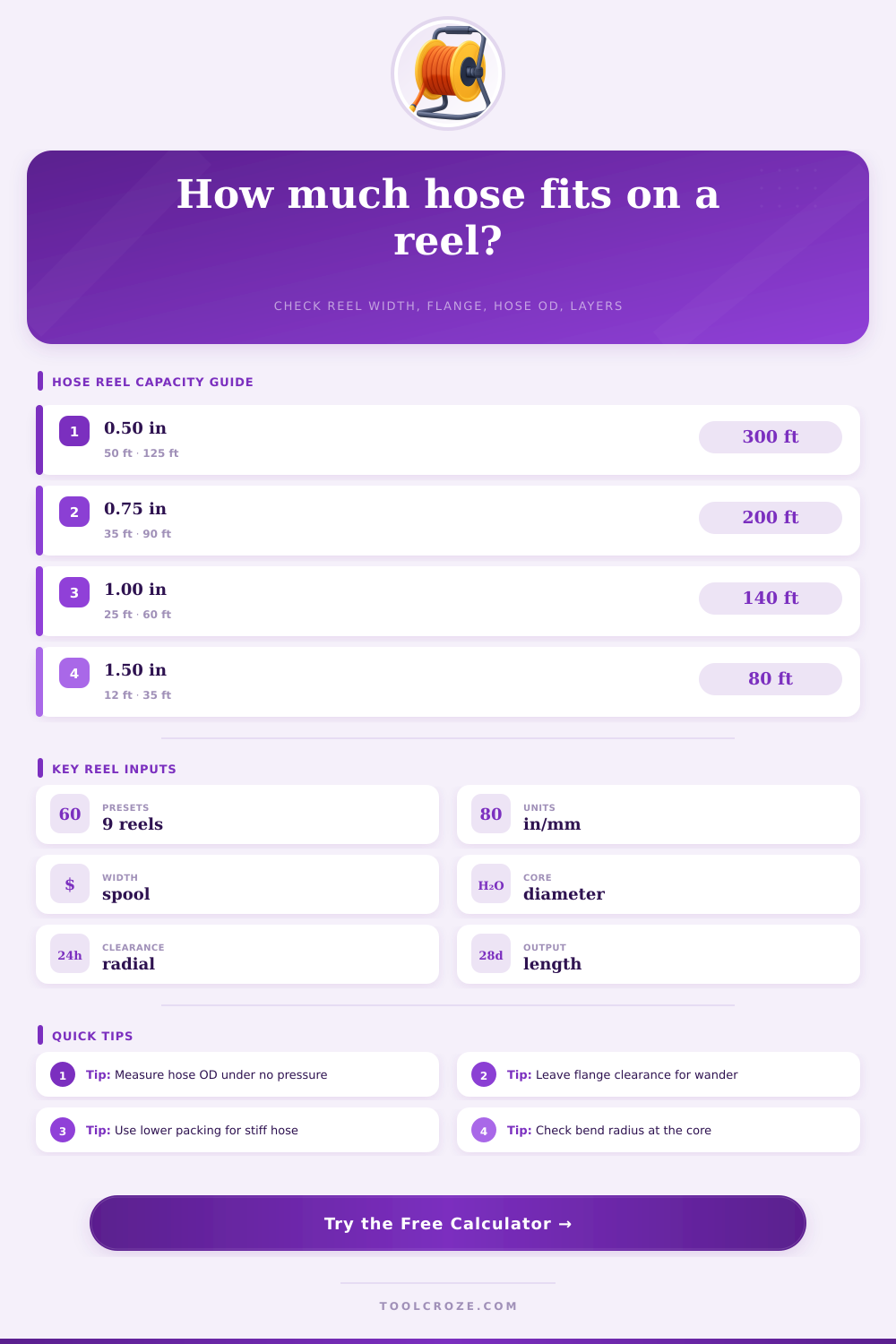
Estimate how much hose fits on a reel from core diameter, flange diameter, spool width, hose outside diameter, packing factor, layer count, usable length target, and flange clearance.
⚙Named reel presets
Load a realistic hose reel size, then adjust dimensions for your drum, flange, and actual hose outside diameter.
📏Reel, hose, layer, and clearance inputs
Measure the drum where the first hose layer sits.
Use the usable inside flange diameter if lips or guards reduce space.
Use actual measured OD, including cover or coupled bundle diameter.
Lower values allow for imperfect winding, stiffness, and side wander.
Enter 0 for all layers that fit below the clearance line.
Space left below the flange edge so hose does not climb over.
Length not counted as usable hose on the reel.
Hose reel capacity result
📊Capacity factors snapshot
📋Reference tables and reel planning notes
| Reel style | Typical hose | Packing factor | Planning note |
|---|---|---|---|
| Wall garden reel | 1/2 to 5/8 inch garden hose | 78% to 86% | Soft hose packs well, but the last layer can wander near the flange. |
| Shop air reel | 1/4 to 1/2 inch rubber air hose | 80% to 88% | Guided spring reels wind consistently when the hose is straight. |
| Hydraulic service reel | 3/8 to 3/4 inch hydraulic hose | 68% to 78% | Stiff hose needs extra clearance and fewer optimistic wraps per layer. |
| Welding twin hose reel | Oxygen and fuel twin line | 70% to 82% | Use the bundled outside diameter, not a single hose diameter. |
| Layflat irrigation reel | Flattened discharge hose | 86% to 94% | Measure the flattened wound thickness rather than round inflated diameter. |
| Hose outside diameter | Wraps on 6 in width | Wraps on 10 in width | Common hose class |
|---|---|---|---|
| 0.45 inch / 11 mm | 10 to 12 wraps | 17 to 20 wraps | Compact pressure washer or small air hose. |
| 0.65 inch / 16 mm | 7 to 8 wraps | 12 to 14 wraps | 3/8 inch air, water, or fuel transfer hose. |
| 0.85 inch / 22 mm | 5 to 6 wraps | 9 to 10 wraps | 5/8 inch garden hose or medium washdown hose. |
| 1.15 inch / 29 mm | 4 to 5 wraps | 6 to 8 wraps | Large water, suction, or hydraulic hose. |
| 1.75 inch / 44 mm | 2 to 3 wraps | 4 to 5 wraps | Booster, fuel, or bulky industrial hose. |
| Check | Formula cue | Good sign | Recheck when |
|---|---|---|---|
| Radial layers | (flange radius - clearance - core radius) / hose OD | The last layer stays below the flange edge. | The layer count is forced above the calculated maximum. |
| Layer length | 2 x pi x layer center radius x wraps per layer | Outer layers add visibly more length than inner layers. | The hose is oval, kinked, or wound under high tension. |
| Width packing | spool width / hose OD x packing factor | Wraps sit side by side without climbing or crossing. | Hand winding leaves gaps or overlaps between wraps. |
| Usable length | gross wound length - leader and coupling allowances | The target length fits with reserve left. | Couplings, swivels, or nozzles are stored on the drum. |
Calculating the correct amounts of hose to place on a hose reel requires a level of knowledge of the components of the hose reel and how each variable can impact the length of hose that may be calculated for a persons specific needs. For many people, purchasing a hose reel that is large on the box may leave them twenty feet short of the length that they need due to the complexity of the length of the hose that may sit upon the reel. The length of the hose can depend upon the stiffness of the hose, how the hose sits upon the layer of the hose reel, and the amount of space that is left at the flange of the hose.
The diameter of the core of the hose reel is one of the most important measurement of the hose reel. A smaller diameter of the core of the hose allow for more hose to be stored upon the reel. However, smaller core force the hose to create tighter turns to accommodate for the smaller diameter.
How to Work Out How Much Hose Fits on a Hose Reel
More flexible hose will allow for these turns to be made, but hoses that are more rigid, such as hydraulic lines or pressure washer hoses, may not allow for those turns due to the radius of those hoses. The calculator will ask for the type of behavior that the hoses exhibit to account for these different types of hoses. The diameter of the flange of the hose and the usable width of the hose reel will determine the number of layer of hoses that will be able to be placed upon the hose reel.
A person will need to account for the amount of radial clearance that will be provided for the layers of hose. The hose may wander from side to side upon the hose reel. More specifically, the hose may wander more if the person is winding the hose at a faster rate then they should.
An amount of clearance provided below the flange will prevent the outer layer of hose from riding up over the flange of the hose reel. This clearance is important to provide if the person plans to transport the hose reel on an angle, or if the hose is to be transported at all. The calculator will use this clearance to automatically determine the number of layers of hose that can be placed upon the hose reel.
The outside diameter of the hose is the most important measurement of the hose; however, it is also often the easiest of the measurements of the hose to measure incorrect. Many individuals will measure the nominal size of the hose. However, the individual should measure the actual outside diameter of the hose.
For instance, a 5/8-inch garden hose may measure 0.72 inch with the thickness of the hose cover. This small difference in the size of the hose can have a significant impact upon the layers upon which the hoses are wound; thus, the individual should provide the actual outside diameter of the hose. The packing factor of the hoses is another measurement of the hose that will impact the length of hose that is calculated for the individual.
The efficiency with which the hoses are wound can impact the length of hose that is wound upon the hose reel. For instance, soft hoses are often able to pack into the layers of the hose reel to 90% efficiency, while stiff hoses, like hydraulic lines, will not pack as efficiently as the soft hoses. The quality of winding of the hoses may also have an impact upon the efficiency of packing of the hose layers.
More specifically, a level-winding of the hoses will result in more efficient packing of the hoses than if those hoses are wound by hand. The output of the hose winding calculator will provide more than the length of hose that will be calculated for the individual. The output will provide the number of layers of hose that are used to calculate the length of the hose.
The output will also reveal how much radial clearance remains upon the hose reel after the hoses are wound upon it. Additionally, the individual can view the length of the target hose, which will allow the individual to understand if the length of hose that is purchased will be sufficient for its designated use. The length of the tail reserve is created both by the length of hose that is attached to the hose reel, as well as the bulge that can be created by the coupling of the hose to the tail reserve.
Finally, the individual can review the status of the target length, which will allow the individual to decide if more hose of a different diameter is needed to be purchase. The environmental conditions in which the hoses are to be used may impact the way in which the hoses behave upon the hose reel. For instance, increases in the temperature will increase the stiffness of the hoses.
Those hoses that are old and exposed to the sunlight may not be as flexible as those that are relatively new. If the hose reel is to be placed upon a truck, for instance, the vibrations may lead the hoses to settle into the layers of the hose reel. Thus, experienced individuals may perform the calculations twice.
More specifically, they may initially calculate the length of hose that can be wound upon the hose reel with a higher packing factor (indicating more flexible hoses), then calculate the length of hose that can be wound with a lower packing factor to account for the potential for the hoses to not behave as calculated upon first calculation. Reference tables are provided for the individual to provide an understanding of the types of hoses and hose reels that exist. These tables are not to replace the winding calculator, but they can help the individual understand if their calculations and specifications for the hoses and hose reel are realistic.
For instance, the table that indicates the efficiency of packing of twin welding hoses may indicate that those types of hoses do not achieve high rates of efficiency due to their couplings. The individual should measure the actual usable width of the hose between the flange faces of the hose reel. The outside dimension of the hose reel may be narrow due to a bracket or swivel that is attached to the hose reel; thus, the individual must manually measure the usable width of the hose.
The use of the hose may also impact the type of measurement that is made for the leader reserve. For instance, if the first ten feet of hose are to be dragged across the concrete or otherwise stepped upon, the length of hose can be sacrificed for that portion of the hose; thus, the leader reserve can account for that portion of the hose. The individual will have to decide whether they wish to replace the end of the hose at regular intervals, or whether they wish to keep the entire length of the hose in good condition.
A functional hose reel will have the hose flat upon each layer of the hose reel. The hose should not climb upon the layers of the hose reel. This function may be impacted by the type of rigidity of the hoses, the tension with which the hoses are wound upon the hose reel, and the amount of clearance that the hoses have laterally within the flange faces of the hose reel.
Thus, by entering each of these factors into the calculator, the individual will have a reliable estimation of the length of hose that can be stored upon that hose reel. Thus, an individual will be aware of the length of usable hose that is stored upon the hose reel.