Hose Pressure Calculator
Estimate outlet pressure, hose friction loss, elevation head, fitting allowance, velocity, burst-pressure safety margin, and usable working-pressure reserve.
Calculation Breakdown
| Hose type | Typical ID | Typical flow | Pressure planning note |
|---|---|---|---|
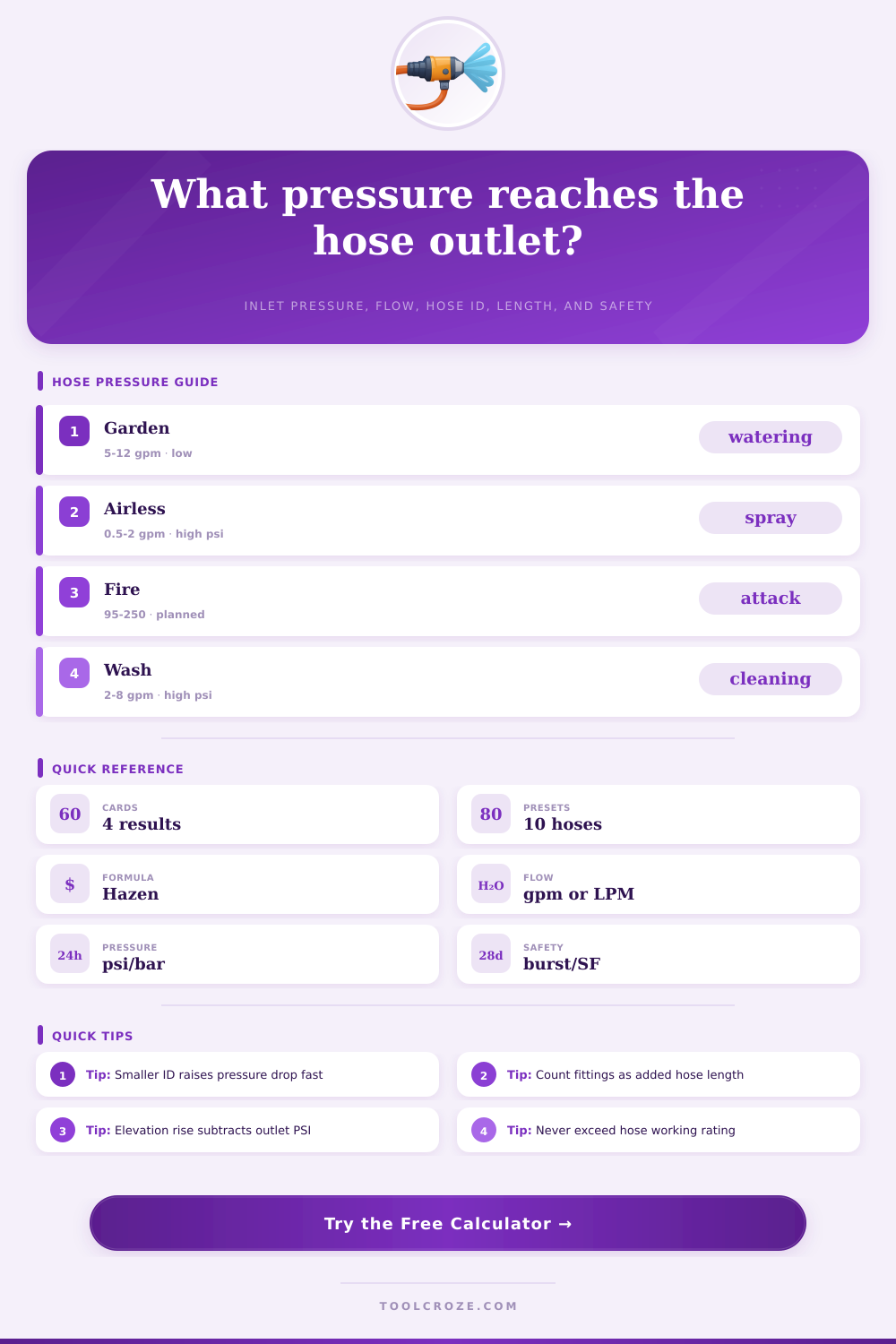
| Garden hose | 1/2 to 3/4 in | 5 to 15 gpm | Diameter changes pressure drop more than length changes. |
| Pressure washer hose | 1/4 to 3/8 in | 2 to 8 gpm | High working pressure needs matching couplers and reel rating. |
| Fire attack hose | 1-1/2 to 2 in | 95 to 250 gpm | Plan nozzle pressure plus friction and elevation loss. |
| Layflat supply hose | 1-1/2 to 4 in | 50 to 500 gpm | Slick liners reduce friction loss at high flow. |
| Inside diameter | Area | Good velocity range | Use case |
|---|---|---|---|
| 3/8 in | 0.110 in² | 3 to 10 ft/s | Pressure washer, short transfer, compact reels. |
| 5/8 in | 0.307 in² | 2 to 8 ft/s | Garden watering and light utility service. |
| 1 in | 0.785 in² | 3 to 12 ft/s | Utility water, dewatering, and service lines. |
| 2-1/2 in | 4.909 in² | 4 to 15 ft/s | Fire supply and high-volume transfer hose. |
| Condition | C factor | Loss effect | When to use |
|---|---|---|---|
| Slick lined layflat | 150 | lowest | Clean water, smooth liner, newer hose. |
| Smooth rubber | 145 | low | EPDM or smooth bore pressure hose. |
| Standard water hose | 130 | medium | General-purpose hose in normal condition. |
| Aged or corrugated | 100 to 110 | high | Rough liner, suction hose, deposits, or kinks. |
| Fitting style | Equivalent length | Pressure effect | Planning note |
|---|---|---|---|
| Straight coupler | 10 diameters | small | Use when the bore is smooth and nearly full size. |
| Moderate bend | 25 diameters | medium | Good default for common hose bends and nozzles. |
| Tight elbow or valve | 45 diameters | high | Use for compact reels, ball valves, and sharp turns. |
| Restrictive stack | 75 diameters | very high | Use for multiple quick connects, strainers, or undersized adapters. |
Every hose run involves a difference between the inlet pressure coming out of the pump and the outlet pressure at the end of the hose. Although the pressure gauge on the pump may indicates that the system is operating at high pressures, the water that exits the end of the hose may be at a lower pressure. A variety of factors contribute to this drop in pressure along the length of the hose, such as the weight of the water in the hose due to changes in elevation, the friction of the water against the walls of the hose, and the restrictions to the movement of water placed into the hose by various fittings.
Each of these factors contribute to the drop in water pressure along the length of the hose. Factors like the inside diameter of the hose will impact friction within the hose; the smaller the diameter of the hose, the more greater the friction loss of the water within the system. The length of the hose also plays a role in the drop of the water pressure along the length of the hose, although in a linear fashion; the longer the hose, the greater the drop in water pressure along that hose.
Why water pressure drops in a hose
In addition to the length and diameter of the hose, other factors that contribute to the drop in water pressure include the elevation of the water within the system, the number of fittings along the length of the hose, and the age of the hose. Each of these factors will be accounted for in the pressure loss calculator provided here to estimate outlet pressure. The calculator will calculate the outlet pressure of a water system once you enter the inside diameter of the hose, the inlet pressure of the system, the flow rate of the system, the length of the hose, and the elevation of the system.
Additionally, the calculator will include the effects of the fittings, and the calculator will display the outlet pressure of the system to you. Furthermore, the calculator will also indicate to you if the inlet pressure remains within the working pressure and burst pressure limits of the hoses that will be utilized within the system. The working pressure and burst pressure limit of hose systems is a critical factor to determine and understand.
Most hose systems will have two different numbers printed on the hose itself. One of those numbers will be the working pressure of the hose system. The working pressure is the pressure that the manufacturer intends to be used continuously within the system.
The other number is the burst pressure of the hose system. Burst pressure is the pressure at which the hose will fail when measured in a laboratory setting. There is a safety factor between the working and burst pressures, such as the age of the hoses, the amount of temperature changes that the hoses have endured, and the amount of physical damage that the hoses may have endured.
Hose systems and manufacturers provides safety factors within the burst and working pressures for these reasons. The pressure loss calculator incorporates these safety factors. As with any mathematical calculation, there will be some differences between the calculated outcome of the system and the actual outcome of the system based on the hoses that are utilized.
Factors like the viscosity of the water can change slightly due to temperature changes in the system. Additionally, there may be debris within the system or the hoses may be knotted in some cases. Additionally, couplings that appear to be the same size may have different internal diameters.
These variables may impact the actual outcome of the system. As such, the calculated outlet pressure is a target that should of been met, but with a margin for error and for these unknown factors. There are some common mistakes made by individuals who use hose systems.
Many individuals may set the inlet pressure but input the nominal size of the hose instead of the actual inside diameter of the hose; using the nominal size underestimates the drop in outlet pressure. Additionally, many individuals may ignore elevation within the system; ignoring elevation leads to an outlet pressure that is lower than the individual may have intended. Finally, another common mistake is underestimating the number of fittings along the length of the hose; as more fittings is included, the greater the drop in outlet pressure.
These three mistakes will lead to an outlet pressure that is lower than that which is desired. One method of correcting the outlet pressure of a system is to increase the inlet pressure. However, increasing the inlet pressure can create other problems within the system.
If the inlet pressure is increased, the hoses may reach closer to their working pressure limit; increasing inlet pressure also increases the velocity of the water through the hose to the point where the hose may vibrate or make noise. Instead of increasing the inlet pressure, you can increase the diameter of the hose, reduce the length of the hose, or reduce the number of restrictive fittings. Similar considerations can be made to each of the different types of hoses that can exist.
For instance, the flow of water from a garden hose that is feeding a soaker hose is likely to have a high drop in outlet pressure; the target outlet pressure for a soaker hose is low. In contrast, the pressure of a pressure washer hose will have a low drop in outlet pressure; high pressure within the system is required for the pressure washer to effectively clean the objects that are to be cleaned. Finally, hose systems that are used in fire attack are somewhere in the middle of these two extremes; the pressure attack lines must move high volumes of water at high rates, as well as reach elevations that are higher than those of the fire engines that are supplying the water.
As such, both the length and the elevation of the attack lines will account for pressure loss in fire attack lines. The reference tables that are included with the calculator provide information about the different types of hoses. The tables include the inside diameter of the hoses, the flow that each of these hoses can move, and the C factors associated with each hose size.
These factors are not meant to replace measuring the actual dimensions of the hoses, but they can help to provide individuals a recommendation for the size of the hose that should be purchased for a given task. For instance, a slick-lined layflat hose will have higher C factors than an older rubber hose; the flow of water within a slick-lined hose will have a lower drop in pressure than that within an older rubber hose of the same diameter. A pressure washer hose will have a relatively small diameter, yet will have high working pressures.
As such, the number of fittings into which the water will enter and the velocity of the water through that hose will be the primary considerations when purchasing a pressure washer hose of a specific diameter. The velocity of the water through the system is another variable that should be considered; velocity does not have a gauge to measure it. However, if the velocity of the water is too high within the system, the water may become noisy within the system, or, if any fittings are detached from the system, the hoses may whip.
Most water hoses will have a safe velocity within the hose of 15 feet per second. It is a recommendation for most people to keep the velocity of the water within the hose below 15 feet per second if there are any individuals nearby who should not be exposed to such high velocities of water. The changes in elevation within the system also have an impact on the outlet pressure.
If the water is moving downhill along the hose run, there will be an increase in the outlet pressure. If the water is moving uphill along the hose run, the outlet pressure will experience a loss of some of the available pressure of the system due to the weight of the water that has to be lifted to that elevation. The calculator will account for the changes in elevation within the system and automatically convert the height within the system to the amount of pressure loss that is caused by elevations.
A habit can be implemented into the construction and use of hose systems that will allow for an individual to understand the effects of each variable and to adjust each variable to meet the needs of the system. One such habit is to measure the various parameters of the system that can be measured. For instance, an individual can measure the inside diameter of the hose that is to be used; the individual can count the number of fittings that are to be used in the system; and the individual can measure the elevation of the system.
These measurements can be entered into the calculator, and the individual can begin to adjust each variable to determine which variables will have the greatest effect on the outlet pressure. This will allow individuals to determine, for instance, whether increasing the diameter of the hose will have as great an impact as shortening the length of the hose. Finally, the calculator is only an aid in planning the system that is to be used.
Additionally, it is an essential tool to provide a picture of the various factors that may impact the outlet pressure of the water within the hose. Once you understand how each of these factors may play a role in the performance of the hose system, you can begin to determine in what way the actual system may differ from the calculated parameters of the system. The outlet pressure of the system is that which actually arrives at the end of the hose, and any difference between the calculated outlet pressure and the actual outlet pressure is due to one of these factors accounted for by the calculator.