Hose Friction Loss Calculator
Estimate hose friction loss from flow, inside diameter, length, roughness, fluid density, viscosity, fittings, method choice, and elevation using Darcy-Weisbach or Hazen-Williams.
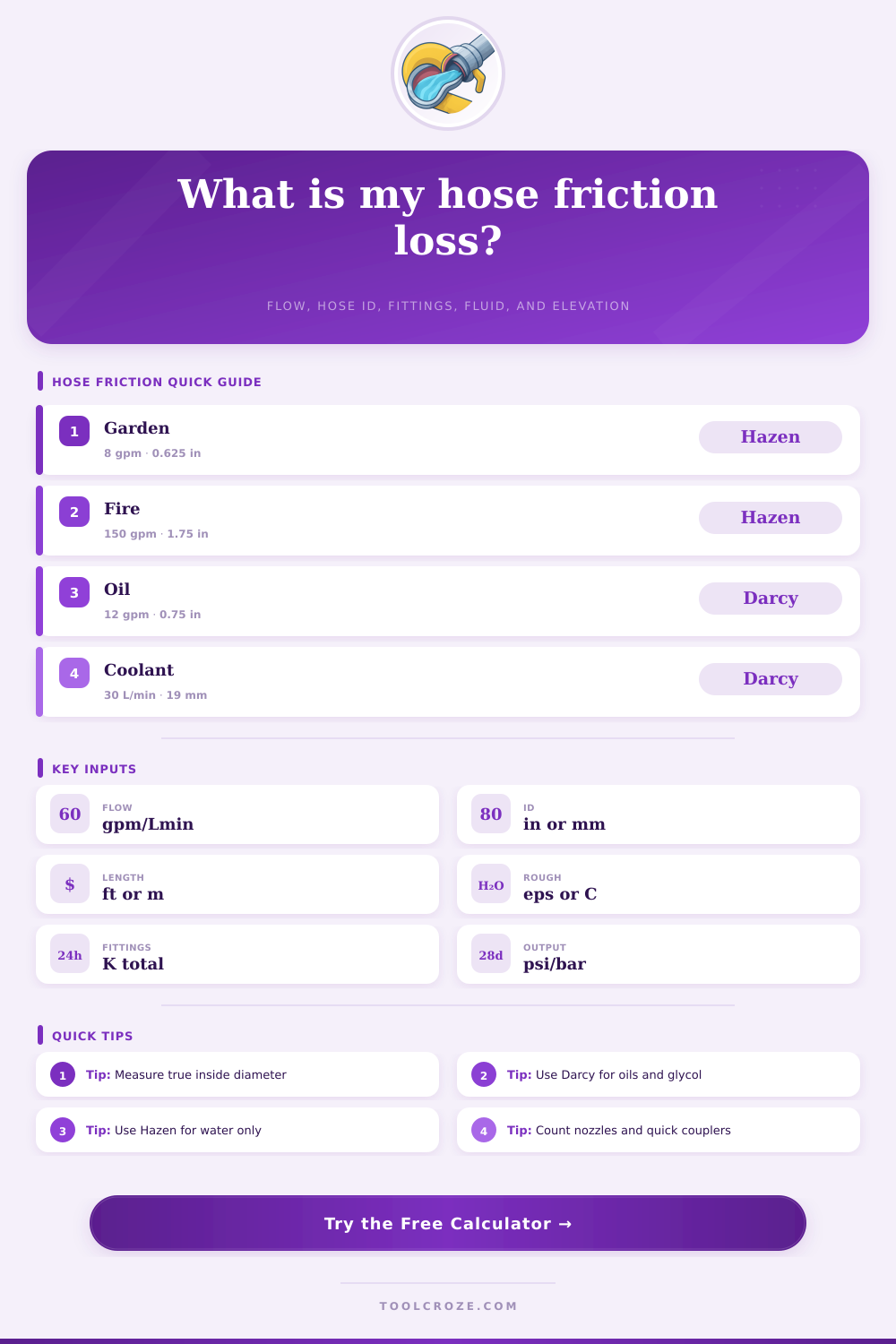
Pick a common field case. Each preset fills method, fluid, hose size, length, roughness, Hazen C, fittings, and elevation.
| Hose or tube condition | Typical roughness | Typical C | Best calculation use |
|---|---|---|---|
| Smooth rubber, PVC, or clean garden hose | 0.00005 to 0.00010 in | 130 to 145 | Water service, washdown, transfer |
| Woven layflat or fabric jacketed hose | 0.00010 to 0.00020 in | 120 to 140 | Fire, irrigation, temporary pumping |
| Hydraulic or fuel hose smooth bore | 0.00007 to 0.00015 in | Not normally used | Darcy with measured viscosity |
| Corrugated suction or vacuum hose | 0.00150 to 0.00400 in | 70 to 105 | Darcy preferred, high K fittings |
| Aged, scaled, kinked, or ribbed hose | 0.00020 to 0.00100 in | 80 to 120 | Use conservative roughness or lower C |
| Fitting or device | Typical K range | When to use | Calculation note |
|---|---|---|---|
| Straight quick coupler or smooth barb | 0.10 to 0.40 | Low-restriction hose ends | Use count x average K |
| Full-port ball valve | 0.05 to 0.20 | Open isolation valves | Add as extra K if not counted |
| Sharp elbow, small valve, or tee flow | 0.70 to 2.00 | Restrictive fittings | Raises minor loss at high velocity |
| Nozzle, strainer, meter, filter, or reel swivel | 1.00 to 10.00 | Devices inside the hose run | Enter combined value as extra K |
| Service | Common velocity | Concern if high | Concern if low |
|---|---|---|---|
| Water transfer or washdown | 3 to 10 ft/s | Nozzle pressure loss and surge | Oversized hose, poor spray energy |
| Fire or irrigation layflat | 8 to 18 ft/s | Pump pressure and hose reaction | Bulky hose with little benefit |
| Hydraulic return or coolant | 4 to 12 ft/s | Heat, backpressure, aeration | Low scouring, settling risk |
| Suction or viscous fluid | 2 to 6 ft/s | Cavitation and inlet starvation | Large, expensive routing |
Friction loss is another factor that exists when the pump move the fluid through the hose. Friction loss lead to a reduction in the fluid pressure as the fluid move through the hose. Friction loss is the result of several different variable, including the flow rate, the hose diameter, the length of the hose, the roughness of the inside of the hose, the number of fittings along the hose, the fluid properties, and the change in elevation of the fluid along the hose.
You can calculate friction loss by enter several different sets of variables into the calculator, after which the calculator will provide the resulting friction loss for those entered variables. The flow rate for the system will tell the calculator the volume of fluid that is flowing through the hose. The diameter of the hose will tell the calculator the area of the hose where the fluid molecules will rub against the side of the hose.
How to Calculate Friction Loss in Hoses
The length of the hose will determine how much the friction loss will scale with the length of the hose. The roughness of the hose will allow the calculator to understand how much the friction loss will contribute to the friction loss in the system. Additionally, the property of the fluid will allow the calculator to understand how the fluid will move through the hose; different fluids will have different viscosity and densities, so it is important to enter the correct fluid into the calculator.
The Hazen-Williams method is most often use to calculate friction loss in hoses that carry water. The Hazen-Williams method is the simpler of the two methods, but it isnt always the most accurate method to calculate friction loss. For instance, the Hazen-Williams method is inaccuracy for fluids like glycol or hydraulic oil.
Due to the different viscosity rates of fluids other than water, you should use the Darcy-Weisbach method instead. Both methods can be entered into the calculator, and the calculator can load the fluid properties to allow it to calculate the friction loss for those specific property. The inside diameter of the hose is a critical variable in the calculation.
The inside diameter of the hose is a highly sensitive variable to the calculation. If the inside diameter of the hose are smaller than expected, the friction loss will increase. The diameter of the hose can be measured with calipers, for instance, and you should use that measured diameter in the calculator to ensure the accuracy of the friction loss calculation.
The number of fittings along the hose can be entered into the calculator. These fitting can contribute to the friction loss within the system, potentially more than the length of the hose itself. Additionally, while the change in elevation is not the same than friction loss, it is another variable that should be considered in the calculation of fluid system loads.
Changes in elevation has the potential to increase the load that must be overcome by the pump if the fluid is moving uphill, or decrease the load on the pump if the fluid is moving downhill. The calculator provide several different sets of outputs. The calculator will calculate the friction loss through the hose.
The calculator will calculate the total friction loss for the system. The calculator will calculate the velocity of the fluid along the hose, which is another way to describe the rate of flow through the system. Finally, the calculator will calculate the method that was use to determine the friction loss.
The velocity of the fluid through the hose has the potential to contribute to the erosion of the sides of the hose, especially at high velocity. Additionally, if the velocity is too low, the solids within the fluid will not move enough to prevent them from settling within the hose. Very high velocities within the system, however, can lead to the couplings becoming “chatter,” or the nozzles being difficult to control.
Within the calculator, the calculator calculates the Reynolds number, which can indicate the type of flow within the system. The Reynolds number can also help to indicate whether the friction loss within the system is due to the viscosity of the fluid or the roughness of the inside of the hose. The variables described above are theoretical and under ideal conditions.
The viscosity of the fluid could change with alterations in the temperature of the fluid. Additionally, if the hose has any kinks or if it has scale within the hose due to the fluid that has passed through it, the inside of the hose may become more rough than expected. You can account for these variables in the calculator by entering a value in the “allowance” field.
Despite accounting for the variables described above, though, the actual fluid system will need to be measured for the actual fluid pressure at each end of the hose. Friction loss is a variable that will change if any of the variable related to the system or the fluid are change.