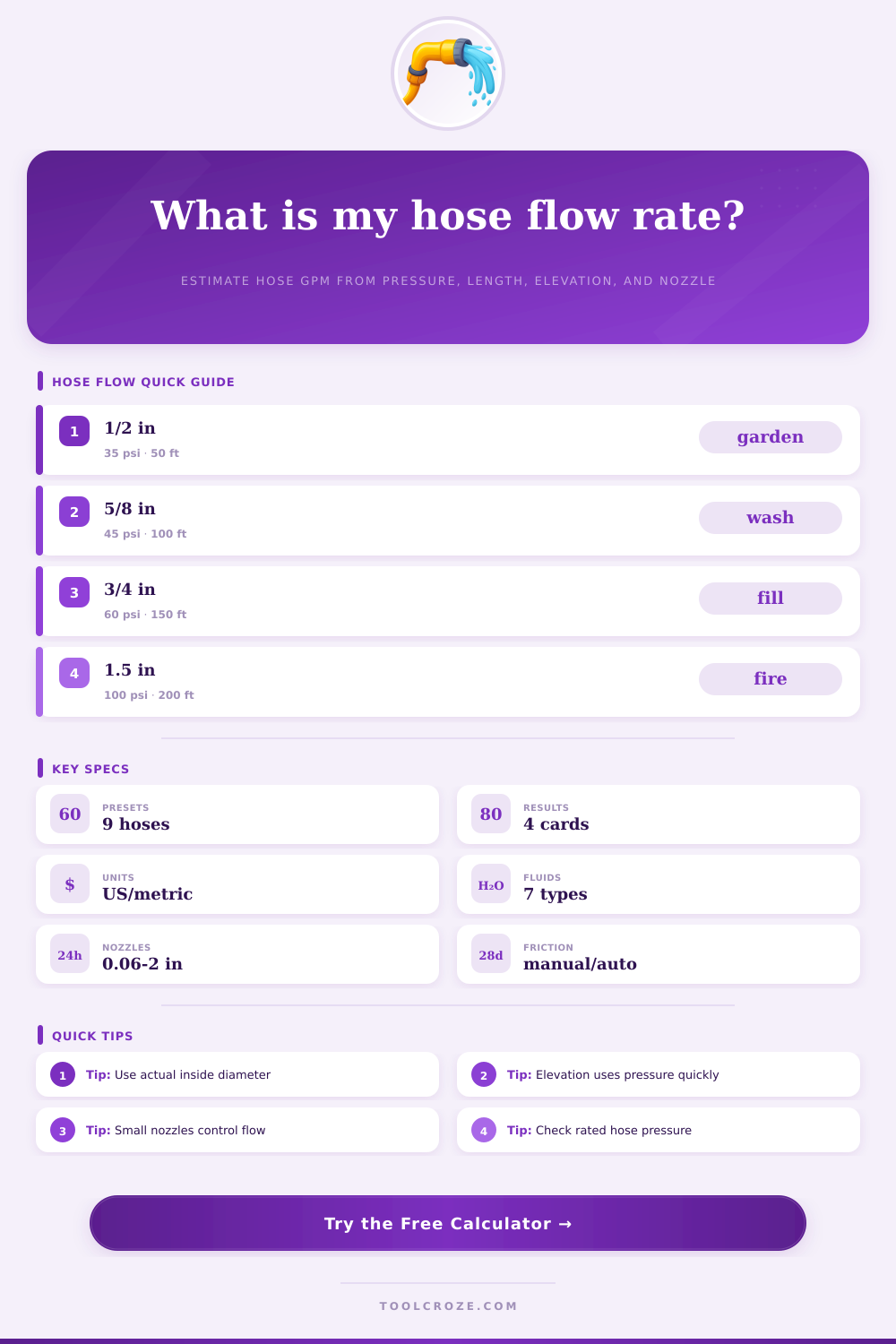
Hose Flow Rate Calculator
Estimate hose flow from inside diameter, supply pressure, hose length, elevation rise or drop, nozzle or orifice size, friction factor, minor losses, and fluid properties.
Use actual ID, not nominal outside diameter.
Use a negative value when the outlet is lower than the supply.
Set equal to hose ID for an open outlet.
Allows for couplings, valves, bends, reels, strainers, and quick connects.
Only used in auto friction mode.
Hose Flow Estimate
Estimated Flow Rate
0
GPM after allowance
Hose Velocity
0
ft/s in hose
Friction Head Loss
0
ft of fluid
Outlet Velocity
0
ft/s through nozzle
62.4
Water lb/ft³
2.31
ft head per psi
0.018-0.030
Common Darcy f
5-12
Good ft/s range
| Hose type | Typical ID | Typical working pressure | Calculator note |
|---|---|---|---|
| Light garden hose | 1/2 in / 12.7 mm | 40 to 80 psi | Small ID causes high loss on long runs. |
| General garden hose | 5/8 in / 15.9 mm | 40 to 100 psi | Common washdown and yard supply size. |
| High-flow garden hose | 3/4 in / 19.1 mm | 60 to 150 psi | Better for sprinklers, filling, and long runs. |
| Transfer hose | 1 in / 25.4 mm | 50 to 150 psi | Good for tanks, pumps, and low restriction flow. |
| Fire attack hose | 1-1/2 in / 38 mm | 150 to 300 psi | Use department friction charts for final fireground work. |
| Large discharge hose | 2 in / 51 mm | 50 to 200 psi | Flow is often pump or fitting limited. |
| Outlet type | Typical Cd | Common diameter range | How it affects flow |
|---|---|---|---|
| Open hose end | 0.98 to 1.00 | Same as hose ID | Hose friction dominates when no smaller nozzle is fitted. |
| Smooth bore nozzle | 0.92 to 0.98 | 1/8 to 1-1/4 in | Good jet flow with moderate discharge loss. |
| Sharp-edge orifice | 0.60 to 0.65 | 1/16 to 1 in | Higher contraction loss, lower actual flow. |
| Adjustable spray nozzle | 0.70 to 0.90 | Varies by setting | Pattern setting can be the controlling restriction. |
| Sprinkler nozzle | 0.75 to 0.95 | Small jets | Manufacturer pressure-flow charts are best for final tuning. |
| Fluid | Density | Viscosity | Flow effect |
|---|---|---|---|
| Water 60°F / 16°C | 62.37 lb/ft³ / 999 kg/m³ | 1.12 cP | Baseline for most garden and shop calculations. |
| Hot water 140°F / 60°C | 61.99 lb/ft³ / 993 kg/m³ | 0.47 cP | Lower viscosity may reduce friction factor. |
| Seawater | 64.0 lb/ft³ / 1025 kg/m³ | 1.08 cP | Slightly denser, similar viscosity to water. |
| 30% propylene glycol | 64.2 lb/ft³ / 1028 kg/m³ | 2.7 cP | More viscous, so long hose losses rise. |
| Hydraulic oil ISO 46 | 54.3 lb/ft³ / 870 kg/m³ | 40 cP | Viscosity can dominate and lower Reynolds number. |
| Check | Typical range | Problem sign | Adjustment |
|---|---|---|---|
| Darcy friction factor | 0.018 to 0.030 water hoses | Manual factor too low | Use auto mode or a rougher value. |
| Hose velocity | 5 to 12 ft/s / 1.5 to 3.7 m/s | Noise, whip, pressure loss | Use larger ID or shorter hose. |
| Elevation head | 2.31 ft per psi for water | Outlet higher than supply pressure allows | Raise supply pressure or lower outlet. |
| Nozzle ratio | Nozzle area below hose area | Very high outlet velocity | Use a larger nozzle or lower pressure. |
Hose flow is an important measurement for many tasks. Understanding the flow of a hose allow a person to determine how much water will exit the hose. Many peoples use hoses for gardening, construction, and maintenance tasks.
The amount of water that exits a hose is not dependent upon the pressure that is applied to the hose; other factors that impact the flow of water include the diameter of the hose, the length of the hose, the elevation changes of the hose, and the type of nozzle attach to the end of the hose. Each of these factors impacts the flow rate of water through the hose; thus, a calculator can be used to determine the flow rate of a hose by entering each of these factors. One of the factors that the calculator should take into consideration is the inside diameter of the hose.
What Affects Water Flow in a Hose
The diameter of the hose impact the area within the hose, and that area impacts the flow of the water within the hose. For instance, if the inside diameter of the hose is small, high friction within the hose will reduce the flow of water through the hose. Therefore, the inside diameter should be used rather than the outside diameter.
Additionally, changes in the elevation of the hose will impact the pressure within the hose. Thus, changes in the elevation will impact the flow rate of the water within the hose. For example, if the hose moves uphill, the elevation change will reduce the pressure of the water within the hose.
The resulting loss of pressure will reduce the amount of water that exit the end of the hose. Therefore, the elevation change can be entered into the calculator to permit the calculator to account for the loss of pressure within the hose. Nozzles and the fittings that attach to the hose can also impact the flow of the water through the hose.
For instance, the nozzles that are attached to the end of many hoses will restrict the amount of water that can exit the nozzle. The nozzle has a discharge coefficient that impact the flow of water. For example, if the nozzle is smooth, more water can exit the nozzle than if the nozzle is sharp or restrictive.
Additionally, any water fittings will create resistance within the hose, which is referred to as “minor losses.” These minor losses can impact the flow of water within the hose, and so a field for entering a “K” factor is included within the calculator to account for these effect. The properties of the fluid within the hose can also impact the flow through that hose. For instance, the most common fluid used within hoses is water.
However, other fluids such as glycol or oil may also be used within the hose. Each fluid has a viscosity that impact how the fluid moves within the hose. For instance, fluids that have high viscosity will create friction within the hose.
This friction will reduce the flow of that fluid through the hose. Therefore, a fluid selection is permitted within the calculator, which will also allow for the density and viscosity of that fluid to be automatically change to reflect that fluid. The calculator can reveal four specific pieces of information regarding the hose system.
For instance, flow rate after allowance is provided. Additionally, the calculator also provide velocity within the hose, friction head loss, and the outlet velocity of the water through the nozzle. Each of these four pieces of information help to provide a complete understanding of the water system, and the four parameters can each be used to analyze the system.
In addition to each of the factors that impact the flow of water through a hose, there are also other factors that impact that flow rate in the real world. For instance, hoses age over time, fittings within the system may corrode, and pumps may not be able to reach their rated pressure. Thus, it is recommended to enter a ten or fifteen percent allowance within the calculator to account for the possibility that the system will not reach the calculated flow rate.
Additionally, the calculator includes reference tables that list common hose inside diameters and nozzle discharge coefficients in case exact measurements are not available. Water velocity is a factor that should be considered. For instance, the velocity of the water within the hose should be between five and twelve feet per second.
Too slow of a velocity will prevent the hose from effectively performing its task; too fast of a velocity can make the hose difficult to control, and can even result in “water hammer.” Water hammer is dangerous and can lead to broken pipes; thus, if the calculated velocity falls within the dangerous range, the calculator will allow a user to change the diameter of the hose to reduce the velocity. Another factor to consider is the elevation and length of the hose. For instance, an uphill slope will make it difficult for the water to move uphill; the elevation will reduce the pressure, and the length of the hose will create friction.
Thus, both factors will reduce the water pressure within the hose. In contrast, a downhill slope may make it difficult to determine issue with the hose; gravity will increase the water pressure within the hose, but the diameter may be too small for the task. Therefore, it is beneficial to calculate the flow rate for both uphill and downhill scenarios.
Another factor that impacts the calculations of the flow rate of water is the friction factor. A user can manually enter the friction factor if they are using a chart to determine the value of that factor. An “automatic” mode is also provided that will calculate the friction factor based upon the Reynolds number for the system.
The two factors are similar for water moving through a smooth hose. However, the factors can be significantly different for other fluids and hoses. The friction factor determines the head loss in the hose.
The head loss within the system is the factor that determine the pressure within the hose at its outlet. Many people make mistakes when calculating the flow rate of water through a hose. Some people use the outside diameter of the hose in place of the inside diameter of the hose.
Others do not account for the elevation within the hose. Other mistakes include not accounting for dirty strainers or open valves. However, before a person installs a hose system, they can use the calculator to determine the consequence of these mistakes.
For instance, users may be surprised to see that increasing the diameter of a hose increases the flow more effectively than increasing the pressure of the system. Additionally, changing the nozzle at the end of the hose is one of the easiest fix for a flow problem. Safety should always be considered in the design of a water system using hoses.
For instance, the pressure within the system should never exceed the rated working pressure of the hose. Additionally, the water system should never exceed the rated temperature of the hose. Any hose with high flow rates should be secured.
Additionally, the hose should always be depressurized before changing a nozzle or fitting. The calculator allows individuals to understand what the water within the system will do. However, the calculator cannot change the physical limit of the hose.
Thus, every individual should respect the physical limits of the hose and it’s fittings for their own safety when using the system.