
Do you feel panicky on a hot day when temperature gauge reaches max and your windshield fogs with steam from a burst radiator hose? It’s the screw holding a metal band that keeps your coolant circulating. Without it, you either has to call a tow truck or drive yourself home. Hose clamps are considered generic items by most. Instead, think torque specifications and material science. If not, that mistake usually cost more then the clamp itself.
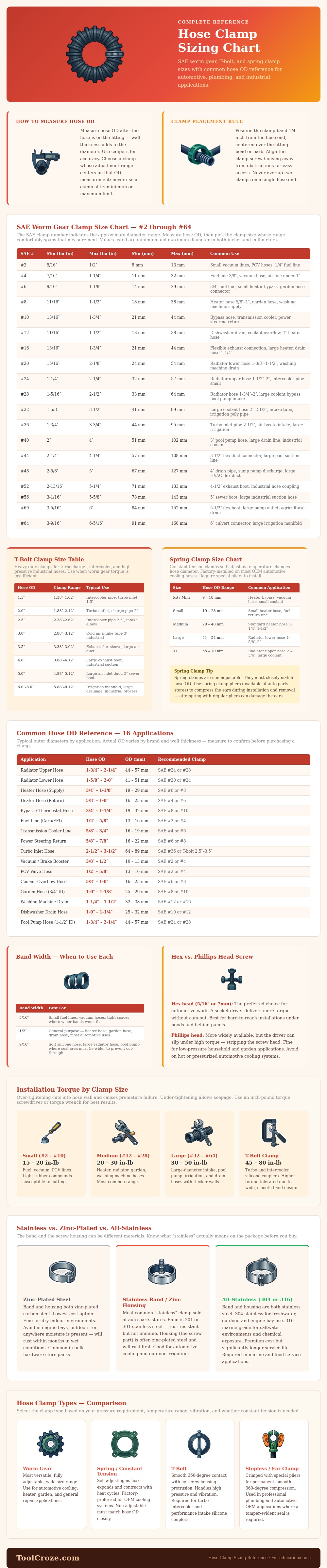
There is a picture of the sizing chart. Spring clamps, T-bolt clamps, and SAE worm gear clamps has their diameter ranges listed in the chart. That saves you having to guess at what size will fit your heater hose. By the way, clamp size is stated as outside hose diameter. It is not the inner diameter. Lots of DIYers just go by the inner diameter and choose a clamp with an equal size. But when it’s on, it get too loose because you’re taking into consideration the thickness of the rubber walls. A caliper is worth its weight in gold because tape measures lack the precision needed for this task. SAE sizes aren’t stated at a specific number but they are a range. Center your hose diameter inside this range. Why? So you don’t push up against the mechanical stops of the adjustment mechanism.
How to Choose and Install Hose Clamps Correctly
Size isn’t everything. Where you put it counts too. The band need to be positioned roughly a quarter-inch from the end of the hose. Place it not on the low-friction smooth part, but above the high-friction bead. Two overlapping clamps won’t make an even clamp and will slice into the rubber. The more metal doesn’t equal more secure. It’ll pinch your hose at the weak spot. Screw housing must stay clear of heat sources and moving engine parts. Exposed thread corrodes fasterer.
Turbocharger/intercooler hose clamps should be rated for holding power but many common worm gear clamps is not. T-bolt clamps spreads force across the full circumference. No projecting screw housing obstructs air flow. They are rated for continuous high heat changes and vibration. In these conditions, a standard clamp can loosens up. Spring clamps provides consistent tension and automatically self-adjust to the changing length of expanding and contracting hoses. Used in OEM cooling systems to eliminate the risk of human error during installation torque. Spring clamps is permanent; you cannot adjust. Make sure it’s the right size.
Until they start to rust, material selection is important. For indoor, dry applications, low-cost zinc-plated steel bands are fine. Within a few months in an engine bay, they’re orange powder. Outdoors or under-hood, only stainless steel bands make sense. Many clamps combine metals: The band may be stainless but the housing is still zinc plated. That housing will corrode first and trap the adjustment screw. All-stainless construction costs more but outlasts the cooling system.
Failure also comes from excessive torque. Torquing a tool against a hose too hard tears into the wall of the hose and forms leak paths. Not enough torque and the hose can lose it’s coolant. Using a torque screwdriver ensures equal force is applied. Smaller clamps should of see fifteen to twenty inch-pounds. Large industrial sizes are closer to fifty inch-pounds. Maintaining proper tension will maintain the integrity of the rubber compound. When the engine cools, you’ll be happy you got this right. It’s not just tight, but it’s correct. That’s what makes it hold.
