Honing Stroke Speed Calculator
Estimate axial stroke speed, stone surface speed, included crosshatch angle, overstroke, dwell allowance, and target adjustments before setting up a cylinder hone.
Honing speed results
| Material / bore type | Typical grit path | Included angle | Stone speed | Setup note |
|---|---|---|---|---|
| Cast iron engine cylinder | 180 to 280 | 35 to 50 deg | 180 to 300 fpm | Stable oil-retaining finish |
| Ductile iron sleeve | 220 to 320 | 40 to 55 deg | 220 to 340 fpm | Good for plateau finishing |
| 6061 aluminum bore | 280 to 400 | 30 to 45 deg | 140 to 240 fpm | Use sharp abrasive and fluid |
| Nikasil plated cylinder | 320 to 600 | 25 to 40 deg | 120 to 220 fpm | Light pressure only |
| Hard chrome hydraulic barrel | 220 to 400 | 20 to 35 deg | 100 to 180 fpm | Avoid heat and loading |
| SAE 660 bronze bushing | 280 to 400 | 35 to 50 deg | 120 to 220 fpm | Flush chips continuously |
| 316 stainless sleeve | 180 to 320 | 30 to 45 deg | 90 to 180 fpm | Control glazing and heat |
| D2 or O1 tool steel | 180 to 320 | 25 to 45 deg | 80 to 160 fpm | Use rigid mandrel support |
| Desired included angle | Speed ratio | Pattern effect | Common use |
|---|---|---|---|
| 20 deg | 0.176 axial/stone | Very flat hatch | Low oil transport |
| 30 deg | 0.268 axial/stone | Shallow hatch | Plated bores, chrome |
| 45 deg | 0.414 axial/stone | General engine finish | Cast iron cylinders |
| 50 deg | 0.466 axial/stone | Open oil path | Ductile sleeves |
| 60 deg | 0.577 axial/stone | Aggressive oil return | Selected long-stroke builds |
| Grit stage | Purpose | Pressure cue | Dwell risk | Finish cue |
|---|---|---|---|---|
| 180 grit | Size correction | Moderate pressure | High if paused | Visible valleys |
| 220 grit | Standard finish | Steady pressure | Medium | Uniform matte hatch |
| 280 grit | Fine engine finish | Light to medium | Medium | Cleaner peaks |
| 320 grit | Plateau prep | Light pressure | Low to medium | Reduced peak height |
| 400 grit | Plated bore touch | Very light | Low | Fine, even texture |
| 600 grit | Superfinish | Minimal pressure | Low | Polished plateau |
| Preset | Bore | Stroke rate | RPM | Target angle |
|---|---|---|---|---|
| Briggs-Style Cast Iron Liner | 2.690 in | 130 spm | 310 rpm | 45 deg |
| Small Block Chevy 350 Bore | 4.030 in | 120 spm | 230 rpm | 45 deg |
| GM LS Iron Sleeve Finish | 3.905 in | 115 spm | 245 rpm | 42 deg |
| Cummins 5.9 Wet Sleeve | 4.020 in | 105 spm | 210 rpm | 50 deg |
| Nikasil Motorcycle Cylinder | 3.228 in | 95 spm | 260 rpm | 32 deg |
| Chrome Hydraulic Barrel | 3.000 in | 70 spm | 210 rpm | 28 deg |
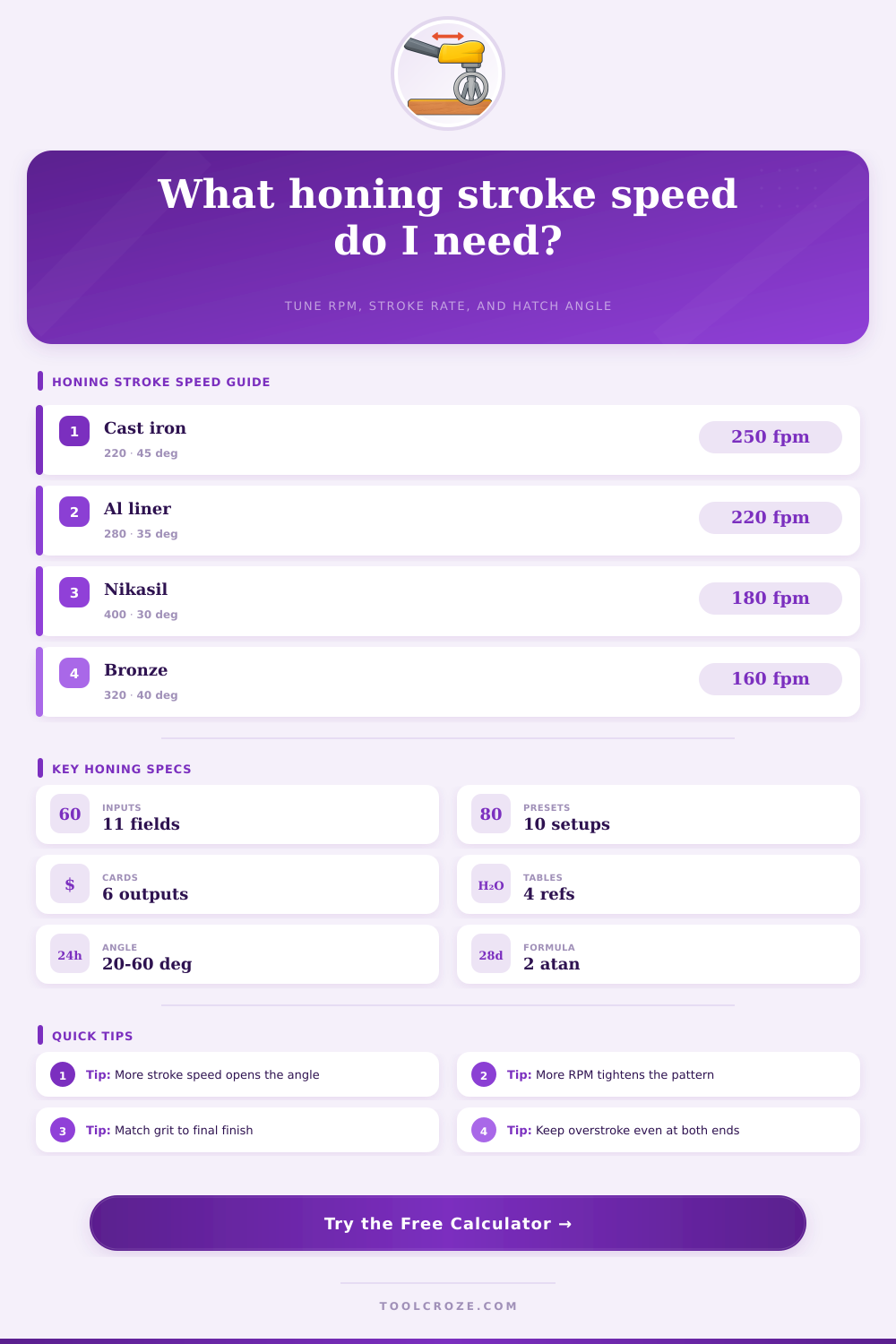
The calculator compares stroke rate, spindle RPM, stone speed, overstroke, material, grit, and dwell so a machinist can preview crosshatch geometry before trial cuts. The calculator compares factors like stroke rate, spindle RPM, stone speed, overstroke, material, grit, and dwell so a machinist can preview crosshatch geometry before trial cuts. Grit and dwell is independent factors that affect the outcome alongside stroke rate. This is the material type.
A bore’s crosshatch geometry is what separates an average engine rebuild from one that will last forever. How long it stays sealed, how the rings bed in, how well the oil clings to the walls are all controlled by the crosshatch pattern. This is why we created this honing stroke speed calculator so you can preview crosshatch geometry before making trial cuts.
How to Use the Honing Calculator
The right angle is measured in tenths of a degree. Too little and the rings starve for lubrication (you ran the spindle too fast or the stroke too slow). Go the opposite direction, though, and the hatch gets so steep that the rings skate rather then seal. It’s all about feet per minute and a few degrees. That’s what separates oil burning at 5,000 miles from oil burning at 50,000 on your shiny new honed cylinders.
The stroke speed control is deceivingly basic. It’s simply the rate at which the hone moves up and down inside the bore. Combining that with the rotation of the stones produce the recognizable diamond pattern. What most folks don’t know is just how sensitive the included angle will be to minor adjustments on both speed and RPM. Increase your stroke speed keeping RPM constant? The angle opens rapidly. This is why seasoned shops consider these two controls a matched set instead of separate dials.
There’s also another wrinkle that involves material selection. Hard chrome and Nikasil are very unforgiving. They require a shallow crosshatch so the abrasive doesn’t get loaded up and overheat the plating. They also requires slow surface speeds and light pressure. On the other hand, cast iron is naturaly porous, which allows it to hold oil even with an imperfect hatch; this results in a pretty broad angle/speed window where it will still be forgiving. Aluminum falls somewhere in middle here. It requires enough speed to blow off chips before they embed, but not too much. You also need to use a sharper stone.
The calculator accounts for all this going on behind the scenes. As you input your number, it shifts the range references so what you enter appear within the safe zone for that particular bore. But there’s a place for grit too. You need something aggressive enough to straighten a bore but still leave some valleys so it holds oil. Your 220 stone does that. But go up to 600 or 400 grit and now you’re not making a cylinder anymore. Now you’re polishing a plateau where the rings will literal ride. That means knowing when to change stones so you don’t make the all-too-common mistake of glazing a bore because it was perfect on your first pass.
That switch also affects how that dwell time work at stroke reversal. Dwell and overstroke don’t recieve their due. Yet, more than most weekend builders care to admit, both are important. Leaving too much dwell at reversal can result in a small ledge; this prevents the rings from seating properly, which creates blow-by later. Too little overstroke at the other end create a tight spot that the rings won’t ever seat against. You can’t see either of these things happening when the machine is running. So, checking it with this tool or on paper will pay off before metal meets stone.
There are variables that go beyond what the math can tell us in real world applications. The coolant temp will affect how the stone act. The pattern tightens to one side or the other because the mandrel deflects under load. How you cut the edge at the top of the cylinder also impacts the action of the hone on the initial stroke. But the numbers serves as a reliable starting place. Dial in the desired angle for your particular application. Then monitor where it lands with respect to axial speed and recommended RPM. Then make small adjustments based off what you see after the first light pass to find out how it is reacting to the actual material.
So what’s honing? It’s part feel and part geometry. The calculator handles the geometry of the hone so your hands can focus on the feel of it. Dial those two in correctly, and the rest of the bore just happens. The rings seats in a few minutes and when she fires up, the engine will tell you it likes what you’ve done the very first time. The crosshatch you dial in at the bench table is why the build lasts for years.