Hole Saw Arbor Depth Calculator
Check whether the cup depth, pilot bit protrusion, plug clearance, and mandrel travel are enough for a clean hole saw cut.
Arbor depth result
Full calculation breakdown
| Arbor or system | Typical usable cup depth | Common pilot protrusion | Practical depth note |
|---|---|---|---|
| Milwaukee Hole Dozer quick-change | 1-7/8 in | 1/2 in | Good for door bores and single-pass framing holes. |
| Diablo Snap-Lock Plus | 1-7/8 in | 1/2 in | Fast plug release; keep slug below the shoulder. |
| Lenox Snap-Back | 1-7/8 in | 1/2 in | Useful when plug ejection is part of the setup. |
| Bosch quick-change mandrel | 1-5/8 in | 3/8 in | Check thick locksets and stacked panels carefully. |
| Starrett A-series deep cut | 2 in | 1/2 in | Extra cup capacity helps with thicker plugs. |
| Job type | Typical saw diameter | Plug stack to expect | Depth planning rule |
|---|---|---|---|
| Door lock bore | 2-1/8 in | 1-3/8 to 1-3/4 in | Use full cup depth; backer may require flipping. |
| Pipe or conduit pass-through | 1-1/4 to 3 in | 3/4 to 1-1/2 in | Add overdrill so the teeth clear the far face. |
| Cabinet grommet hole | 2 to 3-1/2 in | 1/2 to 3/4 in | Cup capacity is usually fine; pilot exit matters. |
| Sheet metal knockout | 7/8 to 2 in | 1/16 to 1/8 in | Mandrel travel is low, but pilot control is critical. |
| Duct or soffit opening | 3 to 4-1/4 in | 1/2 to 1 in | Large cups need room for wobble and plug tilt. |
| Material | Plug behavior | Suggested cup reserve | Overdrill caution |
|---|---|---|---|
| Softwood framing lumber | Fibers compress and spring back | 3/16 to 1/4 in | 1/16 in is usually enough after breakthrough. |
| Hardwood | Dense plug, more heat | 1/4 to 5/16 in | Use modest pressure and confirm mandrel reserve. |
| Plywood / OSB | Layered chips and splinters | 1/4 in | Backer thickness should be counted in the stack. |
| MDF / particleboard | Dust packs around the plug | 5/16 in | Stop and clear dust on deep cups. |
| Aluminum | Thin slug with curled chips | 1/8 to 3/16 in | Keep pilot controlled and avoid over-plunging. |
| Mild or stainless steel | Shallow slug, high resistance | 1/8 in | Travel may be enough, but feed pressure must be controlled. |
| Depth symptom | Likely cause | Calculator field to check | Common correction |
|---|---|---|---|
| Plug jams before breakthrough | Cup depth is too shallow | Usable cup depth and plug clearance | Clear the plug, flip the work, or use a deeper cup. |
| Pilot exits too far early | Pilot protrusion is excessive | Pilot bit protrusion | Shorten pilot exposure if the arbor allows it. |
| Teeth do not clear far face | Not enough overdrill or travel | Overdrill and mandrel travel | Add controlled plunge depth or finish from the back. |
| Chuck bottoms on the cup | Mandrel travel is short | Available mandrel travel | Use a drill press stop, shorter arbor stack, or flip cut. |
| Backer gets grabbed | Backer thickness not counted | Backer thickness | Include the backer only when teeth must enter it. |
Manufacturer dimensions vary by exact model and hole saw series. Use the named presets as planning references, then measure your actual cup depth, pilot protrusion, and mandrel travel before cutting.
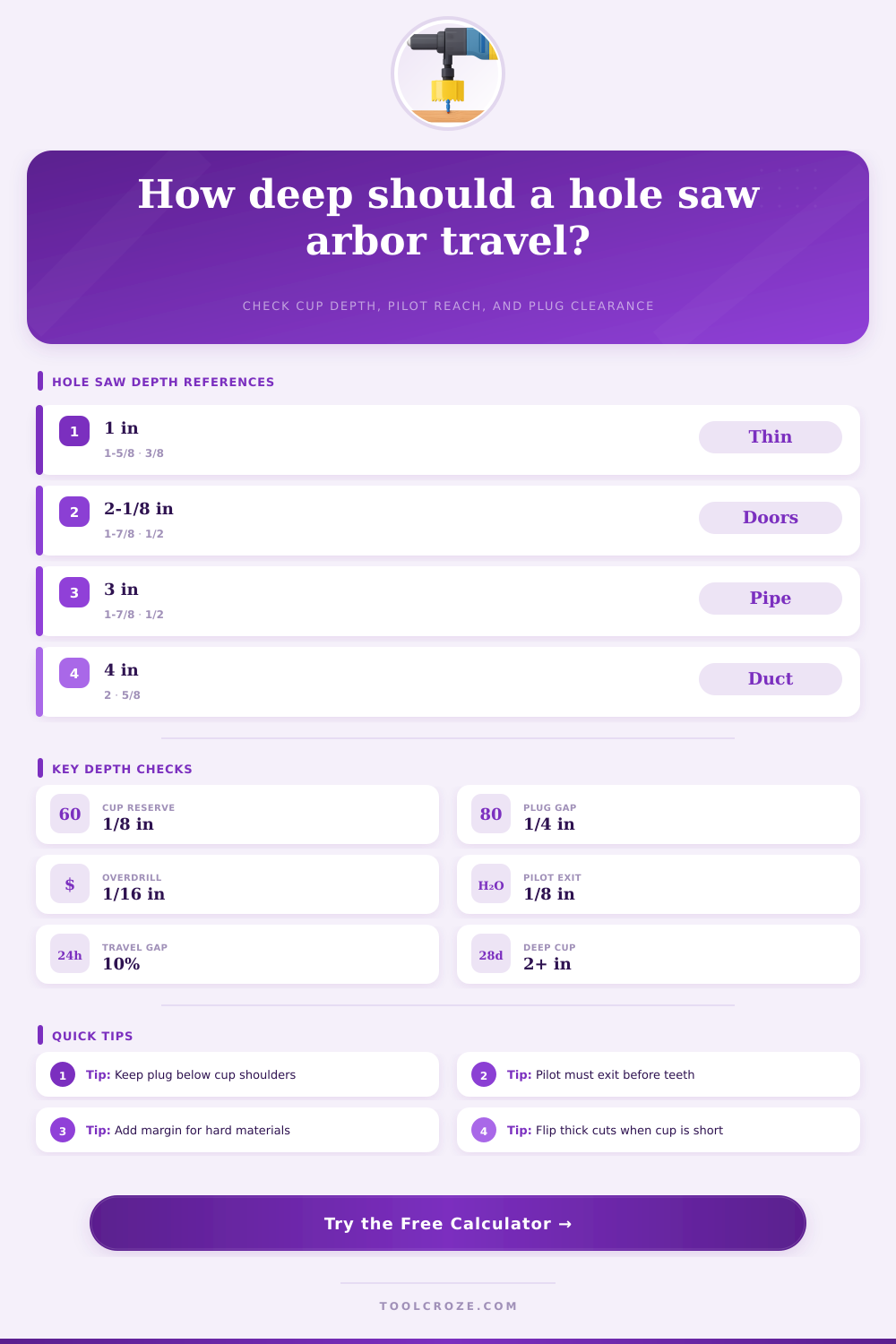
A common mistake among woodworkers are to overlook details like cup depth and pilot reach when setting up a cut. But sometimes we line up a straightforward cut, pull the trigger, and realize that the pilot bit has wandered or jammed in the plug. That’s usually the result of misjudging how much the mandrel travel. It also involves misjudging how far the pilot reach into that space and how deep the cup is meant to sit. All three must be correct or the mess begins, this tool on the page shows the relationship very well.
The calculator take the hole saw diameter as well as the usable depth within the cup. It also takes the thickness of the material being cut and distance the pilot projects beyond the teeth. Does it require a backer board? Are you making a straight cut through material or will you be stopping short? It’s not an abstract question.
How to Use a Hole Saw Correctly
Cup depth is space from the cutting teeth up to the shoulder where the plug eventually stops. When the plug reach the shoulder, there is no further room for it to go. It tries anyway, twists the saw off-center, heats up, and binds. This is why many woodworker don’t know about it … until they see the drill struggling.
The same applies to how far the pilot stick out. The bit needs to set the center first then the teeth cut into the wood. But do not go too far out so you damage other side or mess up your backer board. That’s where the little allowance is in the calculator for that exit point. So now you can determine if you have the right pilot setting for enough lead-in but no new problems.
Then there are things like packing chips and swelling of the material itself. You’ll generally want a little more than dead-on through the material to completely sever the fibers. Factor in a safety margin for mandrel travel and it gets complicated. The tool does all of that in one step.
The perfect situation displayed on packaging is not always what happens in real life. Hardwood plugs are denser and generate more heat, so they need a bit more breathing room inside the cup than softwood. They will also generate less heat. Plugs will bind if they do not has enough space in the cup. MDF dust packs tight.
If the numbers add up correctly on paper, that means there isn’t much room left for usable cup depth. If you have a shallow cup, flipping a thick door lock cut over will often save the day. This way, you won’t have to purchase an arbor deep enough to handle it. Adjusting the inputs will show you those options on the calculator.
The tool clearly shows how common mistakes occur. For example, someone might set zero clearance because the plug usualy comes out, but it fails during a crucial job. Another mistake is not accounting for the safety factor of mandrel travel. You think you have two and three-quarter inches to plunge. That number is reduced by natural give in the drill, vibration, and the force applied by the operator.
At first a ten percent buffer sounds like not much. Half a hole undone with the chuck grinding against the shoulder of the cup makes it very critical. The reference tables on the page provide context for common jobs. A cup holding a one-and-three-eights-inch plug with some clearance is about right for door lock bores that typically run around two inches. For pipe penetrations, a bit of overdrilling beyond the teeth are required to ensure clean clearances on the far side.
Knockouts in sheet metal are forgiving regarding how deep the cup is, though they are very particular about pilot control. Patterns like this help you gauge whether yours is standard or requires adjustment. It doesn’t substitute for taking accurate measures of your own tools. Even in the same moddern model line there can be slight variations in manufacturer cups.
Before you cut, it’s always best practice to measure quill travel, pilot stick-out and cup depth with a ruler then put those numbers in the calculator. That makes the numbers real measurements. Those go into the tool that gives you a clear verdict. You wouldn’t of had to guess halfway down the plunge.
If executed properly, a hole saw feels effortless. It’s as if the teeth is gliding across the material and the plug falls away exactly when needed. No straining of the drill while cutting. Understanding how the different depths interact is what makes that happen. Seeing the pattern lets you work with the tool rather than fight against it.