Hole Punch Force Calculator
Estimate hole punching force from diameter, shape perimeter, sheet thickness, material shear strength, die clearance, punch shear relief, stripper force, holes per stroke, and press tonnage.
Hole punch force results
Calculation breakdown
| Material | Typical shear strength | Clearance per side | Stripper guidance | Punching note |
|---|---|---|---|---|
| Aluminum 5052-H32 | 23 ksi / 159 MPa | 4% to 6% of thickness | 5% to 10% | Good sheet formability and moderate burr control. |
| Aluminum 6061-T6 | 31 ksi / 214 MPa | 5% to 7% of thickness | 5% to 12% | Harder than 5052; watch edge cracking in tight radii. |
| Mild steel 1018 | 45 ksi / 310 MPa | 6% to 8% of thickness | 8% to 15% | Common baseline for turret, ironworker, and press tooling. |
| Galvanized sheet steel | 48 ksi / 331 MPa | 7% to 9% of thickness | 10% to 18% | Coating can increase galling and withdrawal force. |
| Stainless steel 304 | 75 ksi / 517 MPa | 9% to 12% of thickness | 12% to 22% | High work hardening; use sharp tooling and adequate clearance. |
| Copper 110 | 26 ksi / 179 MPa | 4% to 6% of thickness | 10% to 18% | Ductile and sticky; stripping load can surprise the setup. |
| Cartridge brass 260 | 36 ksi / 248 MPa | 5% to 7% of thickness | 6% to 12% | Punches cleanly but can crack with poor edge condition. |
| Annealed tool steel | 88 ksi / 607 MPa | 10% to 13% of thickness | 12% to 25% | Confirm punch compressive strength and press reserve. |
| Hole shape | Perimeter formula | Diameter input | Width and length inputs | Use case |
|---|---|---|---|---|
| Round | pi x diameter | Hole diameter | Ignored | Bolts, pins, conduit holes, knockouts. |
| Square | 4 x width | Ignored | Width is side length | Carriage bolt holes and square pierce punches. |
| Rectangle | 2 x (length + width) | Ignored | Both used | Tabs, windows, connector openings. |
| Obround or slot | 2 x straight + pi x end diameter | Optional fallback | Width and length used | Adjustment slots, panel brackets, elongated holes. |
| Hex | 2 x sqrt(3) x across flats | Across flats fallback | Width preferred | Hex key holes and specialty punches. |
| Custom | Measured perimeter | Ignored | Custom perimeter field | D-shapes, keyed holes, lanced forms, odd punches. |
| Setup factor | Typical range | Force effect | Quality effect | Setup caution |
|---|---|---|---|---|
| Straight punch face | 0 shear height | Full peak force | Balanced slug and square load | Highest tonnage demand. |
| Light punch shear | 0.2t to 0.5t | Small to moderate peak reduction | Often still stable | Check punch face angle and slug control. |
| Heavy punch shear | 0.5t to 1.5t | Large peak reduction | Can distort thin sheet | Side load and uneven stripping can rise. |
| Tight die clearance | Below material range | Load and wear increase | Lower rollover, higher burnish | Risk of chipping and galling. |
| Loose die clearance | Above material range | Force may fall slightly | Burr and rollover increase | Slug pulling and edge taper may increase. |
| Sticky material | 10% to 25% stripper | Withdrawal demand rises | Can pull slugs or lift sheet | Size springs, urethane, and stripper plate. |
| Preset | Material | Hole geometry | Thickness | Practical note |
|---|---|---|---|---|
| 1/2 in Mild Steel Bracket | 1018 mild steel | 0.500 in round | 0.125 in | Common ironworker and hand-fed press job. |
| 1/4 in 304 Stainless Panel | 304 stainless | Two 0.250 in rounds | 0.105 in | High shear strength and higher stripper load. |
| D-Sub 5052 Aluminum Slot | 5052 aluminum | 0.500 x 1.125 in obround | 0.080 in | Panel connector opening with light punch shear. |
| 1/2 in Square Tube Hole | Mild steel tube | 0.500 in square | 0.083 in | Shape perimeter drives load more than area. |
| Brass Washer Four Holes | 260 brass | Four 0.188 in rounds | 0.064 in | Multiple holes per stroke multiply tonnage. |
| Copper Busbar Bolt Hole | 110 copper | 0.406 in round | 0.250 in | Thick, ductile material with meaningful stripping force. |
| HVAC Galvanized Knockout | Galvanized steel | 1.125 in round | 0.036 in | Large perimeter but thin sheet keeps tonnage modest. |
| Tool Steel Fixture Plate | Annealed tool steel | 0.375 in round | 0.1875 in | High load; verify punch, die, holder, and press capacity. |
The hole punch force calculator calculates margin, punch shear relief, clearance, stripper load, press tonnage, and cutting force. It use your press capacity, material shear strength, thickness, and hole geometry to do this.
Punching a hole in sheet metal seems like such an easy task, until it bangs, bottoms out the press, and has everyone in the shop looking up. Then you’re left facing a cracked die, a bent punch or some other tonnage overload no one saw coming.
How to Use the Punch Force Calculator
It’s not just the size of the hole that determines how much force to expect. Several factors combine to surprise first-timers. These include how the punch enter the material, the thickness, the shear strength, and the perimeter. So, know the numbers before you hit the green button.
Then there’s the material. Mild steel at 0.125 inches doesn’t behave remotly like 304 stainless of the same thickness. You’ll be able to select typical materials (or add one you have data for) on the alloy selector. But don’t make the age-old error of using tensile strength rather than shear. Shear, which is what fights back against the edge, tend to be lower. And if that figure is incorrect, everything else will change to match.
It takes you through that step with both the baseline cutting force as well as the effect of adjusting clearance. Going too tight can increases maximum force by as much as ten or fifteen percent. It also helps cut quality. Too loose decreases the force slightly but results in larger pieces of crud (burrs and slugs) that won’t fall free cleanly.
Most folks is surprised that shape plays a greater role than expected. For a fixed amount of area, a round hole has the smallest perimeter (i.e., less tonnage). Change to an obround or even a rectangle slot and the cutting edge length increase. Watch how quickly the perimeter changes on the calculator as it reflect your changes. It’s this one number that drives the whole estimate of force.
Then introduce multiple holes per stroke and total load rises rapidly. Small hole may appear harmless until the math reveals they equate to one really big punch. The smartest lever you pull is punch shear relief. You roof or angle the punch face to spread the cut across a length, rather than slam it all together at once. Tonnage can drop significently. What you give up is slug control & side load. It tell you exactly where you put relief into the tool and what that factor was. No magic here. Excessive shear on light material can cause erratic stripping or even tilt the slug.
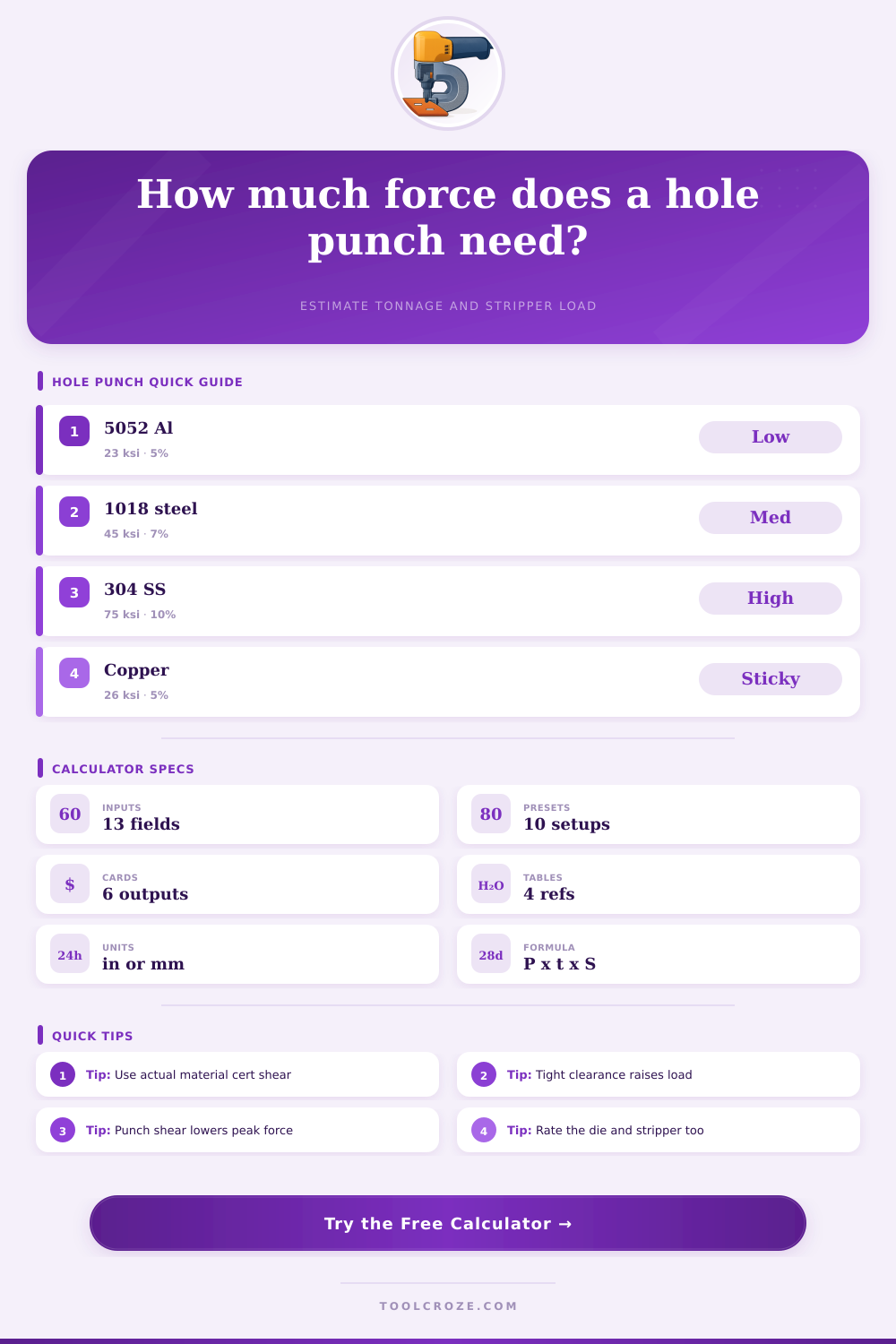
This is the stripper. Lots of rigs make stripers an afterthought until the sheet comes up when punched and fouls the following shot. Typically, stripper force is 5-20% of cut force (it pushes higher on gummy stuff such as copper). With the stripper force estimate from this calculator you’re not guessing at spring size or urethane, just estimating realisticly how much force is needed for withdrawal.
In the real world, there is no single magic number that makes a decision. Then again, you have to consider lubrication, tool sharpness, press condition, and how many safety factor your shop actualy needs. For controlled production, a 10 percent margin is plenty. Prototype runs on unknown stock would of be 20-30 percent. The output labeled design tonnage rolls all of this reality into one place so you are not comparing apples to theoretical oranges.
But those are the best users who don’t take it as gospel but use it as a starting point for a conversation. They plug in their numbers, look at the reference table on the page then walk out to the machine and make one test hit with a load cell or careful observation. That feedback loop turns the calculator from a black box into a shop veteran who has seen every mistake before.
The trick is to get it right, because when you get it wrong, you don’t work at all. Respect what the numbers say to you in terms of shear and clearance and run ‘em and leave yourself some wiggle room. You’ll be thankful, your press will be thankful, your tooling will be thankful and so will your nerves.