Hip Rafter Angle Calculator
Turn roof pitch and plan angle into hip layout numbers, bevels, and rafter length checks before you cut.
1Layout Inputs
2Results
3Reference Guide
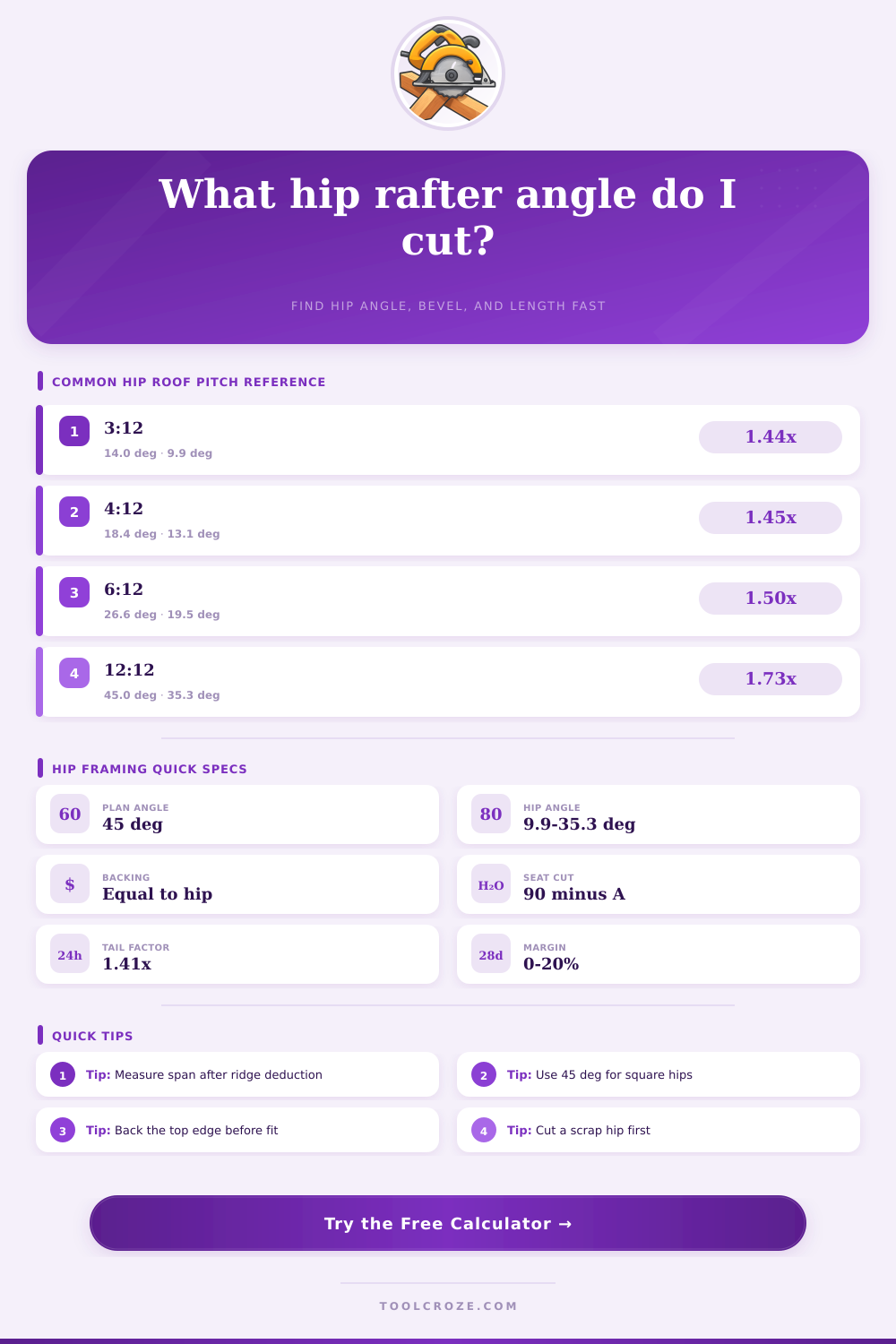
| Pitch | Common angle | Hip angle | Hip factor |
|---|---|---|---|
| 3:12 | 14.0 deg | 9.9 deg | 1.44x |
| 4:12 | 18.4 deg | 13.1 deg | 1.45x |
| 6:12 | 26.6 deg | 19.5 deg | 1.50x |
| 12:12 | 45.0 deg | 35.3 deg | 1.73x |
| Task | Angle | Use | Note |
|---|---|---|---|
| Plumb cut | Hip angle | Rafter end | Square cut |
| Plan miter | 45 deg | Square hip | Corner set |
| Backing | Hip bevel | Top edge | Roof fit |
| Seat cut | 90 minus A | Birdsmouth | Wall seat |
4Tips and Safety
Layout tips
- Measure span after ridge deduction.
- Use 45 deg for a square hip corner.
Cutting tips
- Back the top edge before final fit.
- Test the setup on a scrap hip first.
Keep the workpiece supported, wear eye and ear protection, and confirm saw settings with a scrap cut before touching the real rafter.
Hip rafters are structural component that extend from the corner of a building to the ridge of the roof. These rafters bridge the gap between two wall that are not parallel to each other. The path that the hip rafters take is different than the common rafters.
While the common rafters typically follow the straight pitch of the roof, the hip rafters must slant in the plan view of the building to follow the diagonal path that the rafters must take to complete the roof. For building with square corners, the hip rafters will typically slant at a 45-degree angle in relation to the building plan view. However, if a building has a rectangular or irregular layout, the angle of the hip rafters will change.
How to Measure and Cut Hip Rafters
Due to the diagonal slant of the rafters, compound angles is required. These compound angles will include plumb, level, and bevel cuts. The pitch of the roof will dictate the angle of the rafters for the roof.
For instance, if the roof has a 6-inch rise for every 12 inches of run, then the hip rafter will have a different angle then the common rafter for that roof. For a roof with a 6-inch rise for every 12 inches of run, a common rafter may require a 26.6-degree plumb cut, but the hip rafter would require a 19.5-degree plumb cut. Additionally, the hip rafter will have a backing bevel so that its top edge will be flush against the roof sheathing.
If the backing bevel is not included for the hip rafter, the roof sheathing will not lay flat against the rafters. In order to cut the correct amount of lumber for the hip rafters, precise measurements must be performed. The total span of the building should be calculated.
However, half the thickness of the ridge board must be subtracted from the total span of the building since the hip rafter will but against the ridge board. The total rise of the roof from the wall plate to the ridge peak should be calculated. The overhang projection for the roof will be longer on the hip rafters than on the common rafters.
The plan angle of the corner of the building should be calculated. Additionally, workers will cut lumber incorrectly on the construction jobsite so an allowance for waste in the total length of the lumber should be included in the calculations. Precise mathematical calculations is necessary to determine the length of the rafters.
The length of rafters can be determined using mathematical calculations since these calculations help to calculate the trigonometry for the hip rafters. The length factor will be calculated and used to determine the total length of the hip rafters based on the length of the common rafters. For instance, if the common rafters are 24 feet in length, the hip rafters may need to be 36 feet in length based on the length factor.
The backing bevel for the rafters will be calculated using the length factor. Additionally, the seat cut for the rafters will be calculated using the length factor. The seat cut will need to be 90 degrees minus the hip angle of the rafters so that the rafters will sit snugly against the wall plate.
However, errors can occur when cutting and installing the rafters. For instance, one of the most common error is to forget to subtract the thickness of the ridge board. If this is done, the rafters will be too short.
Another error may occur in the calculation of the overhang of the rafters. The overhang may be 12 inches on the common rafters, but longer on the hip rafters. Additionally, if the corner of the building is not square, then the plan angle must be calculated when installing the rafters.
A rectangular hip roof will have a different plan angle than a square hip roof. The slopes of the roof can also present challenge for the rafters. Hip rafters will have a harder time being installed on a low-slope roof than they will on a steep-slope roof.
The type of lumber that is used will also present challenges for the rafters. For instance, if Douglas fir is used, it will hold the compound bevels well. However, if engineered lumber is used, such as LVL lumber, it may warp.
In this case, the lumber should be backed properly. Additionally, the top edge of the rafters should be beveled prior to installing the roof sheathing. Additionally, any high spots on the rafters should be planed.
Another challenge will be the birdsmouth cut on the rafters. The birdsmouth cut on the rafters should be deep enough so as to allow the rafters to bear the weight of the roof. However, the thickness of the wall plate should be checked so as not to have the rafters break.
Safety is important when cutting the rafters. The rafters should be secured flat on the sawhorses. Additionally, the rafters should also be secured in a vise.
Eye protection and ear protection should be worn when cutting the rafters since the compound angles will kick some of the wood chips toward the face. Prior to cutting the rafters, the bevels of each angle should be tested on a piece of scrap lumber. Cutting the rafters incorrectly will waste the lumber that will be purchased for the roof.
Finally, the saw stops should be confirmed before the rafters are cut.