Heat Shrink Size Calculator
Size heat shrink tubing from cable or bundle OD, largest connector OD, shrink ratio, recovered ID, wall thickness, overlap length, and temperature rating.
⚡Electrical Presets
📏Sleeve Sizing Inputs
📊Heat Shrink Sizing Result
🧮Current Sleeve Snapshot
📋Heat Shrink Ratio Reference
| Ratio | Typical use | Connector pass margin | Recovered fit caution |
|---|---|---|---|
| 1.5:1 | Marker sleeves and light insulation where OD changes little | Small | Needs a close match to cable diameter |
| 2:1 | General wire splices, simple strain relief, labels, and small terminals | Moderate | Common choice when connector OD is not much larger than cable OD |
| 2.5:1 | Metric transition sleeves and moderate connector shoulders | Good | Verify the listed recovered ID for the exact part number |
| 3:1 | Connector boots, adhesive-lined repairs, and cable-to-terminal transitions | High | Useful when the sleeve must pass a larger feature and still grip cable |
| 4:1 | Harness breakouts, battery leads, molded plugs, and uneven bundles | Very high | Watch wall build and stiffness after full recovery |
| 6:1 | Special boots and extreme transitions | Extreme | Use only when the material data sheet supports the bend and seal need |
🌡Material And Temperature Reference
| Material | Rating | Typical wall | Electrical use |
|---|---|---|---|
| Flexible polyolefin | 125 C | Thin to medium | General cable insulation, marking, and strain relief |
| Adhesive-lined polyolefin | 125 C | Medium to thick | Moisture sealing, marine leads, automotive splices, outdoor repairs |
| Flame-retardant thin wall | 135 C | Thin | Electronics cabinets, panels, and dense wiring with limited space |
| PVDF | 175 C | Thin | High temperature, abrasion, and chemical exposure in compact assemblies |
| Fluoroelastomer | 200 C | Medium | Fuel, oil, solvents, and severe cable environments |
| PTFE | 260 C | Thin to medium | High temperature insulation with strong chemical resistance |
🔌Electrical Preset Reference
| Scenario | Cable or bundle OD | Largest pass OD | Recommended start |
|---|---|---|---|
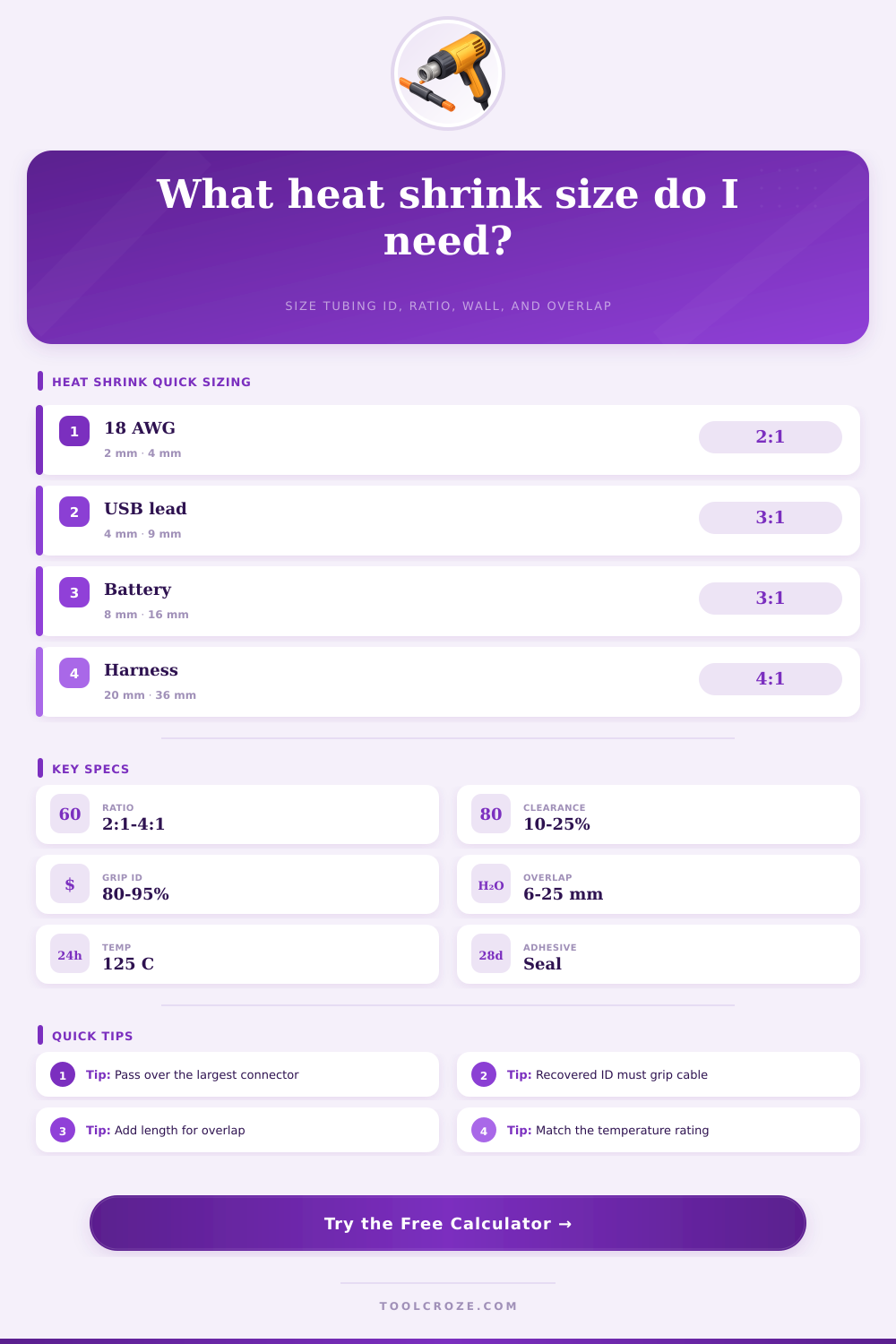
| 18 AWG inline splice | 2.2 mm | 3.5 mm splice barrel | 2:1 thin-wall polyolefin |
| USB cable strain relief | 4.2 mm | 8.5 mm molded plug shoulder | 3:1 flexible sleeve |
| XT60 battery lead cover | 7.5 mm | 15 mm connector body edge | 3:1 adhesive-lined sleeve |
| 8 AWG ring terminal boot | 9.5 mm | 18 mm terminal barrel | 3:1 or 4:1 adhesive boot |
| Sensor harness branch | 12 mm | 22 mm branch transition | 4:1 flexible transition sleeve |
| Panel harness breakout | 20 mm | 36 mm bundle fanout | 4:1 medium wall sleeve |
ℹSizing Tips
When you selects heat shrink tubing for a cable assembly, you have to make sure that the size of the tubing allow it to slide over the largest part of the assembly while still providing a tight grip on that cable after the heat are applied. The size of the heat shrink tubing is important because the size of the heat shrink tubing will impact how well it provides strain relief for the cable, how well it will seal against moisture, as well as how well it will protect the cable against abrasion. If the size is too small for the cable and its largest connector, the tubing will not fit onto the connector.
However, if the size of the tubing is too large for the cable, then the tubing will not grip onto that cable. To determine the size of the heat shrink tubing that you should use for a given assembly, you must consider several different variables of that assembly. For instance, you must consider the outside diameter of the cable, the diameter of the largest connector, the shrink ratio of the heat shrink tubing, how much the heat shrink tubing will recover to after heat are applied, and the correct cut length for the heat shrink tubing.
How to Choose the Right Size Heat Shrink Tubing
These different variables are often complex to consider, so many people simply guess at what size of heat shrink tubing they should use. Because of this complexity, people often make mistakes when guessing at the size of the heat shrink tubing. The calculator that is provided on this page utilizes each of these different variables to output four specific results.
The first result is the minimum supplied inside diameter that is required for the heat shrink tubing to pass over the largest connector. The second result is the supplied diameter that the heat shrink tubing will provide based on the recovered diameter and the shrink ratio. Third, the calculator will provide a fit check that ensures that the recovered diameter of the heat shrink tubing will provide a snug fit on the cable.
Finally, the calculator will provide the cut length of the heat shrink tubing, which includes extra length to account for both the overlap of the heat shrink tubing as well as the shrinkage of the heat shrink tubing with the application of heat. In order for the calculator to provide you with the correct results, the information that you enter into the calculator must be accurate. For instance, you must measure the diameter of the cable and the diameter of the largest connector correctly.
For instance, a terminal may have a much larger diameter than the cables that are inserted into the terminal. Therefore, if the heat shrink tubing is not large enough to pass over that terminal, the tubing will not fit into the terminal. The shrink ratio for the heat shrink tubing is a measurement of the size of the shrinkage that will occur in the tubing when heated.
For instance, a shrink ratio of 2:1 indicates that the heat shrink tubing will shrink to 50% of its original diameter. A shrink ratio of 3:1 or 4:1 indicates that the heat shrink tubing can accommodate for a much larger shrinkage of diameter. The recovered inside diameter is the measurement that should be used to determine the gripping ability of the heat shrink tubing.
Instead, many people make the mistake of using the expanded diameter for this calculation, which will result in a heat shrink tubing that does not adequately cover the cable. Additionally, people must consider the thickness of the walls of the heat shrink tubing. The thickness will provide the protection of the cable but will also make the heat shrink tubing more rigid.
Furthermore, the length of the heat shrink tubing that overlaps itself will affect the performance of the heat shrink tubing. If the heat shrink tubing has adhesive lining, then the overlap length will determine the seal that is created between the heat shrink tubing and the cable. Another important input into the calculator is the temperature rating of the heat shrink tubing.
Heat shrink tubing made of polyolefin, for example, may have a temperature rating of 125 C. Such heat shrink tubing is appropriate for use in most indoor or automotive applications. However, if the application of the tubing is to be used in an engine compartment or in areas that are exposed to chemicals, different materials may be required. The calculator will display the temperature ratings for each of the materials for which the calculator can calculate, so that users can be sure that the temperature rating of the tubing is appropriate for its intended use.
Common mistakes when using heat shrink tubing include incorrectly calculating the recovered diameter to the cable. If the recovered diameter is too large, the heat shrink tubing may shift along the cable. People also often make mistakes when they do not ensure that the supplied diameter is large enough to pass over the largest connector.
People also make mistakes when they do not provide the correct cut length for the heat shrink tubing to account for the shrinkage of the tubing. Furthermore, people make mistakes when they do not account for the thickness of the walls of the heat shrink tubing, especially when the heat shrink tubing is to fit within a conduit box or grommet. In addition to those mistakes, there are other factors in addition to the size of the heat shrink tubing that may impact the performance of the heat shrink tubing.
For instance, the texture of the cable may impact the ability of the heat shrink tubing with adhesive lining to properly bond to the surface of the cable. Additionally, if the assembly containing the heat shrink tubing is exposed to vibrations, any heat shrink tubing that does not provide a snug fit to the cable may shift over time. Additionally, the sharp edges of a connector may cut the heat shrink tubing.
Finally, the changes in temperature may impact the expansion and contraction of the heat shrink tubing relative to the cable. In spite of the risks of any of these variables, the best method is to always measure the components carefully, use the highest shrink ratio necessary to allow the heat shrink tubing to pass over the largest connector, and ensure that the temperature rating of the tubing will survive any exposure to heat within the environment in which it will be used.