
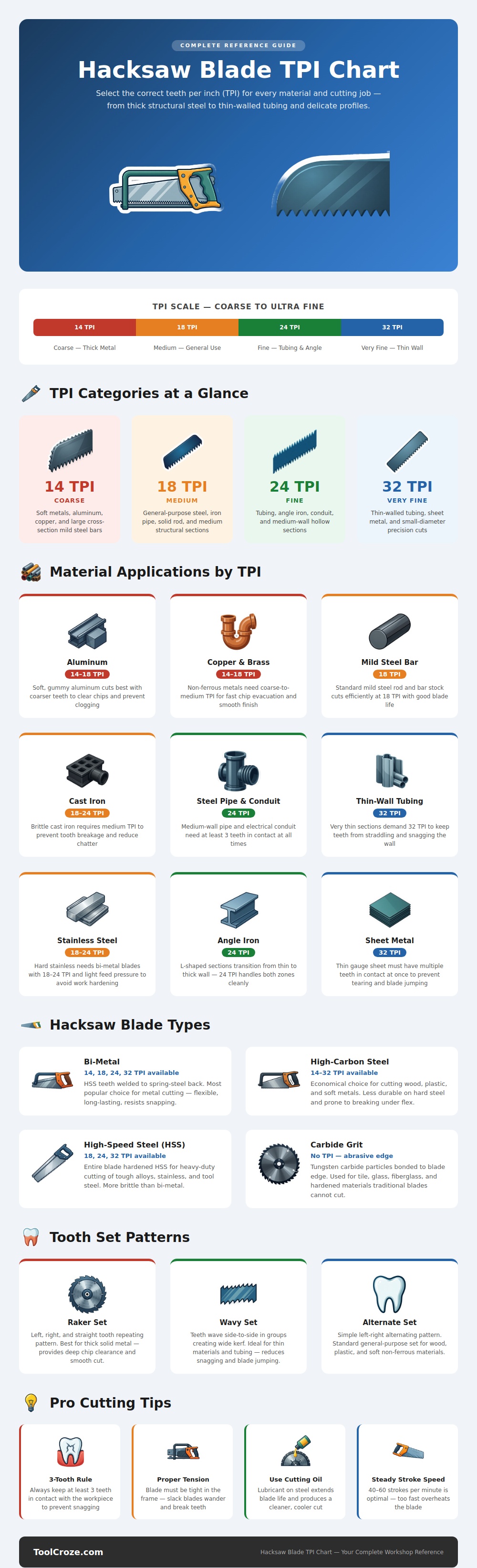
Ever tried cutting with a hacksaw blade that won’t? You grind away and grind away, then push harder and feel frustrated. There’s no bite on the material. What gives? It’s usually not your strength that is lacking; it’s the tooth count versus the thickness of the material being cut. Most folks pick up whatever blade they can find.
Using the right number of teeth (teeth per inch) turns the grind into a clean-cutting action. This is where the visual guide come in. It categorizes your cuts based off material thickness. It goes from coarse to fine for thick stock and delicate profiles.
How to Pick the Right Saw Blade
Think of TPI as a pacing strategy. A few coarse teeth = quick cut. Deep gullets remove chips fast so you don’t get bogged down cutting thick steel or soft aluminum. Use them on thin sheet metal, however, and it’ll just snag. Not enough material between the tooths peaks for it to grip propery.
This is where fine-toothed blades comes into play. When you’re cutting conduit or any other type of thin walled tubing, there’s just not much there to grab onto. The more teeth you have engaged on the object, the less it bind and jumps around. That means that blade isn’t jumping off course or getting hung up. A little mechanical advantage like this go a long way.
You still want plenty of teeth engaging the object so as to spread out the cutting force. If only one or two teeth is doing the work, they will snap under pressure. Those are going to get snappers. Keep at least three teeth gripping the object. This will not only protect your blade, but keep the cut nice and clean.
What happens when stressed? That depends on what kind of blade you have. First off: bi-metal blades are normal. It’s simply welding a cutting edge made of high-speed steel to a spring-steel backing that can be flexible and still not being brittle. You get the best of both worlds with hardness without brittleness.
Cheaper options are carbon steel. They will dull more quickly and, if bent too far, snap. If you’re using them on stainless steel or other tougher applications, some full high-speed steel options is available. These can’t take abuse unless cut squarely or else they’ll be damaged. Then you have abrasive grit blades for things like tile where even regular teeth won’t do.
Choosing the right tool matters, but how you use it matter just as much. A loose blade is a wasted blade. The saw frame needs to be tight so the blade stays straight. Use cutting oil if cutting steel. It reduces friction and heat which extends blade life more considerabley.
Your cut should of have a steady rhythm with about forty to sixty strokes a minute. If you rush your cuts, you generate heat which softens teeth. That defeats the whole reason for having a hard alloy blade.
Respect the material you’re cutting out by matching your blade to the job. Aggressive removal capacity is required for thick stock. Care and support are necessary when thin materials is involved. By selecting the appropriate tooth density from the reference, guesswork is eliminated. It makes a faster, cleaner and quieter cut.
No more fighting the tool; instead, you start working with it. The end result is a square edged cut and a blade that’s still got some life left in it.
