⚡ Ground Wire Gauge Calculator
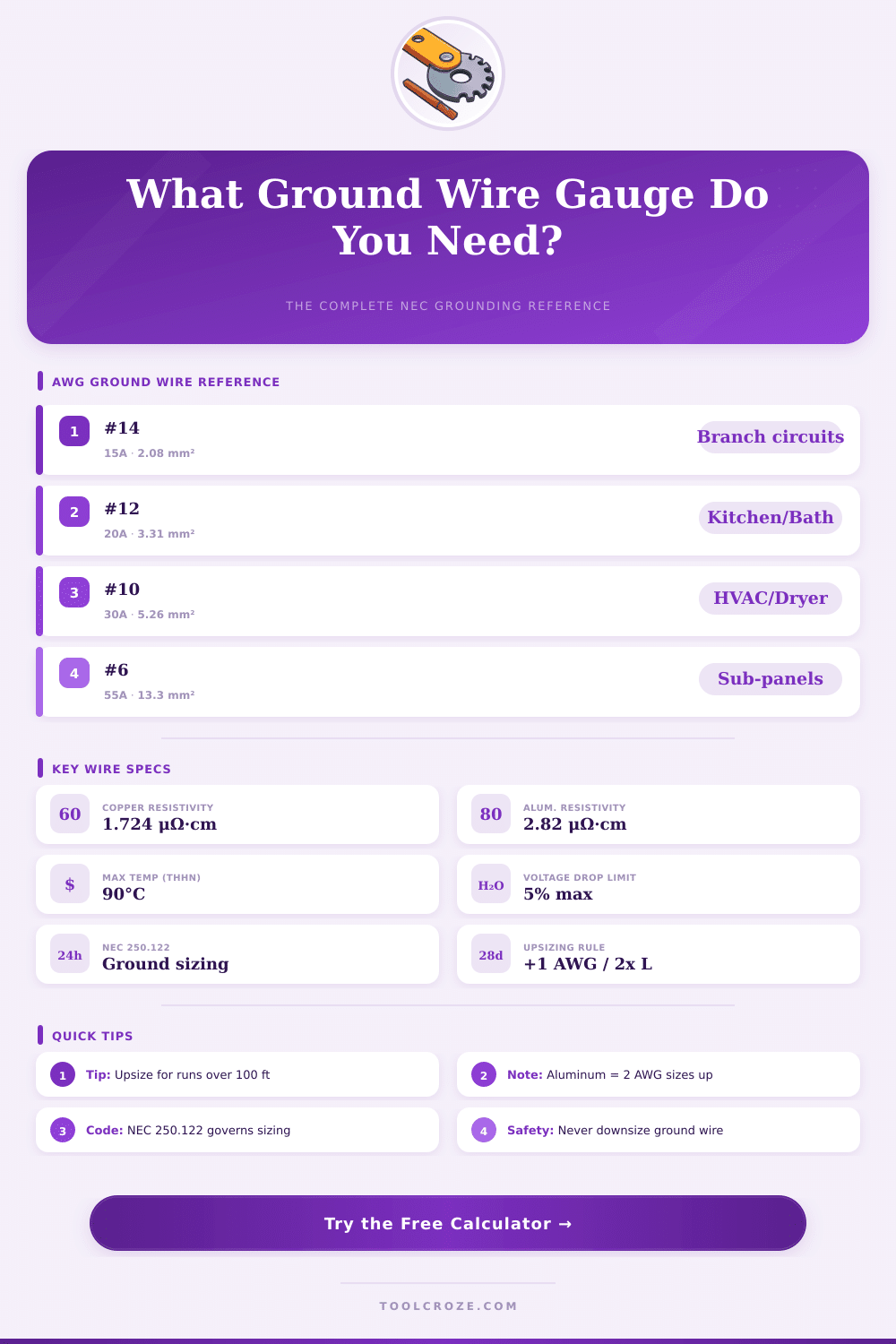
Find the correct AWG ground wire size per NEC 250.122 — enter circuit amps, run length, and material for instant results.
| Breaker (A) | Cu Ground AWG | Al Ground AWG | Cu Area (mm²) | Al Area (mm²) | Cu Dia. (in) | Typical Use |
|---|---|---|---|---|---|---|
| 15 | #14 | #12 | 2.08 | 3.31 | 0.064" | Branch circuits, lighting |
| 20 | #12 | #10 | 3.31 | 5.26 | 0.081" | Kitchen, bath, garage |
| 30 | #10 | #8 | 5.26 | 8.37 | 0.102" | HVAC, dryer, water heater |
| 40 | #10 | #8 | 5.26 | 8.37 | 0.102" | EV charger, range |
| 60 | #10 | #8 | 5.26 | 8.37 | 0.102" | Sub-panel (small) |
| 100 | #8 | #6 | 8.37 | 13.3 | 0.128" | Sub-panel feed |
| 200 | #6 | #4 | 13.3 | 21.2 | 0.162" | Main service entrance |
| 300 | #4 | #2 | 21.2 | 33.6 | 0.204" | Large sub-panel |
| 400 | #3 | #1 | 26.7 | 42.4 | 0.229" | Heavy commercial |
| 600 | #1 | #2/0 | 42.4 | 67.4 | 0.289" | Service entrance |
| AWG | Resistance (Ω/1000ft) | 20A @ 50ft (%VD) | 20A @ 100ft (%VD) | 30A @ 50ft (%VD) | 30A @ 100ft (%VD) | Max Safe Amps (75°C) |
|---|---|---|---|---|---|---|
| #14 | 3.14 | 2.6% | 5.2% | 3.9% | 7.9% | 15A |
| #12 | 1.98 | 1.65% | 3.3% | 2.5% | 5.0% | 20A |
| #10 | 1.24 | 1.03% | 2.1% | 1.55% | 3.1% | 30A |
| #8 | 0.778 | 0.65% | 1.3% | 0.97% | 1.9% | 50A |
| #6 | 0.491 | 0.41% | 0.82% | 0.61% | 1.2% | 65A |
| #4 | 0.308 | 0.26% | 0.51% | 0.38% | 0.77% | 85A |
| #2 | 0.194 | 0.16% | 0.32% | 0.24% | 0.49% | 115A |
| #1/0 | 0.122 | 0.10% | 0.20% | 0.15% | 0.31% | 150A |
| #2/0 | 0.0967 | 0.081% | 0.16% | 0.12% | 0.24% | 175A |
| #4/0 | 0.0608 | 0.051% | 0.10% | 0.076% | 0.15% | 230A |
| Conduit Type | Abbrev. | Metal? | Separate EGC Required? | Notes |
|---|---|---|---|---|
| Electrical Metallic Tubing | EMT | Yes | Optional* | Conduit can serve as EGC if properly bonded |
| Rigid Metal Conduit | RMC | Yes | Optional* | Best mechanical protection; conduit is EGC |
| PVC Conduit (Schedule 40/80) | PVC | No | Yes — Required | Non-metallic; always pull a separate ground wire |
| Non-Metallic Cable | NM-B | No | Yes — Required | Bare copper EGC included in cable |
| Metal-Clad Cable | MC | Yes | Included | Armor is listed as EGC; verify listing |
| Direct Burial Cable | UF-B | No | Yes — Required | Min 24" depth; EGC included in cable |
Choosing the right ground wire size matters a lot for safety. The size of the ground wire depends on the amp rating of the protective devices in the circuit. Charts exist that show exactly how big a ground wire one uses according to the kind of circuit.
The higher the current need the bigger must be the copper ground wire. Ground wires come in various sizes, like 1/0, 2, 4, 8, 10, 12, 14 and 16 ratings. Here is something that commonly confuses folks: the higher the gauge number, the smaller actually is the wire.
How to Choose the Right Ground Wire Size
For a circuit of 20 amps, a 12 AWG works. A circuit of 50 amps requires 10 AWG. For a 100 amp circuit one requires 6 AWG, while a 200 amp circuit must have 4 AWG.
The main ground wire for 200 amp service must be 4 AWG copper. At a 100 amp panel with 1 AWG aluminium, the smallest ground wire is 8 AWG coppar or 6 AWG aluminium. Service of 125 amps requires a ground wire of 6 copper rating.
In the United States, a typical 60 amp home panel requires a 10 gauge ground wire. For a 100 amp panel the National Electrical Code shows 8 ratings. At 100 amps, 8 AWG copper ground wire matches with 3 AWG copper wire.
The NEC has rules that give demands for the size of ground wires regarding the hot leads in the circuit. Some details deserve attention, for instance when one extends the hot wires for longer distances. If you extend your hot leads, maybe you must also extend the ground wire.
According too the code, 12 AWG equipment ground wires should be used with 12 AWG leads, although usage of 14 AWG for the ground does not make a big difference in practice.
The ground wire usually has a smaller rating than the main leads. For instance, 12/2 cable commonly carries a 14 gauge ground. Some 10 gauge cables come with 10 gauge ground, while 8 gauge cables sometimes have only 10 gauge ground inside.
What happens if the ground wire is way too small? During a major ground fault, the whole short circuit flow passes through the ground wire. A small 24 gauge wire would burn red hot like a tube moment before melting.
Even so, a 16 gauge ground wire is enough for most cases, to remove short circuit, fault or overload. Using a bigger rating for the ground does not harm, except that it can make it hard to fit everything back in the boxes. Also the maximum distance matters, because there are advised maximum lengths for the ground wire, to ensure safety and right function.
The number 4 AWG relates to the cross section area, not to thediameter, which is useful to know when buying parts.