Ground Bearing Pressure Calculator
Estimate outrigger or pad bearing pressure from machine weight, work load, pad dimensions, number of supports, soil bearing capacity, load distribution, dynamic factor, slope, pad efficiency, and safety factor.
Start with a similar machine setup, then replace the values with the project lift plan, mat layout, support count, and site-specific soil information.
{}
| Soil or surface condition | Typical allowable range | Use in calculator | Main concern | Field action |
|---|---|---|---|---|
| Soft clay, organic soil, wet fill | 500 to 1,500 psf / 25 to 75 kPa | Use low value until verified | Punching, settlement, water | Get geotechnical review or larger mats |
| Firm clay or compacted fill | 1,500 to 3,000 psf / 75 to 145 kPa | Common planning range | Layer variation and disturbance | Probe, proof-roll, and confirm compaction |
| Dense sand or gravel | 3,000 to 6,000 psf / 145 to 290 kPa | Use verified value | Rutting, saturation, edge loss | Level and contain pad bearing surface |
| Crushed stone working pad | 4,000 to 8,000 psf / 190 to 380 kPa | Use engineered pad rating | Thickness, subgrade, drainage | Check design section and inspection records |
| Concrete slab or pavement | Project specific | Do not rely on soil value alone | Slab bending, voids, utilities | Engineer slab and hidden services |
| Equipment case | Typical support count | Worst share range | Dynamic factor | Primary check |
|---|---|---|---|---|
| Outrigger crane, centered pick | 4 | 30% to 45% | 1.10 to 1.25 | Worst outrigger pressure |
| Crane with side pick or offset radius | 4 | 45% to 70% | 1.10 to 1.40 | Lift chart reaction and mat area |
| Boom lift or bucket truck | 4 | 35% to 55% | 1.10 to 1.25 | Platform outreach and stabilizers |
| Crawler crane or excavator | 2 tracks | 50% to 70% | 1.10 to 1.30 | Track contact length and travel surface |
| Jacking or machinery move | 2 to 8 | 25% to 100% | 1.00 to 1.20 | Crib stack area and point load |
| Pad or mat item | Input dimensions | Contact efficiency | Useful for | Watch item |
|---|---|---|---|---|
| Square outrigger pad | Length and width equal | 85% to 95% | Stabilizers on firm level ground | Pad bending and edge loading |
| Round synthetic pad | Diameter in length field | 80% to 95% | Boom lifts and utility trucks | Actual contact if ground is crowned |
| Timber crane mat | Mat length by width | 70% to 90% | Soft ground and crawler paths | Gaps, rocking, and mat condition |
| Steel road plate | Plate plan dimensions | 75% to 90% | Load spreading over firm support | Slippery surface and plate bridging |
| Crib stack cap | Cap block bearing size | 60% to 85% | Jacking and machinery setting | Stack stability and crushing |
| Calculator output | Formula idea | Good planning range | Warning signal | Next action |
|---|---|---|---|---|
| Adjusted ground pressure | Worst support load / effective area | Below allowable soil pressure | Near soil capacity | Increase pad area or reduce reaction |
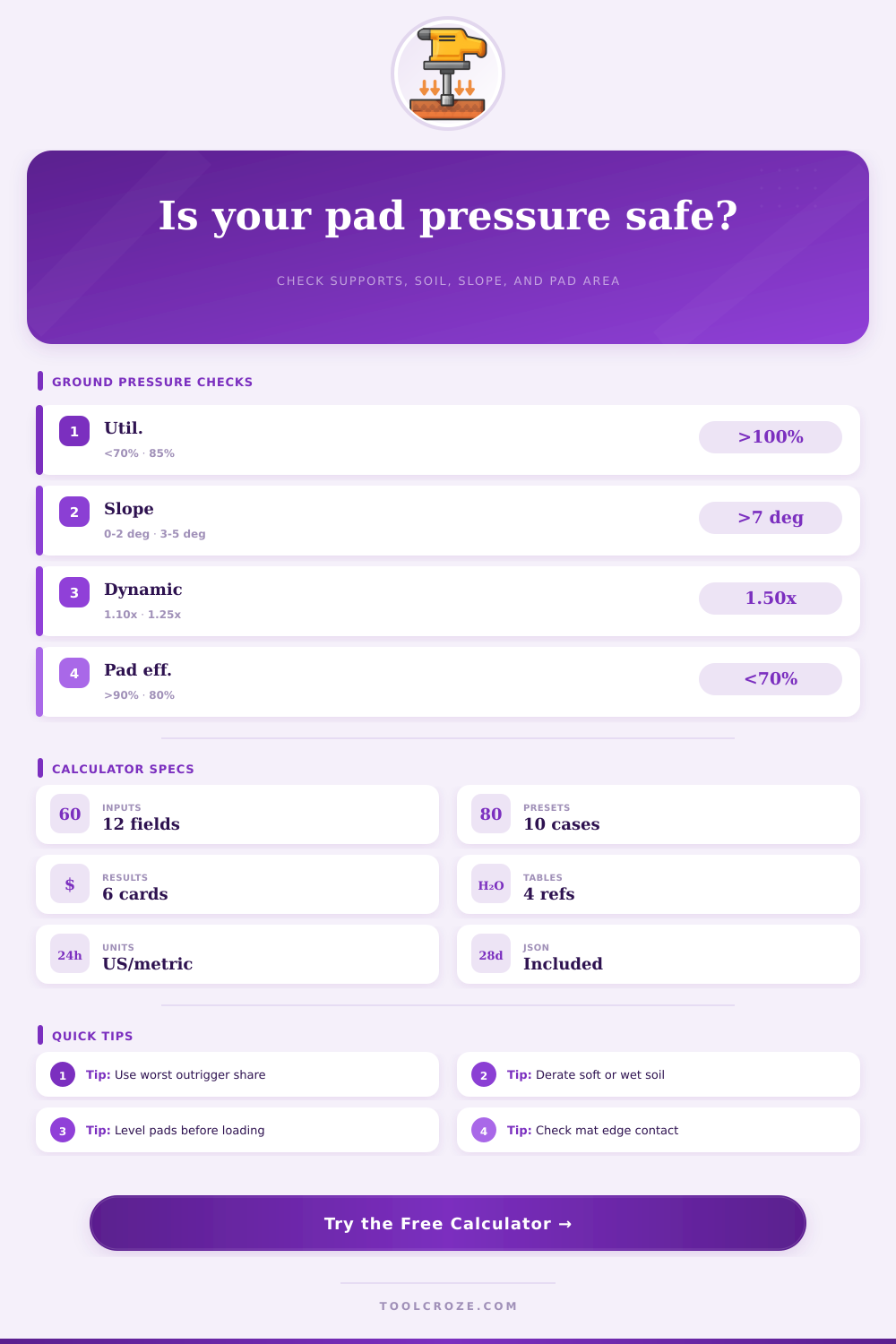
| Utilization | Pressure x safety / capacity | Below 70% | 85% or higher | Verify soil and mat design |
| Required pad area | Support load x safety / capacity | Less than available area | Larger than installed pad | Use larger mats or more support |
| Slope multiplier | 1/cos plus shift allowance | Near 1.00 | Above 1.08 | Level and crib to manufacturer limits |
| Area margin | Effective area / required area | Above 1.3x | Below 1.0x | Stop and redesign support setup |
Ground bearing pressure is the measurement of a force that a machine will exert on the soil. To ensure that the soil can withstand the machine’s weight, it is necesary to calculate the ground bearing pressure. Despite the possibility that a machine may sit on the ground for many hours without causing any problems, the ground bearing pressure can cause the failure of that soil if the soil’s capacity change.
Soil capacity can change due to rain falling on the ground, or if the soil was not compacted correct when the machine was first placed upon it. If the soil’s capacity decreases, the ground bearing pressure can become too great for that soil to handle, causing the machine to sink or tip over. To calculate the ground bearing pressure, the calculator requires the user to input several different variable.
How to Use the Ground Bearing Pressure Calculator
Variables include the weight of the machine, the working load of the machine, the number of support that the machine will have while in operation, the dimensions of the pads that the machine will use, the soil capacity of the ground where the machine will be operated, and various other modifiers to the calculation. While this calculator is not a substitute for a geotechnical report that could be performed of the site, the calculator does allow individuals to compare the ground bearing pressure of various machine setups. Furthermore, the calculator focus upon the worst support reaction of the supports that the machine will utilize.
This is the point at which the ground bearing pressure will be the greatest, and where the ground is most likely to fail. Soil capacity is a variable that can change frequently. Soil capacity can be different than what an individual might think is the capacity of that soil.
For instance, a patch of soil may have a high capacity if it is dry, but that same patch of soil may have a lower soil capacity if it is wet from rain falling on the land. Therefore, if an individual is unsure of the soil capacity of the site that they are planning to use their machine, they can always use the calculator to test a value for soil capacity. When the user changes the soil capacity within the calculator, the calculator will display how the required area for the pads and the percentage of the soil’s capacity that the machine is utilizing change.
Another variable to consider is the distribution of the load of the machine. Machines do not always distribute their load equally to each of the supports that they utilize. Furthermore, the load is often distributed in an uneven manner to the supports.
This is most likely due to the center of gravity of the machine or the position of the boom of the machine. Thus, each support does not necessarily have to carry the same percentage of the load as the other supports. It is therefore best to use a realistic percentage in the calculator of how much of the load belongs to each support, rather than assuming that the load is equally distributed to each support.
Another factor that those utilizing the calculator should consider is the slope of the ground. Slope will increase the load upon the supports upon the downhill edge of the pad. Furthermore, slope will also increase the percentage of the soil’s capacity that is utilized by the machine.
The individual using the calculator should use the slope factor to ensure that each support is accounted for correct. Additionally, the individual using the calculator may have to decide whether the individual should reduce the slope using cribbing, or whether the size of the pad should be increased to accommodate the slope of the ground. Another variable is the dynamic factor of the machine.
Dynamic factors are used to account for the fact that the machine may move while in operation. Therefore, a parked machine will have a different ground bearing pressure than a machine that is moving or lifting something heavy. The individual using the calculator must select a dynamic factor.
This will have an impact upon the ground bearing pressure and the percentage of the soil’s capacity that is being utilized. One more variable to consider is the effective contact area of the pads that the machine will utilize. Even if the pads are large, the point of contact between the pad and the ground may not be large, for instance, if the ground is rutted or if the pad is cupped.
Therefore, the calculator can utilize the efficiency of the contact area to change the gross area of the pads to the effective contact area. Thus, if the contact area for the pads is small, the ground bearing pressure will be higher than if the pads were in contact with a larger area of the ground. Finally, the calculator also includes reference tables that detail the typical value for each of the variables.
These reference tables are not to be used as a substitute for a geotechnical report on the site, but they can help the individual who is using the calculator to review the suggested values for the different variables. Additionally, the user can enter the safety factor for the setup into the calculator. This factor will not impact the capacity of the soil, but will provide a margin of safety in regard to the ground bearing pressure of the machine.
The calculator will provide several different outputs. For instance, the ground pressure will indicate the actual bearing pressure that the soil will experience, the utilization will allow the individual to review how close the ground bearing pressure comes to the allowable limit for that soil, the required area of the pads and the area margin will allow individuals to review whether the pads that the machine will use are large enough, and the suggested square pad size will allow the individuals to quickly determine the size of the pads. Each of these figures will help the individual to make a decision regarding the placement of the machine.
Many individuals may make mistakes when calculating the ground bearing pressure. For instance, many individuals may use an average reaction among the supports rather than the worst support reaction. Additionally, many individuals may not account for the fact that the soil capacity may be reduced due to rain.
Finally, many individuals may not account for the fact that the pads may not be distributing their load equally to each support. These variables are made visible to the users of the calculator, as they will impact the outcome of the calculator and create visible changes to the calculation of the ground bearing pressure. Many projects will have conditions that will reduce the reliable bearing area for the pads of the machine.
For instance, the ground may include underground utilities, or the area may have recently been trench dug. Drainage patterns to the area may affect the capacity of the soil to support the machine, as well. These conditions should be accounted for in the calculation of the project, so using these variables in the calculator will allow the individuals to have a safer conversation with others who must approve the placement and use of the machine.
Overall, the goal of the calculator is for individuals to gain an understanding of how the different variables can impact the calculation of the ground bearing pressure. For instance, the calculator can be used to determine how different variables will impact the utilization percentage of the soil. If the utilization percentage is too high, an individual will have to make a decision as to which variable to change.
For instance, they may decide to use larger pads for the machine. The calculator will allow individuals to more easily make these comparison.