Grinding Wheel RPM Calculator
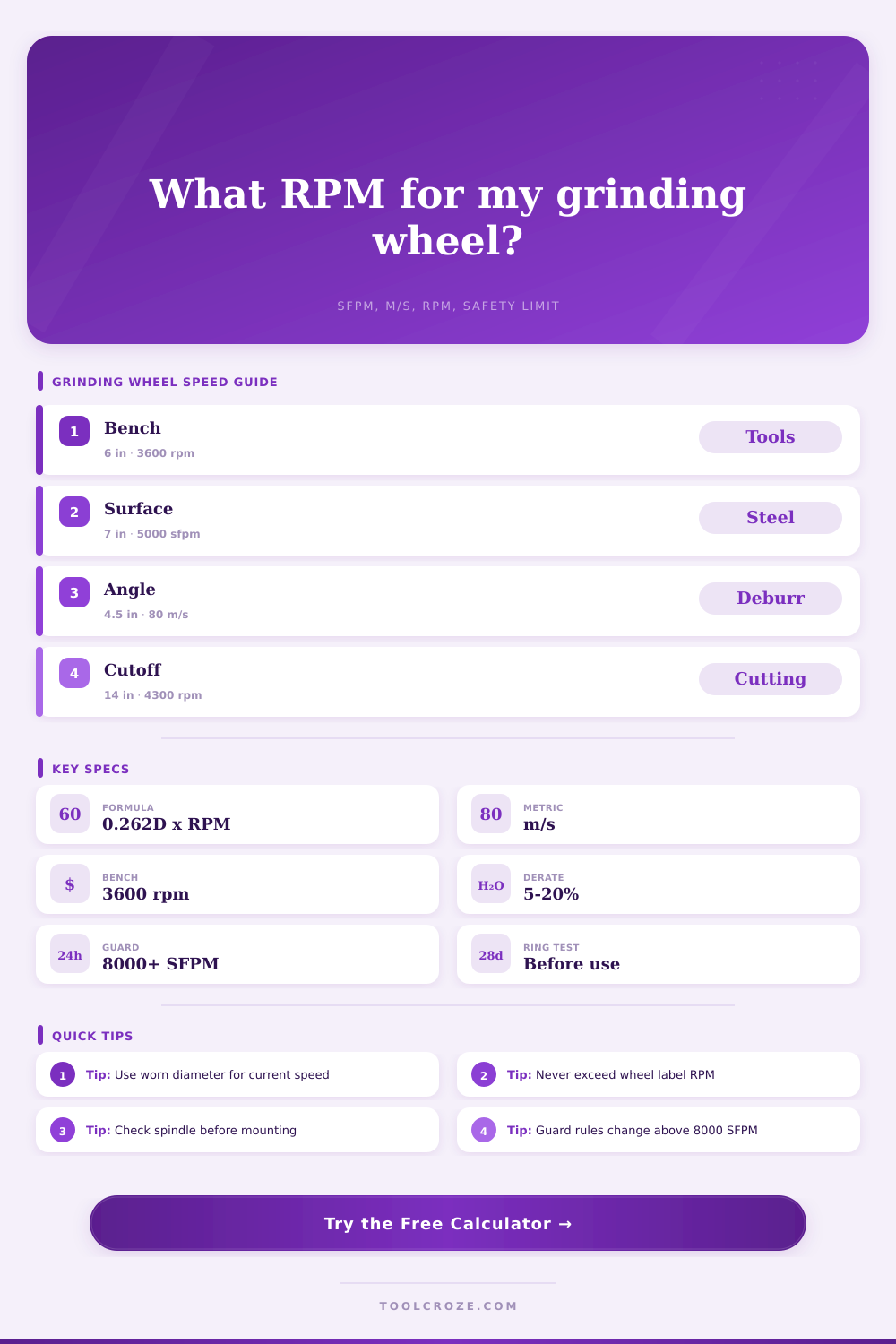
Check grinding wheel RPM from target surface speed, compare actual spindle SFPM or m/s, account for worn diameter, wheel type, marked maximum RPM, machine spindle limit, guard range, flange support, and safety derate.
📌Grinding Wheel Presets
⚙Wheel Speed Inputs
Grinding Wheel RPM Results
📊Wheel Spec Grid
📐Wheel Type Surface Speed Reference
| Wheel Type | Typical Surface Speed | Common Machine | Safety Focus |
|---|---|---|---|
| Vitrified bench wheel | 4,500 to 6,500 SFPM | Bench or pedestal grinder | Marked RPM, ring test, tool rest gap, and guard fit |
| Vitrified surface wheel | 5,000 to 7,200 SFPM | Surface grinder | Wheel balance, dressing, coolant, and spindle speed |
| Resin bond wheel | 6,500 to 9,500 SFPM | Toolroom or production grinder | Bond rating, heat, and maximum wheel label speed |
| Reinforced angle wheel | 63 to 80 m/s | Portable angle grinder | Use only matching guards and never side-load cutoff wheels |
| Diamond or CBN wheel | 4,000 to 6,000 SFPM | Carbide, hardened steel, or tool grinding | Follow wheel maker speed, coolant, and bond guidance |
| Mounted point | 15,000 to 45,000 RPM range | Die grinder or flex shaft | Overhang, mandrel size, and accessory marked speed |
🔁RPM by Diameter and Surface Speed
| Wheel Diameter | 4,500 SFPM | 6,500 SFPM | 8,000 SFPM |
|---|---|---|---|
| 4 in | 4,297 rpm | 6,207 rpm | 7,639 rpm |
| 6 in | 2,865 rpm | 4,138 rpm | 5,093 rpm |
| 8 in | 2,149 rpm | 3,104 rpm | 3,820 rpm |
| 10 in | 1,719 rpm | 2,483 rpm | 3,056 rpm |
| 12 in | 1,432 rpm | 2,069 rpm | 2,546 rpm |
🛡Safety Check Table
| Check | Calculator Input | Pass Condition | Why It Matters |
|---|---|---|---|
| Marked wheel RPM | Wheel max rated RPM | Spindle RPM is not above marked wheel limit | A wheel should be checked before mounting against machine spindle speed. |
| Surface speed | Target SFPM or m/s | Target does not require more than the safe RPM cap | Surface speed controls grinding action and wheel stress. |
| Diameter wear | Current worn diameter | Constant-surface-speed RPM remains below limits | Smaller wheels need higher RPM for the same peripheral speed. |
| Guard speed range | Guard class | Actual SFPM is inside the selected guard range | Guard material requirements increase at higher surface speeds. |
| Flange support | Flange diameter | Flange ratio is appropriate for the wheel style | Flanges spread clamping pressure and help prevent bore damage. |
🔧Machine and Wheel Preset Data
| Preset | Wheel and Target | Rated RPM | Machine RPM |
|---|---|---|---|
| 6 in bench vitrified | 6 in new, 5.5 in worn, 5,500 SFPM | 4,145 rpm | 3,450 rpm fixed |
| 8 in bench grinder | 8 in new, 7.25 in worn, 6,500 SFPM | 3,600 rpm | 3,450 rpm fixed |
| 4.5 in angle Type 27 | 4.5 in new, 4.0 in worn, 80 m/s | 13,300 rpm | 11,000 rpm fixed |
| 14 in cutoff saw | 14 in new, 13 in worn, 14,000 SFPM | 4,400 rpm | 3,800 rpm fixed |
💡Grinding RPM Tips
There’s something about a wobbly or loose grinding wheel that triggers a certain kind of panic. It isn’t merely a mechanical annoyance; it store a large amount of kinetic energy. Although most grinder users are preoccupied with the finish quality of their bond or grit type, few remember the speed. In fact, rotational velocity is single most critical safety parameter in the shop. Get your RPM wrong and the rest doesn’t matter.
The calculator above handles math for you by converting surface feet per minute to spindle revolutions. This saves you the trouble of doing those conversions yourself using diameter and pi. But the key is that surface speed stress wheels more than just RPM alone.
Why You Need to Check RPM for Safety
Outward force are applied to a wheel at its peripheral velocity, such as a wheel rated for 6,500 SFPM. RPM and diameter have an inverse relationship. A small wheel must turn faster then a large one to keep the same surface speed so many people fail to understand how they connects. They look at a die grinder with a high RPM and think it’s bad, never mind that the tiny diameter also ensures that the surface speed are well within safe bounds. This is why I like the ability to enter in my desired SFPM and have the tool show me the RPM needed based off my chosen wheel size. It really helps you get a feel for what’s going on.
Another factor that plays into this is something called wear. When a grinding wheel wears out, it become smaller in diameter. So if your machine spins at a set speed, as the wheel gets smaller in size so does the number of feet per second on the surface. Now you’re going slower than what you thought you were. In order to retain consistent heat generation and pressure, you’d want to turn up the RPM as the wheel wears. Use calculator to enter actual worn diameter. It will calculate exactly how much higher your RPM should of be to keep the same surface speed. It’s not a lot but it makes a difference for consistency.
There’s an absolute maximum RPM listed on every wheel, either on the packaging or on the actual wheel itself. Don’t go past it. But there’s also a limit on your machine. If you have a bench grinder that runs at 3,450 RPM, then you can safely run an 8-inch wheel rated up to 3,600 RPM. It’s close. But it’s there. The chart on the page lists some popular machine speeds and their corresponding wheel ratings. What you should know is that you want to look at both limits and go with the smaller number. Use your machine limit plus your wheel limit so you’re not going over either one. We’ve applied a safety reduction to that thinking. The calculator provide a 10 percent buffer for your peace of mind. That takes into account any unforeseen load as well as minor imbalance.
The other key element is flange support. You don’t want to run a small diameter flange on your wheel, that puts all the clamping pressure in the wrong place and will crack your wheel as it accelerates. Flange diameter helps you check against standard rules for your design. Typically, the flange should be no less than a third of the wheel diameter. Not only do you need something to hold the wheel onto the spindle, but you need something to support its structure without giving way to centrifugal force. It’s all about respecting the kinetic energy in the spinning disk. That wheel can holds a huge amount of kinetic energy. The RPM check, the guard fit and the ring test contains that energy.
But the tool doesn’t eliminate the need for judgment on your part. It eliminates the need for calculating guesswork. Still, feel what the work piece is doing and keep an eye on your hands! There’s no need to be doing mental arithmetic when you’re running the machine. Do your figures first then go for it. Don’t press the button till you get it right.
No matter how fast you want to go, the math couldn’t care less. All the math cares about is the truth. And the truth will protect you.